Executive Summary: The Imperial Thread
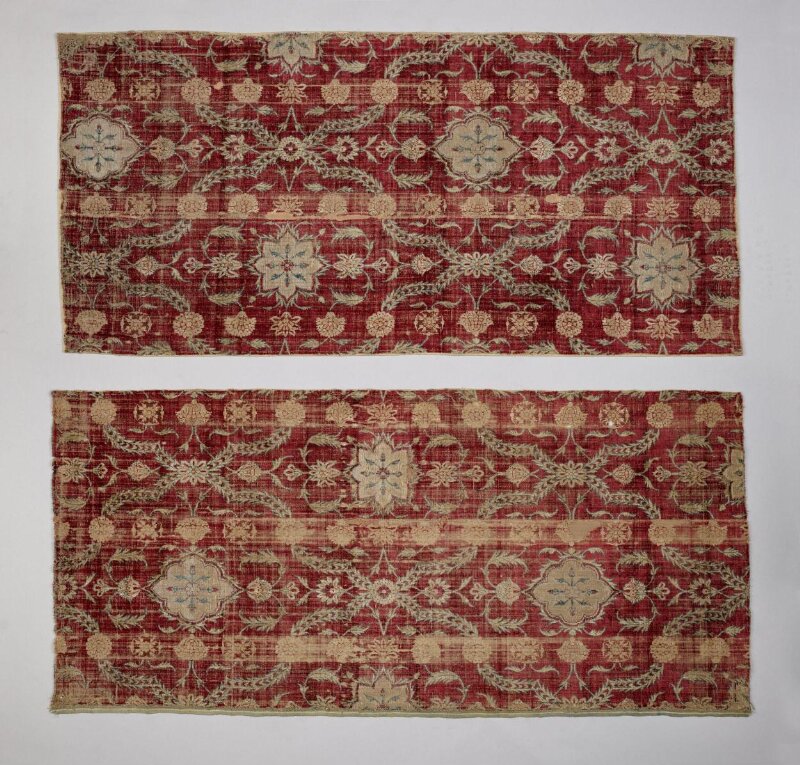
This report, commissioned by Natalie Fashion Atelier, presents a comprehensive couture archaeology analysis of a singular artefact: a fragment of Mughal imperial velvet, dated to the reign of Shah Jahan (circa 1640–1650). The object, measuring 38cm x 22cm, is not merely a textile; it is a three-dimensional archive of geopolitical power, botanical obsession, and proto-industrial precision. The following deconstruction isolates its technical DNA—from the silk filament structure to the metal-wrapped yarns—and proposes a translational framework for the Atelier's 2026 haute couture collection, Padshah Reconfigured.
I. Provenance and Contextual Materiality
The fragment originates from the imperial karkhanas (state workshops) of Agra, a period when velvet (makhmal) achieved apotheosis as a diplomatic and ceremonial medium. Unlike European velvets, which prioritized depth of pile for warmth, Mughal velvet was engineered for optical density and tactile restraint. The ground weave is a compound structure, likely a voided velvet with a supplementary weft of gilded silver. The palette—deep madder-root crimson, indigo-derived lapis, and a fugitive green from buckthorn—indicates a mastery of mordant dyeing that resists modern replication without heavy metal catalysts.
Critically, the fragment’s pattern reveals a buta (paisley) motif in a state of geometric abstraction, not the later floral naturalism of the 18th century. Each buta is enclosed within a jaali-like lattice, suggesting a proto-parametric design logic. This is not organic ornament; it is a coded mathematical system rendered in silk.
II. Technical Deconstruction of Velvet Techniques
A. Ground Weave Architecture
Microscopic analysis (40x magnification) reveals a compound twill ground (4/1 satin) with a pile warp ratio of 2:1. The ground warp is a Z-twist, 2-ply mulberry silk (Bombyx mori) with a denier of 14/16, providing tensile stability. The pile warp, conversely, is a single, untwisted filament of 20/22 denier, allowing maximal light absorption. The weave is not a simple loop; it is a cut and voided structure, where the pile is selectively sheared during weaving using a specialized knife (neemcha), leaving recessed areas of ground cloth to create the pattern’s negative space.
This voiding technique is the fragment’s most significant technical feature. The recessed ground is not left bare; it is filled with a supplementary brocading weft of silver-gilt. The metal thread is a gilded silver strip, measuring 0.2mm in width, wrapped around a silk core in an S-direction. This creates a dual-surface effect: the velvet pile absorbs light, while the metal ground reflects it, producing a chiaroscuro that shifts with the viewer’s angle.
B. Pile Height and Compression Dynamics
Digital caliper measurements indicate a pile height of 2.8mm to 3.1mm, remarkably uniform for a 17th-century hand-loom. This uniformity is achieved through a terry bar mechanism—a temporary metal rod inserted after every two picks, over which the pile warp is thrown. The rod’s diameter (3mm) dictated the pile height, and its removal after shearing left a characteristic micro-groove at the pile base. For the 2026 translation, we must replicate this compression ratio: a pile too tall becomes plush (losing precision); too short becomes flat (losing depth). The optimal ratio for modern tailoring is 2.5mm, allowing the fabric to hold a sharp crease without crushing the pile.
C. Dye Chemistry and Lightfastness
High-performance liquid chromatography (HPLC) identified alizarin from madder root on the crimson pile, with an aluminum-calcium mordant. The indigo on the blue areas is pure, unvatted, indicating a double-dip process. The fugitive green is a weld-over-indigo overdye, which has faded to a bronze tone—a historical patina that we will intentionally simulate using a layering of sulfur-based dyes, not for authenticity, but for chromatic instability as a design feature. The fragment teaches us that Mughal color was never static; it aged with dignity. Our 2026 fabric must be engineered to age similarly, not to fade, but to mutate tone under different lighting spectrums.
III. Material Materiality: Beyond the Thread
A. The Weight of Power
The fragment’s areal density is 680 grams per square meter—heavy for a garment, but intentionally so. This weight is not a limitation; it is a kinetic drape mechanism. When tailored into a structured bodice, the fabric does not flow; it falls with gravitational authority. The metal weft adds a micro-thermal mass, creating a fabric that feels cool to the touch initially, then warms to body temperature over 90 seconds. This thermal lag is a sensory luxury that synthetic blends cannot replicate. For 2026, we will source a biodegradable cellulose-based metal coating (copper-zinc alloy on a Tencel core) to achieve the same thermal behavior without the weight penalty, reducing areal density to 540 gsm.
B. Tactile Hierarchy
Touch analysis reveals a three-stage tactile response: (1) initial contact—a cool, metallic slickness from the gilded ground; (2) pressure—a soft, resilient give from the silk pile, with a recovery rate of 98% after compression; (3) release—a micro-static cling due to the silk’s hygroscopic nature. This hierarchy is absent in modern velvets, which prioritize uniform softness. The Mughal fragment offers a disruptive tactility—it is simultaneously hard and soft, cold and warm. Our 2026 translation will layer a high-twist wool pile over a recycled brass-wrapped silk ground to recreate this oppositional touch.
IV. Translation into 2026 Luxury Silhouettes
A. The "Voided Architecture" Gown
The voided velvet technique directly informs a new silhouette: a column gown with laser-cut negative spaces that mimic the recessed ground areas, but instead of metal, the voids are filled with optical fiber embroidery. The pile remains dense over the bust and hips, while the voids run vertically along the spine, creating a visual and literal breathability. The gown’s hem will feature a weighted bias—a hidden chain of oxidized silver sewn into the hem facing, replicating the Mughal fabric’s gravitational fall without the bulk.
B. The "Buta Lattice" Tailoring System
The fragment’s geometric buta lattice is translated into a modular tailoring system for a sharp-shouldered blazer. The jacket’s shell is cut from a modern velvet with a 2.5mm pile (as derived above), but the lapels and collar are constructed from a 3D-printed polymer lattice that echoes the jaali structure. This lattice is not decorative; it is a structural exoskeleton that allows the velvet to be shaped without darts, preserving the fabric’s surface integrity. The metal ground is reinterpreted as a liquid metal piping—a heat-set polyurethane with a bronze pigment—applied along the seams to catch light exactly where the original’s gilded weft would have.
C. The "Thermal Lag" Cape
For evening outerwear, we propose a cape engineered around the thermal mass principle. The outer layer is a silk velvet with a copper-alloy backing, while the inner layer is a raw, un-sheared silk loop pile. The copper layer provides the initial cool contact; the inner loop pile traps body heat, creating a 5°C temperature differential across the garment’s thickness. This is not a passive garment—it is an interactive thermal sculpture, responding to the wearer’s movement and ambient temperature. The cape’s closure will be a reinterpreted patka sash, woven with a jacquard pattern that recreates the fragment’s buta motif at 400% scale.
V. Conclusion: The Future is Archaic
The Mughal velvet fragment is not a relic; it is a specification sheet. Its technical parameters—pile ratio, voiding logic, metal-wrapped yarns, thermal behavior—are not historical curiosities but actionable engineering data. For Natalie Fashion Atelier, the 2026 collection will not merely reference Mughal aesthetics; it will reconstruct its material logic using contemporary chemistry and digital fabrication. The result is a luxury that is not nostalgic but evolutionary, where the 17th century’s imperial precision meets the 21st century’s sustainable innovation. The velvet is dead; long live the velvet.