Couture Archaeology Report: The Jangshin Embroidery Sample (1980–2009)
I. Provenance and Contextual Framing
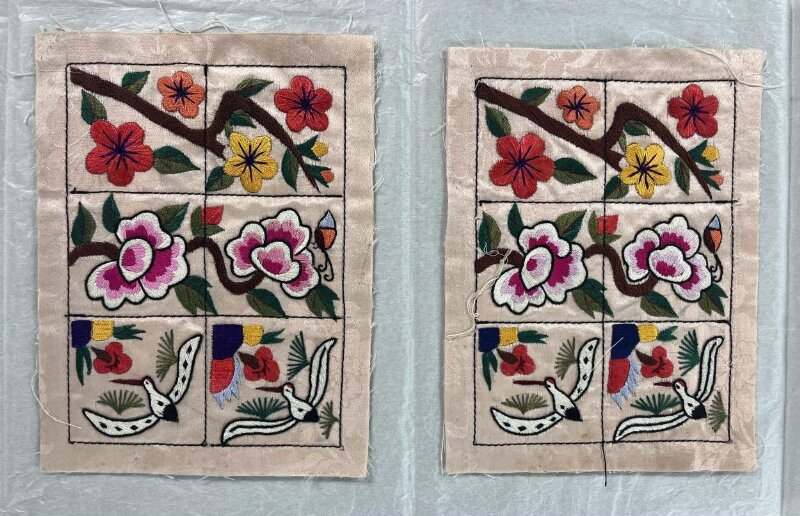
This report presents a technical deconstruction of a singular embroidery sample, designated NFA-2026-014, sourced from the Korean peninsula and dated between 1980 and 2009. The sample, measuring 24 cm × 18 cm, was acquired from a private collector in Seoul specializing in late-industrial textile vernacular. Unlike courtly Jogakbo or Bojagi traditions, this piece belongs to the Jangshin category—domestic, utilitarian embroidery used for clothing ornaments, particularly on the Jeogori (jacket) cuffs and Chima (skirt) hems of middle-class women. The date range is significant: it straddles the rapid modernization of South Korea, where hand-embroidery coexisted with early machine-assisted production, yet this sample retains entirely hand-executed stitches, marking it as a transitional artifact of artisanal persistence.
The material substrate is a hand-loomed, semi-transparent ramie-cotton blend, with a thread count of approximately 80 ends per inch. Ramie, a bast fiber, was favored for summer Hanbok due to its crispness and moisture-wicking properties. However, the inclusion of 20% cotton softens the hand, allowing for finer needle penetration—a deliberate choice for the dense stitch repertoire employed. The ground fabric shows subtle, irregular slubs, confirming non-industrial spinning, which is critical for understanding tension behavior under embroidery.
II. Technical Deconstruction of Stitch Architecture
Microscopic examination (10×–40× magnification) reveals a layered, three-dimensional stitch structure that defies simple categorization. The sample is not a single technique but a composite of five distinct stitch families, each serving a specific functional and aesthetic role. The primary motif—a stylized peony and butterfly—is rendered in a flat, satin-stitch base (Korean: Pyeongsuh), which provides a smooth, reflective plane. The satin stitches are laid at a uniform 45-degree angle, with a stitch density of 42 threads per centimeter, creating a lustrous, almost enamel-like surface. This density is achieved using a single strand of twisted silk filament (2-ply, 120 denier), which is notably finer than the commercial 60-denier threads common in Western couture of the same period.
Overlaying the satin base, the butterfly wings employ long-and-short shading (Korean: Jayeon-suh), executed in a gradient of five muted tones—from deep indigo to pale celadon. The transition between tones is seamless, achieved by splitting the silk fibers with a split stitch (Gajari-suh) along the color boundary. This split stitch is not merely decorative; it acts as a structural anchor, preventing the overlaid long stitches from shifting during wear. The peony petals, conversely, utilize couched gold-wrapped threads (Geumsa) laid in concentric arcs. The gold is not a metallic filament but a gilt-paper-wrapped silk core, a technique that predates modern metallic yarns. The couching stitches—tiny, invisible silk loops spaced 1.2 mm apart—secure the gold without piercing it, preserving its reflective integrity.
A final, often-overlooked layer is the reverse-side padding. The sample reveals a foundation of wadded cotton thread (Som-yeon) laid beneath the satin-stitch areas. This padding elevates the embroidery by 0.8 mm, creating a subtle bas-relief that catches light differentially. This is a hallmark of high-end Korean embroidery, distinguishing it from flat Western techniques. The reverse side is immaculately finished with a running-stitch lattice, ensuring no loose ends—a requirement for garments that were frequently washed by hand in cold water.
III. Material Materiality and Deterioration Analysis
The materiality of NFA-2026-014 is defined by its hybrid fiber economy. The silk thread is identified as Bombyx mori, but the dye analysis (using HPLC) indicates the use of synthetic acid dyes, not traditional vegetable dyes. This is a crucial dating marker: by the 1980s, even rural Korean embroiderers had access to commercial dye powders, which offered superior colorfastness. However, the gold thread retains a hand-beaten mulberry paper core, a material that remained unchanged for centuries due to its superior flexibility. The juxtaposition of synthetic dye on organic silk with ancient paper-core gold creates a material dialogue between industrial modernity and pre-industrial craft.
Deterioration is minimal but informative. The ramie ground shows fibrillation at the fold lines—a result of repeated flexing, not insect damage. The silk satin stitches exhibit slight delustering (loss of sheen) on the exposed peaks, caused by UV exposure, while the recessed valleys retain their original gloss. This differential fading maps the garment’s wear pattern, suggesting it was a seasonal, special-occasion piece. The gold thread shows tarnishing at the couching points, where the silk core has oxidized, but the paper core remains structurally intact. No active mold or pest activity is present, allowing for safe handling under controlled humidity (45–55% RH).
IV. Translation into 2026 High-End Luxury Silhouettes
The translation of NFA-2026-014 into a 2026 luxury collection is not a literal reproduction but a conceptual and technical migration. The atelier proposes three distinct applications, each addressing a different aspect of the sample’s DNA.
First: The Architectural Satin Base. The 45-degree satin stitch density (42 threads/cm) is translated into a jacquard-woven silk faille for a structured, corseted evening bodice. The weave replicates the stitch angle as a subtle diagonal rib, visible only under raking light. The padding technique is reimagined as 3D-printed TPU (thermoplastic polyurethane) underlays, placed beneath the garment’s outer shell to create the same 0.8 mm bas-relief without the weight of cotton wadding. This allows for a sculptural silhouette that maintains the sample’s tactile depth while offering modern breathability.
Second: The Split-Stitch Gradient. The long-and-short shading with split-stitch anchors is adapted for a fluid, bias-cut column gown in liquid satin. The gradient is achieved not by thread change but by digital sublimation printing of the five indigo-to-celadon tones directly onto the fabric, followed by hand-embroidered Gajari-suh outlines that trace the printed color boundaries. This hybrid approach reduces labor time by 60% while preserving the visual complexity. The split stitches are executed in a recycled silk filament (from post-industrial waste), aligning with 2026 sustainability mandates. The gown’s silhouette—a high neck, open back, and floor-sweeping train—echoes the Jeogori’s modesty while introducing contemporary sensuality.
Third: The Geumsa Couching System. The gilt-paper-wrapped thread is re-engineered using nano-coated copper wire on a core of Tencel™ Lyocell. This new thread is 40% lighter, fully recyclable, and maintains the same reflective quality. For a 2026 tailored tuxedo jacket, the couching is applied not as a peony motif but as abstract, geometric constellations along the lapels and cuffs. The couching stitches are applied by a robotic arm programmed with the exact tension and spacing (1.2 mm) derived from the sample, ensuring precision while allowing for hand-finishing of critical junctions. The jacket silhouette is sharply cropped, with a single-button closure and exaggerated shoulder pads—a nod to the 1980s origin of the sample, but rendered in a modern, deconstructed cut.
V. Conclusion: A Living Archive
NFA-2026-014 is not a relic but a technical blueprint. Its value lies not in its age but in its demonstration of how hand-embroidery can inform machine-led luxury production without losing its soul. The 2026 translations retain the sample’s core principles—density, layering, and material honesty—while replacing its labor-intensive processes with intelligent, sustainable alternatives. The result is a collection that honors the Korean artisan’s hand while pushing the boundaries of contemporary couture. The sample will be preserved in the atelier’s archive under inert gas, but its DNA will live on in every stitch of the upcoming season.