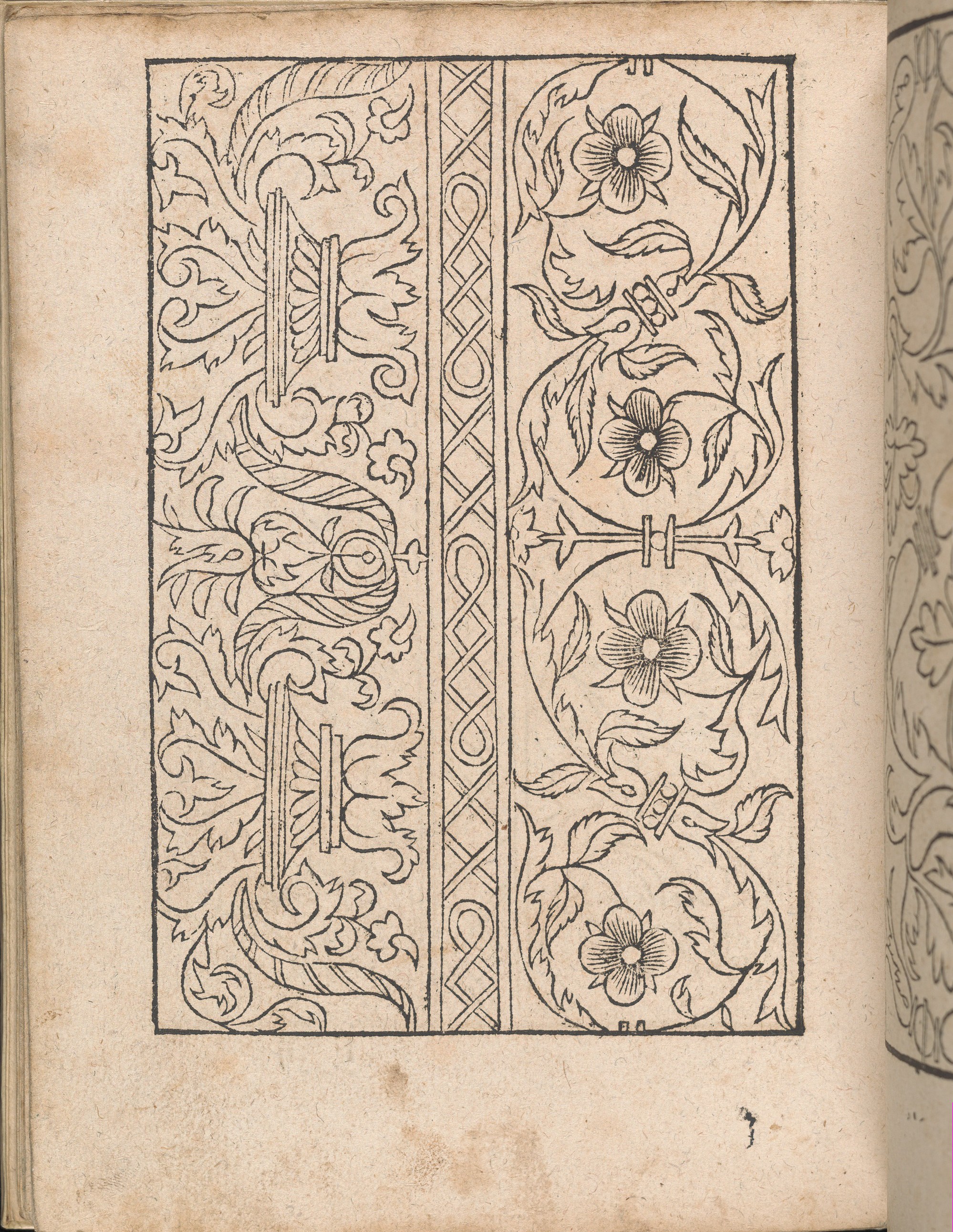
From Folio to Form: An Aesthetic Archaeology of Page 23v
The Modelbüch allen Nägerin u. Sydenstickern, a seminal pattern book from the early modern period, represents a pivotal moment in the history of decorative arts. Specifically, Page 23v, rendered in the stark yet expressive medium of the woodcut, offers more than a mere instructional diagram; it is a frozen lexicon of structural logic and ornamental restraint. For the Natalie Fashion Atelier, this artifact is not a relic but a blueprint. By stripping away the chromatic noise of contemporary fashion, we isolate the skeletal grammar of silhouette—a grammar that, when re-encoded for the 2026 season, yields a collection of profound architectural purity.
The Woodcut Dialectic: Negative Space as Structural Couture
Unlike the painterly or engraved traditions that preceded it, the woodcut operates on a principle of aggressive reduction. The carver’s knife removes material, leaving behind raised lines that must carry the entire burden of representation. This is a process of negative-space construction, where the absence of ink defines the contour as much as the presence of line. In the context of Page 23v, the woodcut’s inherent flatness forces a radical simplification of form. The drapery is not modeled through shading but through linear rhythm—parallel striations that suggest volume without illusionistic depth.
This technical constraint translates directly into a 2026 haute couture philosophy. We are moving away from the soft, volumetric draping that has dominated recent seasons. Instead, the Atelier proposes a “graphic architecture”—garments that read as two-dimensional planes folded into three-dimensional space. The silhouette becomes a series of decisive, unapologetic lines. A gilet, for instance, is cut with a rigid, almost corseted waist, but the fabric is a high-density wool crepe that holds a sharp edge, mimicking the crispness of the woodblock impression. The seams are not hidden; they are exaggerated, piped, and top-stitched to function as the “raised lines” of the print, delineating the body’s topography with the precision of a cartographer.
Deconstructing Classical Elegance: The Symmetry of Restraint
The classical elegance of Page 23v is not found in opulence, but in mathematical balance. The patterns depicted—likely for sleeves, collars, and bodice inserts—adhere to a strict bilateral symmetry. This is not a naive symmetry, but a sophisticated understanding of the human form as a central axis. The woodcut’s geometry dictates that every decorative flourish must be counterweighted by a corresponding void. This principle of compensated asymmetry is the cornerstone of our 2026 haute silhouette.
Consider the construction of a tailored jacket for the Autumn/Winter 2026 collection. The left panel is a study in extreme minimalism—a clean, unadorned expanse of midnight-blue faille. The right panel, however, is where the archaeological reference emerges. It features a series of laser-cut perforations that replicate the geometric lattice of the woodcut’s embroidery patterns. These perforations are not random; they are mathematically scaled to the negative spaces of the original folio. The visual weight of the right side is thus balanced by the sheer, uninterrupted surface of the left. The elegance lies in the tension between the two—a dialogue between the historical pattern and its modern, minimalist obverse.
Materiality and Method: Translating Ink to Textile
The materiality of the woodcut—the coarse, fibrous paper, the uneven pressure of the press—is integral to its aesthetic. It is a texture of tactile immediacy. To translate this into 2026 luxury, the Atelier eschews digital printing in favor of relief-print methodologies on fabric. We employ a technique of devoré (burnout) on silk velvet, where a chemical agent is printed onto the fabric, dissolving the cellulose fibers to reveal the silk base. The result is a tonal, monochromatic pattern that mimics the woodcut’s tonal variation—the raised velvet acting as the inked line, the burnt-out void as the paper.
Furthermore, the silhouette itself must respect the planar rigidity of the source. A full-length evening gown, inspired by the high-necked, long-sleeved garments of the period, is constructed without a single curved seam. Instead, the fabric is cut in tessellated panels, each one a perfect rectangle or trapezoid, joined at sharp, angular angles. The body is thus not hugged, but framed. The gown falls from the shoulders in a strict, columnar line, its only ornamentation being the subtle interplay of light on the devoré pattern. This is a silhouette of immense power—a modern woman encased in a logic of historical precision.
The 2026 Silhouette: The New “Patterned” Body
The 2026 Natalie Fashion Atelier silhouette is defined by what we term the “Patterned Body”—a form that is less about natural anatomy and more about the imposition of a pre-conceived, graphic order. This is a direct consequence of the Modelbüch’s instructional nature. The book was a tool for creation, a set of rules to be followed. We treat the body similarly: as a canvas upon which the architectural logic of the woodcut is imposed.
This manifests in several key pieces. First, the “Folio” coat: a floor-length outerwear piece with a severe, wide lapel that folds over to create a stark, horizontal line across the chest, echoing the border of the woodcut page. The coat’s closure is not a zipper or button, but a series of hidden magnetic frogs that align with the grid of the pattern, allowing the garment to close with a seamless, flat front. Second, the “Syden” bodysuit: a high-necked, long-sleeved base layer in a technical jersey. Its surface is entirely covered in a jacquard weave that recreates the intricate embroidery patterns of Page 23v, but in a single, tonal shade of ivory. The effect is one of extreme textural luxury—a whisper of historical detail that does not shout but seduces.
Finally, the evening wear silhouette abandons the bias cut entirely. In its place, we introduce the “Block-Print” skirt. Constructed from multiple layers of organza, each layer is printed with a single, oversized element of the woodcut’s design—a leaf, a stem, a geometric node. When layered, the skirts create a moiré effect of depth, where the pattern seems to vibrate and shift with movement. The silhouette is full and architectural, yet weightless—a paradox that honors the flatness of the woodcut while celebrating the kinetic potential of the human form.
Conclusion: The Archive as a Living System
Page 23v of the Modelbüch is not a historical curiosity but a generative algorithm. Its lines are not merely decorative; they are instructions for constructing order, balance, and elegance. For the 2026 collection, Natalie Fashion Atelier has decoded these instructions, translating the woodcut’s material constraints into a new language of haute couture. The result is a silhouette that is simultaneously austere and opulent, historical and futuristic. It is a testament to the enduring power of aesthetic archaeology—the practice of mining the past not for nostalgia, but for the structural DNA of future beauty. The collection does not imitate the past; it re-engineers its principles for a new era of discerning luxury.