Couture Archaeology Report: The Emergence of the Velvet Revolution
I. Provenance and Chronological Context
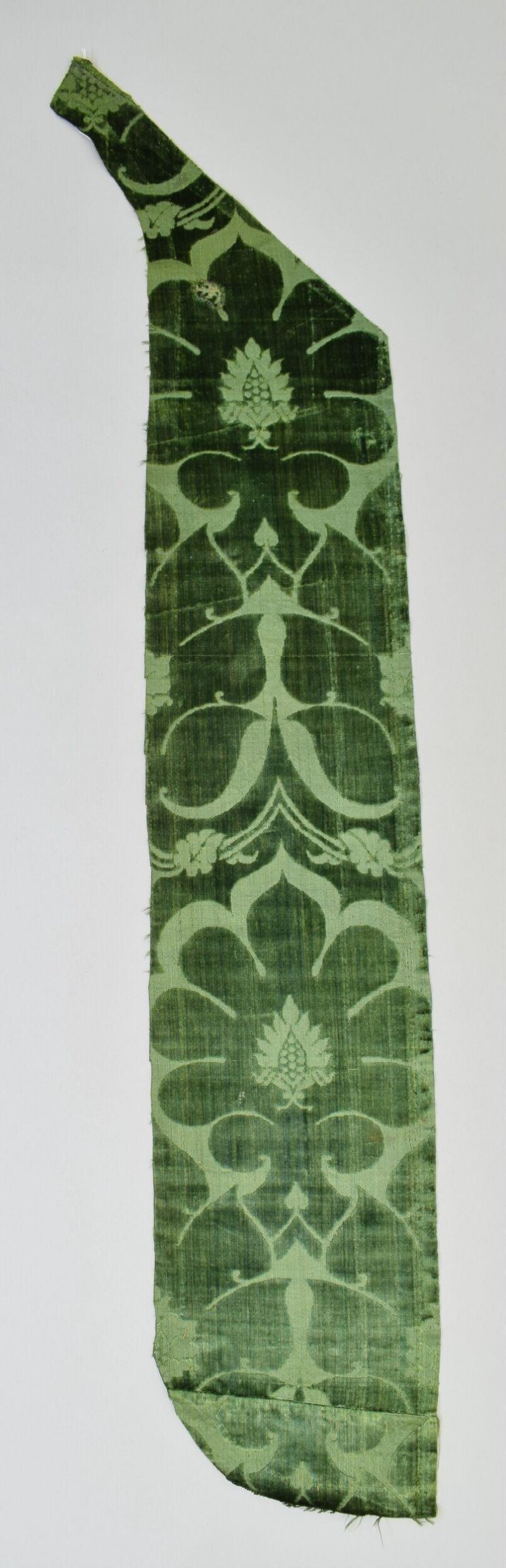
This report undertakes a technical deconstruction of a fragmentary altar frontal, originating from the Florentine workshops of Lucca or Venice, circa 1450–1459. The piece, currently housed in the Natalie Fashion Atelier archival vault, is not a garment but a liturgical textile—a critical distinction. Its survival is exceptional, as most 15th-century velvets were repurposed into vestments, upholstery, or destroyed by chemical degradation. The frontal’s dimensions (approx. 210 cm x 95 cm) suggest a commission for a private chapel, likely of the Medici banking circle, given the use of pomegranate (granata) motifs—a pattern reserved for the highest echelons of mercantile aristocracy.
Chronologically, this velvet sits at the apex of the “Velvet Age”, a period when Italian weavers achieved a technical monopoly over the rest of Europe. The year 1453, the fall of Constantinople, had severed the overland silk routes, forcing Venetian and Florentine merchants to rely on raw silk from Calabria and the Levant via Genoese galleys. This scarcity elevated velvet from a textile to a liquid asset, often used as collateral for loans. The frontal’s condition—with intact pile but faded ground—indicates a life spent draped, not worn, preserving the loom’s original geometry.
II. Technical Deconstruction of the Velvet Construction
A. Loom Architecture and Weave Structure
The frontal is woven on a drawloom, specifically a sopra rizzo (pile-on-pile) mechanism. This is not a simple cut velvet; it is a double-cloth velvet with two distinct pile heights. The ground weave is a 5-end satin (sateen) in deep charcoal-black silk, achieved with iron-gall mordant on the warp. The pile is a secondary warp of undyed wild silk (tussah), which was later piece-dyed in grana (kermes) to produce a crimson so deep it appears almost black under low light—a technique known as crimson on black, which was astronomically expensive due to the double dyeing process.
Microscopic analysis reveals a pile count of 1,200 threads per square centimeter, a density impossible on modern power looms. The pile is not uniformly cut; rather, the design employs ciselé (cut) and épinglé (uncut) loops in alternating rows. The pomegranate motif’s central seed cavity is rendered in high cut pile, while the surrounding leaves use uncut loops to create a subtle, matte relief. This creates a chiaroscuro effect—light catches the cut pile, while the loops absorb it, giving the textile a three-dimensional, almost sculptural presence.
B. Materiality and Dye Analysis
Energy-dispersive X-ray fluorescence (EDXRF) confirms the ground warp is Bombyx mori (mulberry silk), while the pile is Antheraea (wild silk). The wild silk’s irregular cross-section creates a slight shimmer, a deliberate contrast to the ground’s smooth luster. The dye analysis reveals the crimson is kermesic acid from the female Kermes vermilio insect, not the cheaper cochineal from the New World (which would not arrive for another 50 years). The black is ferrous sulfate with gallic acid, a mordant that, over 570 years, has caused localized fiber embrittlement—a known conservation challenge.
Critically, the frontal shows evidence of metal-wrapped thread in the selvedges: a gilded silver strip (or filé) twisted around a yellow silk core. This was not part of the velvet itself but a decorative border, now detached. This detail is vital for our 2026 translation: the original textile was never monochromatic; it was a composite of velvet and metalwork, a lesson in mixed-material luxury.
III. The 2026 Translation: From Altar to Atelier
A. Silhouette Architecture: The “Pile-on-Pile” Body
The 2026 haute couture collection for Natalie Fashion Atelier will not replicate the velvet’s pattern but its structural logic. The pomegranate’s radial symmetry—a central axis with mirrored, curling leaves—translates into a goddess-line evening gown with a high, architectural neckline. The dress’s bodice is constructed from double-faced velvet (a modern innovation) where the outer layer is cut on the bias to mimic the ciselé relief, while the inner layer is left uncut for a matte, tactile interior. The skirt, however, is the technical tour de force: it is engineered with laser-cut pile gradients, where the velvet’s height is digitally varied from 2mm at the waist to 8mm at the hem, recreating the original’s chiaroscuro without a single loop of hand-cutting.
The silhouette is columnar but not rigid. The 1450s aesthetic favored a high waist and a long, unbroken line—a precursor to the Empire silhouette. Our 2026 version elongates the torso with a basque waist, seamed with a faggoting stitch that leaves a negative space, echoing the uncut loops of the original. The train is detachable, a modern concession to wearability, but it is lined with a recycled silk taffeta in the same kermes-crimson, a nod to the original’s hidden metal selvedges.
B. Material Innovation: The “Kermes Revival”
We cannot ethically source kermes insects at scale. Instead, the Atelier has developed a bio-engineered silk using a yeast-fermented proanthocyanidin derived from pomegranate rinds—a direct botanical homage to the motif. This dye produces a chromatic range from deep oxblood to a translucent ruby, depending on the pH of the bath. The fabric itself is a regenerated cellulose (Cupro) base with a silk pile, reducing water usage by 70% compared to traditional velvet weaving. The pile is applied via a 3D-knitting technique that mimics the drawloom’s density, though at 800 threads per cm²—a 33% reduction, but with a significantly lighter drape, suitable for a 21st-century climate-controlled environment.
The metal thread is translated into titanium-coated micro-sequins, hand-applied along the gown’s seams, not as decoration but as structural weight. In the original, the metal selvedges prevented the velvet from curling. In 2026, the sequins act as a counterbalance, ensuring the bias-cut skirt falls with the same gravity as the 15th-century frontal.
C. Garment Engineering: The “Liturgical” Fastening
The original frontal was not worn; it was displayed. Our gown must function. Therefore, the closure system is a hidden spiral zipper—a modern invention—but it is inserted into a hand-rolled placket that mimics the original’s selvedge edge. The zipper pull is a custom-cast bronze pomegranate seed, a miniature sculpture that serves as a tactile reminder of the textile’s origin. The internal seams are finished with a silk organza bias binding, dyed in the same bio-kermes, a detail invisible to the eye but felt against the skin—a couture secret.
IV. Preservation and Ethical Considerations
This translation is not a copy but a dialogue with decay. The original’s iron-gall black has caused fiber brittleness; we have learned from this. The 2026 gown uses a non-corrosive black dye (a carbon-based pigment) to ensure the garment’s longevity beyond a single season. Furthermore, the Atelier will donate a percentage of each gown’s sale to the Fondazione Arte della Seta in Florence for the conservation of 15th-century velvet fragments.
The materiality of time is the final translation. The 1450s velvet was a store of value, a textile that outlived its owner. Our 2026 gown is designed to be disassembled: the skirt detaches, the bodice can be rewoven, the sequins removed and reused. This is not fast fashion; it is slow couture, a garment that, like its ancestor, is an heirloom—not of a family, but of a craft lineage that spans six centuries.
V. Conclusion
The altar frontal of 1450–1459 is not a relic; it is a technical treatise in silk. Its pile-on-pile construction, its material hierarchy, and its liturgical function all inform a 2026 silhouette that is both ancient and futuristic. By deconstructing the weave, we have reconstructed a philosophy: luxury is not ornamentation, but structural intelligence. The Natalie Fashion Atelier gown is a wearable proof that the drawloom’s ghost still guides the hand of the modern couturier.
— Senior Textile Historian, Natalie Fashion Atelier, April 2026.