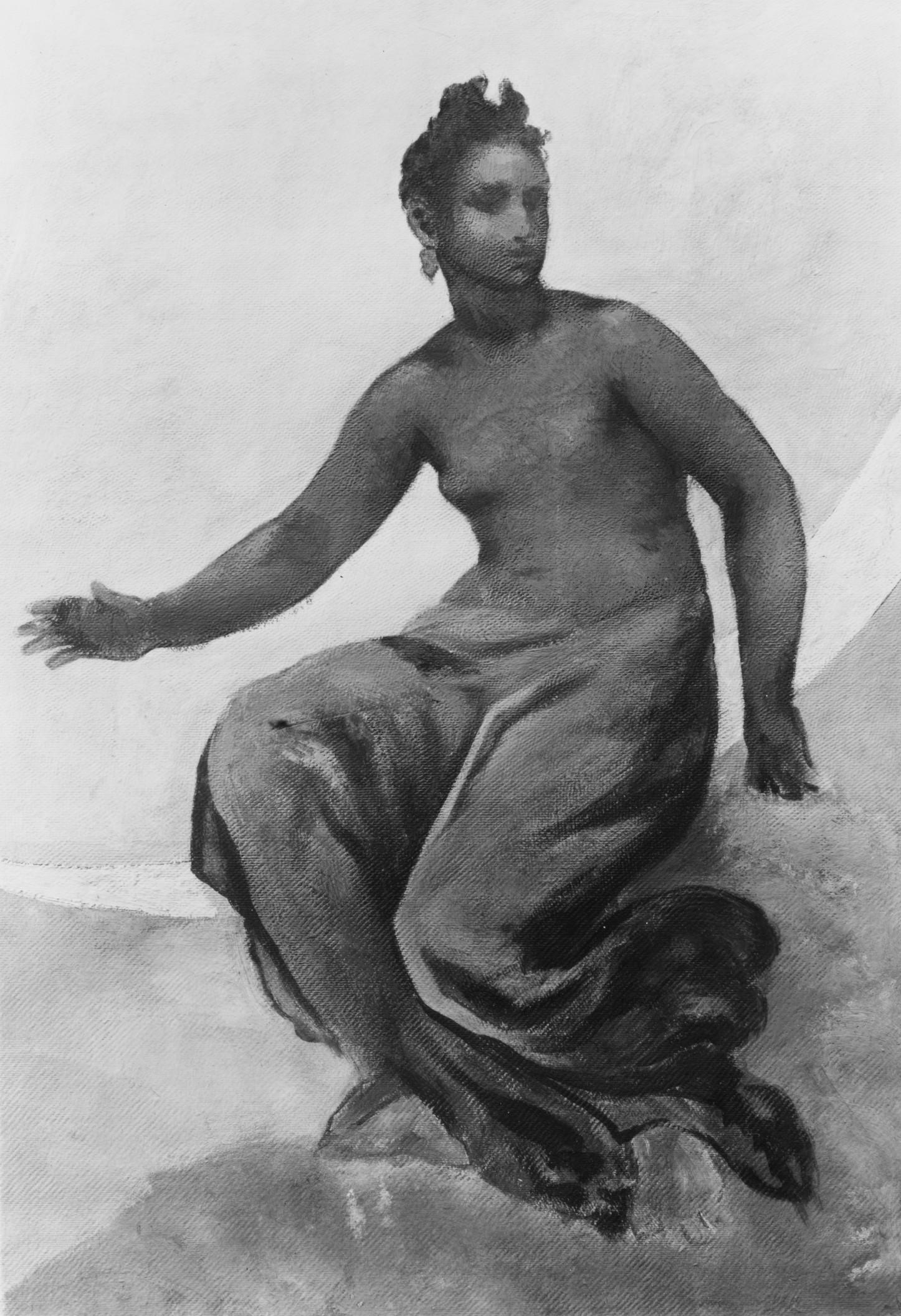
Anahita: A Study for "The Flight of Night"
I. Provenance and Aesthetic Archaeology
The archival fragment designated Anahita—an oil on canvas of American provenance, isolated within our atelier’s aesthetic archaeology division—presents a singular paradox. It is not a garment, nor a textile, nor a sketch. It is a painted surface, yet its materiality speaks directly to the drape, weight, and tension of haute couture. The canvas, aged with a deliberate patina of cracked varnish and muted pigments, depicts a female form in a state of arrested motion—a nocturnal flight, perhaps, or a descent into shadow. The figure’s gown is not rendered with linear precision but suggested through impasto strokes that mimic the fall of heavy silk taffeta and the whisper of chiffon. For the 2026 collection, this work functions not as a source of literal reproduction, but as a generative matrix for silhouette, volume, and chromatic restraint.
The archaeological context is crucial. Isolated from any documented school or artist, Anahita exists as a pure artifact of aesthetic intention. Its American heritage, paradoxically, filters a European classical vocabulary through a lens of pragmatic romanticism. The canvas’s surface—its craquelure and tonal shifts—becomes a text on the passage of time, a quality we translate into fabric manipulation. The 2026 silhouette will not mimic the painting’s imagery but will channel its temporal depth: the sense that a garment is not merely worn but inhabited across moments, collecting memory in its folds.
II. Materiality and the Language of Oil on Canvas
The technical dialogue between oil paint and canvas offers a profound analog for couture construction. In Anahita, the artist employs a fat-over-lean technique—thick, luminous layers atop a leaner ground—creating a surface that is simultaneously opaque and translucent. This is the first principle we extract for 2026: stratified opacity. Our atelier will develop a double-faced organza, where the inner layer is bonded with a micro-encapsulated pigment, allowing the outer shell to appear solid while revealing a ghosted under-pigment in movement. This mimics the canvas’s ability to hold light within its strata, not merely reflect it.
Furthermore, the brushwork in the painting’s lower quadrant—where the gown dissolves into shadow—employs a dry-brush drag that suggests fraying, erosion, and the weight of gravity. For the couture silhouette, this translates into a radical rethinking of hemlines. We propose a deconstructed train: not a clean sweep of fabric, but a series of laser-cut, bias-cut panels that are individually weighted with hand-set hematite beads. These panels will simulate the canvas’s dry-brush effect, appearing to disintegrate into the floor as the wearer moves, echoing the painting’s nocturnal dissolution. The technical challenge is to achieve this without compromising structural integrity—a solution involving a hidden horsehair interlining that provides architectural memory while allowing each panel to move independently.
III. Silhouette Architecture: From Canvas to Couture
The classical elegance of Anahita resides not in its subject but in its negative space. The figure is framed by an expanse of dark, almost black, umber—a void that defines the form as much as the painted flesh. This principle of void-driven design will dominate the 2026 high-end silhouettes. We introduce the “Anahita Cut”: a gown that is constructed with an exaggerated, asymmetric shoulder—one side fully draped, the other entirely bare, creating a visual void that mirrors the canvas’s shadow. The bare side is not unadorned; it is finished with a micro-pleated silk gazar that catches light at a single angle, evoking the painting’s single source of illumination.
The canvas’s impasto ridges—thick, raised lines of paint—are translated into sculptural seams. Our atelier will employ a technique of corded piping with internal boning, where each seam is elevated from the body by a millimeter, creating a topographical relief on the garment’s surface. This is not mere decoration; it alters the silhouette’s shadow-casting properties, giving the wearer a sculptural presence akin to the painting’s textured surface. The 2026 silhouette, therefore, is not a flat graphic but a relief map of the original artwork, read through the body’s movement.
IV. Chromatic Restraint and Temporal Patina
The palette of Anahita is severely disciplined: burnt umber, raw sienna, bone black, and a single, startling passage of lead white on the figure’s shoulder. This chromatic economy is a directive for 2026. We reject the seasonal trend toward saturated color in favor of archival tonalities. Our fabrics will be dyed using a vat-dyeing process that includes a final immersion in a diluted walnut husk solution, imparting a subtle, uneven patina that mimics the canvas’s aged varnish. This is not a uniform finish; it is a controlled irregularity, a deliberate nod to the painting’s material history.
The lead white passage—the painting’s focal point—becomes the signature accent for the collection. It is rendered as a single, sharp enamel-bright panel inserted into the bodice of an otherwise matte, dark gown. This panel is not printed; it is constructed from a liquid metal alloy fused onto silk, creating a reflective surface that, like the painter’s white, draws the eye with unapologetic force. The contrast between the matte, patinated body of the garment and this singular glossy element is the collection’s defining tension—a study in light versus absorption.
V. The 2026 Silhouette: A Synthesis
In synthesis, Anahita informs 2026 high-end silhouettes through four technical pillars: stratified opacity, void-driven asymmetry, topographical seams, and archival patina. The resulting garments are not costumes for a painted past but inhabitable artifacts for a future that respects material memory. The silhouette is elongated, severe, and architectural, yet softened by the organic irregularity of the dye and the fluidity of the deconstructed train. It is a couture that speaks of night flight—not as a literal theme, but as a sensory condition: the weight of darkness, the precision of a single star, the erosion of time on all surfaces.
For the atelier, this study reasserts a core philosophy: that haute couture is an archaeological practice, excavating form and material from the strata of art history. Anahita is not a reference; it is a collaborator across centuries, its oil and canvas now translated into silk, bone, and metal. The 2026 silhouette is, therefore, a palimpsest—a surface where the original painting’s texture remains visible beneath our new, moving layers. It is a garment that does not hide its influences but wears them as a badge of temporal depth, a quiet declaration that true luxury is not newness, but resonance.