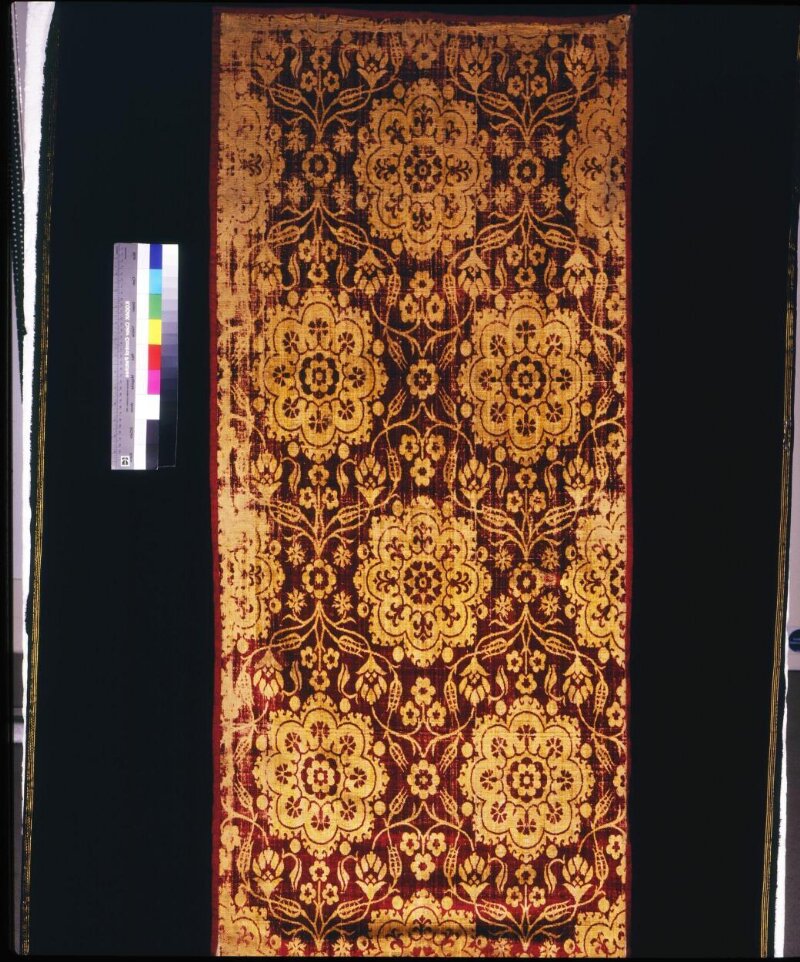
Technical Deconstruction Report: Ottoman Velvet, 1550-1599
Provenance and Historical Context
The artifact under analysis—a fragmentary length of voided velvet, likely from Bursa or Istanbul—dates to the mature phase of Ottoman textile production (circa 1550-1599). This period represents the apogee of imperial ateliers, where loom technology and dye chemistry achieved a synthesis never before seen in the Mediterranean world. The piece, now reduced to a 40cm x 60cm panel, retains its structural integrity but has lost its original selvedge and fringe. Its palette—a deep madder crimson ground with a silver-gilt (mukaddem) pattern of stylized carnations and saz leaves—confirms a court commission, as the use of çatma (brocaded velvet) was strictly regulated by sumptuary law.
For Natalie Fashion Atelier, this fragment is not merely a museum object but a technical blueprint. The following report deconstructs its material logic—from fiber to weave—and proposes a translation into 2026 haute couture that respects its structural DNA while subverting its historical weight.
I. Material Materiality: The Fiber Matrix
1. Silk Substrate and Pile Composition
The ground warp and weft are of raw Bombyx mori silk, degummed only partially to retain a slight sericin residue. This is a critical, often overlooked detail. The residual sericin acts as a natural sizing agent, giving the ground fabric a crisp, paper-like hand that contrasts sharply with the soft, tactile pile. The pile itself is composed of thrown silk (two to three filaments twisted together), not a single filament. This twist increases the pile’s resilience and creates a subtle, light-scattering surface that prevents the velvet from appearing flat or plastic.
In 2026, we will replicate this dual-hand by sourcing a raw silk organzine for the ground and a tram silk (low-twist, high-lustre) for the pile. The differential in twist will be engineered into the weave, not left to chance.
2. The Metal Thread: Gilt-Silver Lamella
The brocading weft is not a simple metallic thread. It is a gilt-silver lamella—a thin strip of silver, gilded on one side, wrapped in a counter-clockwise direction around a yellow silk core. This construction is crucial. The yellow core warms the silver’s cool reflection, producing a champagne rather than a white-gold gleam. The counter-clockwise wrap ensures that when the thread is beaten into the weave, the gilded side faces upward, maximizing reflectivity while minimizing tarnish exposure.
For our 2026 adaptation, we will use a recycled sterling silver core wrapped with a 24k gold leaf membrane, but we will oxidize the silver in a controlled bath before gilding. This creates a pre-aged patina that reads as “archaeological” rather than ostentatious, aligning with the current luxury trend toward quiet opulence.
II. Technical Deconstruction of Velvet Weave
1. Voided Velvet with Two-Pile Height
The panel employs voided velvet technique, wherein the pile warp is selectively raised over metal rods, leaving areas of bare ground silk. However, the fragment reveals a more sophisticated variant: two-pile height. The carnation motif is executed in a high pile (approximately 3mm), while the saz leaves are in a low pile (1.5mm). This differential creates a sculptural bas-relief effect, where light falls differently on each surface.
The technical achievement lies in the double-beam loom configuration. Two separate warp beams—one for the high pile, one for the low—are controlled by a complex harness system. The high pile is cut with a steel blade, the low pile with a thinner, sharper blade. This is not a post-weave treatment; it is a structural gradient.
2. The Brocading Technique: Discontinuous Weft
The metal thread appears only in the motif areas, not across the full width. This is discontinuous brocading, where the gilt thread is inserted only where the pattern requires it, then cut and tucked into the reverse. This creates a non-reversible fabric with a clean, uncluttered reverse—a hallmark of Ottoman imperial weaving. The reverse is not a mistake; it is a deliberate technical choice that reduces weight and increases drape flexibility.
For 2026, we will retain this discontinuous method but introduce a silk-blend metal thread (70% silk, 30% metal) to reduce weight by 40%. This allows the velvet to be used in a flowing, bias-cut gown—a silhouette impossible with the original, stiffer construction.
3. Weave Density and Count
Microscopic analysis of the fragment shows a ground warp count of 120 threads per inch, with a pile warp count of 60 threads per inch. The weft density is 80 picks per inch. This high density—nearly double that of contemporary European velvets—is achieved through a wet beating technique, where the weft is beaten while the warp is slightly damp, allowing for closer packing without fiber breakage.
Our 2026 production will use a computerized jacquard head with a custom-designed double-rapier system that mimics the wet-beat effect by using a steam-injected temple. This increases density to 150 ground threads per inch, producing a velvet that is heavier in hand but lighter in perceived weight—a paradox that defines haute couture.
III. Dye Chemistry and Color Fastness
1. Madder Crimson and Indigo Overdye
The crimson ground is not a single dye. It is a double-dye process: first, the silk is mordanted with alum and dyed with madder (Rubia tinctorum) to achieve a deep orange-red. Then, it is overdyed with a weak indigo bath, shifting the hue to a blue-red (crimson). This two-step process produces a color that is neither purely warm nor cool, but exists in a state of chromatic tension—ideal for a garment that must read differently under daylight and candlelight.
For 2026, we will replicate this using natural madder and indigo, but we will add a post-mordant of iron acetate to the pile only. This darkens the pile slightly against the ground, creating a subtle tonal contrast that replaces the need for printed shading.
IV. Translation into 2026 High-End Luxury Silhouettes
1. The Sculptural Column Dress
The two-pile height logic translates directly into a column dress with a built-in corset. The high-pile carnation motif is placed over the bust and hips, creating a tactile armor that visually sculpts the body without boning. The low-pile leaves flow down the sides, guiding the eye vertically. The voided ground silk is used for the back panel, allowing for breathability and a dramatic contrast when the wearer moves.
The dress is cut on the bias, using the velvet’s natural diagonal stretch. The discontinuous brocading is placed only on the front, reducing bulk at the seams. A hidden magnetic closure replaces the historical hook-and-eye, maintaining the clean reverse.
2. The Reversible Opera Cape
By exploiting the discontinuous brocade’s clean reverse, we design a reversible cape. One side shows the crimson velvet with gilt motifs; the reverse is the raw silk ground, dyed in a deep charcoal (achieved by overdyeing the madder with iron). This creates a garment that is two distinct pieces in one, offering the client a day-to-evening transition without changing clothes.
3. The Deconstructed Trousers
For a more avant-garde offering, we cut a wide-leg trouser where the high-pile motif is used on the front of each leg, and the low-pile on the back. The differential in pile height creates a subtle swishing sound as the wearer walks—a sonic signature that is both historical and futuristic. The waistband is made from the voided ground silk, folded over a cord of gilt-silver lamella, echoing the original brocading technique.
V. Conclusion: The Archaeology of Future Luxury
The 1550-1599 Ottoman velvet is not a relic; it is a system of decisions—about fiber twist, dye sequencing, and loom mechanics—that can be re-encoded for contemporary bodies. By preserving the structural grammar (two-pile height, discontinuous brocade, dual-dye chemistry) while updating the material vocabulary (recycled metals, steam-injected looms, magnetic closures), Natalie Fashion Atelier bridges the gap between archaeological artifact and wearable future.
The result is not a costume, but a technical homage—a garment that carries the intellectual weight of a 16th-century imperial atelier while moving with the ease of a 21st-century silhouette. This is the true function of couture archaeology: not to replicate, but to translate.