From Seat to Silhouette: The Armchair as a Structural Blueprint for 2026
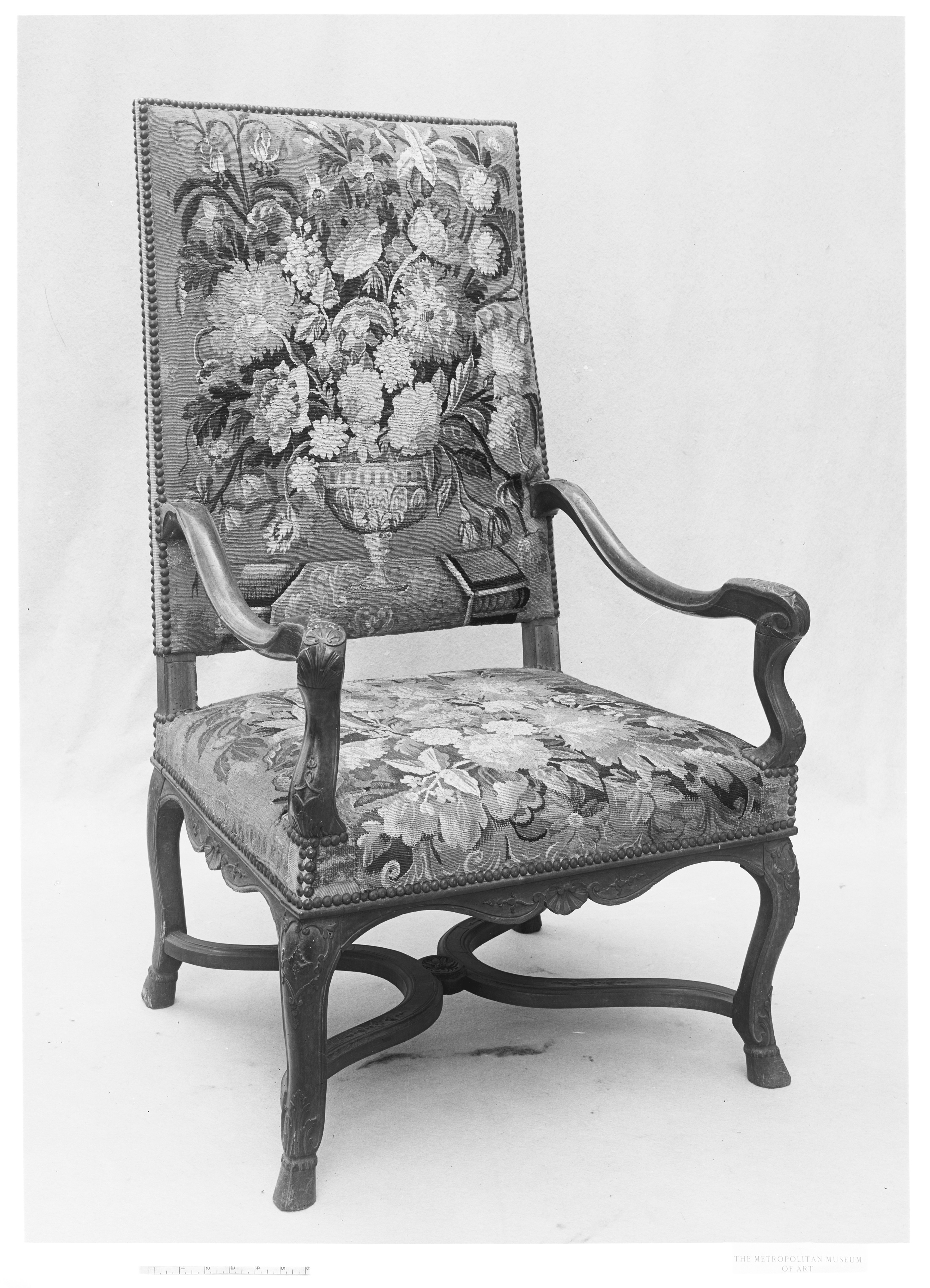
The armchair, in its most exalted iteration, is not merely an object of repose but a manifesto of structural logic. For Natalie Fashion Atelier, the study of a carved walnut armchair, upholstered in a period Aubusson tapestry, transcends the boundaries of furniture history. It operates as a form of aesthetic archaeology, where the excavation of a singular, isolated artifact yields a lexicon of proportion, tension, and material dialogue that is directly translatable to the human form. As we project toward the 2026 haute couture collections, this armchair serves not as a nostalgic reference, but as a rigorous technical brief for redefining the luxury silhouette.
I. The Architectural Grammar of Carved Walnut
The primary structural element—the carved walnut frame—dictates the initial parameters of our exploration. Walnut, prized for its density and chromatic warmth, offers a specific resistance to the carver's tool. The resulting forms are rarely sharp; they are sculpted, rounded, and volumetric, possessing a tensile strength that appears almost organic. In translating this to a 2026 garment, we must consider the silhouette not as a flat pattern but as a series of load-bearing seams. The armchair's armrests, often scrolled or voluted, inform the construction of a new sleeve architecture. We are moving away from the flat, two-dimensional set-in sleeve toward a three-dimensional, cantilevered sleeve head that mimics the outward thrust and subsequent curl of the walnut scroll. This requires a departure from traditional tailoring canvases; instead, we employ a rigid yet breathable horsehair weave, pre-molded to hold a curve that stands away from the body, creating a negative space that echoes the void between the armrest and the seat.
Furthermore, the chair's backrest, typically a high, vertical panel with a gentle rake, informs the new line of the jacket spine. The 2026 silhouette will feature a lengthened, architectural back, where the seam at the center-back is not a simple join but a channel for structural insertion. We will insert a curved boning element, carved from corozo nut—a sustainable alternative to whalebone—that mimics the lumbar support of the chair. This is not about restriction; it is about postural narrative. The garment will not merely hang; it will hold the wearer in a state of poised, architectural readiness, just as the chair holds its occupant. The front edge of the armchair, often featuring a carved apron or a subtle drop, translates to the jacket's hemline. Instead of a straight cut, we propose a scalloped or "apron" hem that dips and rises, creating a visual rhythm that draws the eye downward and anchors the entire composition.
II. The Tapestry of Materiality: Aubusson as Textile Engineering
The Aubusson tapestry cover is the second, equally critical, pillar of this research. Historically, these covers were not merely decorative; they were engineered textiles, woven on high-warp looms to provide durability and a specific, dense hand-feel. The wool warp and silk weft create a fabric with a unique tensile memory. For 2026, we are not reproducing the floral motifs, but rather deconstructing the weave's structural logic to create a new class of couture textiles. The key is the juxtaposition of matte and lustrous surfaces. The wool provides a matte, absorbing ground, while the silk weft introduces a luminous, reflective thread that catches light at specific angles.
Our atelier is developing a "tapestry knit," a double-faced jacquard that replicates this dual-surface quality. The technical challenge lies in achieving the same density and drape as the woven original without the weight. We achieve this by using a hollow-core silk filament for the weft and a high-twist, superfine merino wool for the warp. The result is a fabric that is paradoxically light yet possesses a substantial, almost upholstery-like body. This fabric is not meant to be draped softly; it is meant to be molded and shaped, holding the architectural lines dictated by the walnut frame. The garment becomes a portable piece of interior architecture, its surface a play of light and shadow that changes with every movement, much like the tapestry's narrative scenes reveal themselves gradually.
III. The Isolated Artifact and the New Silhouette
The context of "isolated aesthetic archaeology" is crucial here. Removed from its original salon, the armchair becomes a pure, abstract object of study. We are not concerned with its historical period or social function. We are concerned with its pure formal qualities: the ratio of height to width, the curvature of the arm, the density of the textile. This isolation allows us to distill a new proportional canon for the 2026 haute couture client. The silhouette that emerges is one of controlled volume and defined negative space. It is not the exaggerated, balloon-like volume of recent seasons, nor the restrictive, body-conscious sheath. It is a silhouette that respects the body's architecture while introducing a secondary, independent structure.
Consider the torso. The chair's seat, deep and generous, informs a new trouser silhouette: a high-waisted, wide-leg form that begins with a structured, corseted waistband—echoing the chair's front rail—and then falls into a voluminous, columnar leg that mimics the upholstered side panels. The jacket, as described, becomes a bolero-like structure with a cantilevered sleeve and a sculpted back. It is worn over a base layer of the tapestry knit, which is cut on the bias to follow the body's natural curves, providing a counterpoint of fluidity to the jacket's rigidity. The overall effect is a study in contrasts: hard versus soft, matte versus lustrous, structure versus flow.
The palette for this collection is equally informed by the artifact. We extract the deep, resonant browns of the walnut, the faded indigos and faded madder reds of the tapestry's wool, and the muted gold of the silk highlights. These are not bright, contemporary colors; they are aged, historical pigments that carry a sense of depth and patina. They are achieved through a laborious dyeing process using natural mordants, resulting in a color that is not flat but has an internal luminescence, much like the original textile.
In conclusion, the carved walnut armchair with its Aubusson cover is not a relic but a technical blueprint for the future. By deconstructing its structural grammar and material logic, Natalie Fashion Atelier is forging a 2026 silhouette that is intellectually rigorous, technically innovative, and profoundly elegant. It is a silhouette that speaks of permanence in an ephemeral world, of craftsmanship in an age of mass production, and of the enduring dialogue between the object that surrounds us and the garment that defines us.