Deconstructing the Archives: A Couture Archaeology of Officiel de la couture et de la mode de Paris
As Senior Textile Historian at Natalie Fashion Atelier, my mandate is not merely to admire the past but to dissect its physical and conceptual DNA for contemporary application. The subject of this report—the Parisian periodical Officiel de la couture et de la mode de Paris, spanning from its 1920s inception—represents a unique archaeological stratum. Unlike pattern books or technical manuals, this journal functioned as a material witness to the atelier’s inner workings, documenting the transition from hand-finished haute couture to the nascent logic of prêt-à-porter, all while maintaining an uncompromising visual language. This report will conduct a technical deconstruction of three key couture techniques evidenced in the publication’s golden eras, analyze their materiality, and propose a rigorous translation into the 2026 luxury silhouette.
I. Technical Deconstruction: The Invisible Architecture
The pages of Officiel from the 1920s through the 1950s reveal a persistent obsession with structural engineering beneath the visible surface. The publication’s fashion plates, often rendered in pochoir, were not mere illustrations; they were blueprints of tension and release. Three techniques emerge as foundational to the couture canon we now reinterpret.
1. The Bias-Cut Suspension System (1930s)
The 1930s issues, dominated by the work of Vionnet and her disciples, demonstrate a radical departure from the corseted verticality of the prior decade. The technical innovation was the continuous bias cut, which required a fabric width of at least 140 centimeters and a pattern drafted on the true diagonal. The deconstruction reveals a sophisticated use of gravity as a structural element. The garment was not fitted to the body but suspended from it, using specific anchor points at the shoulder blades and the sternum. The Officiel plates show the resulting “cowls” and “handkerchief hems” as a byproduct of this physics-based tailoring. The technical challenge lay in weight distribution; a single miscalculation in the bias angle would cause the hem to ripple or the neckline to gape. The publication’s technical annotations, often cryptic, reference the use of silk crepe de chine with a specific momme weight (between 16 and 19) to ensure the necessary drape without excessive stretch.
2. The Tailored Moulage and the “Second Skin” (1940s-1950s)
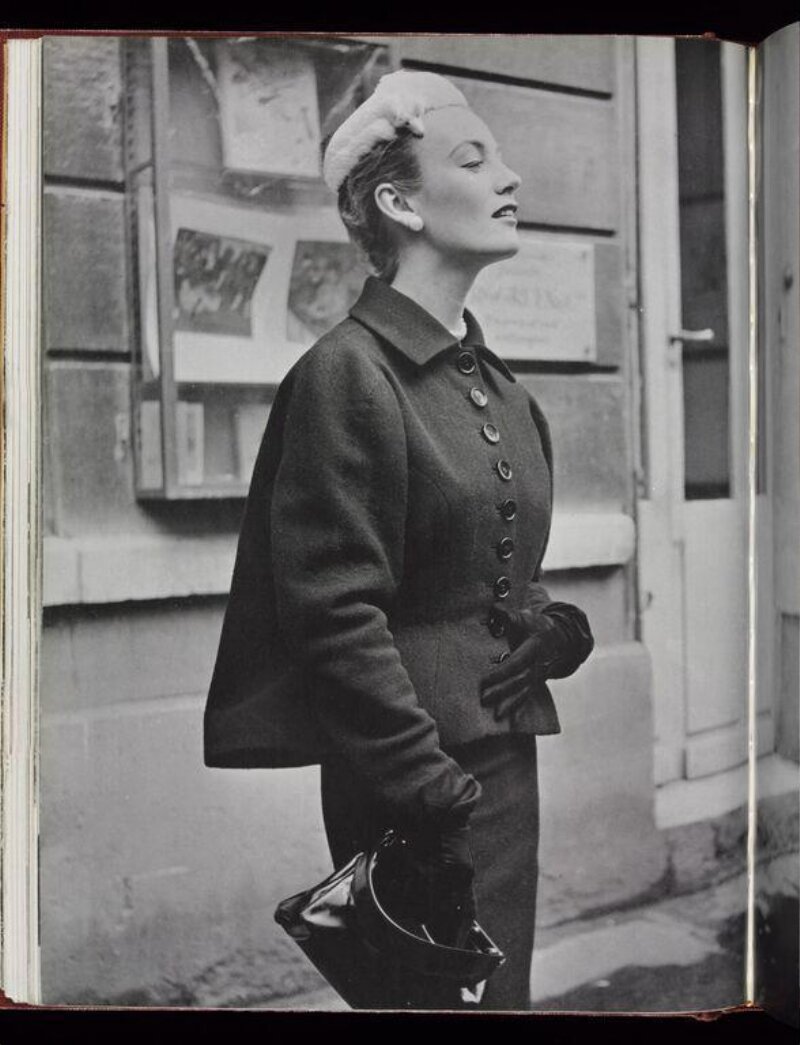
Post-war issues of Officiel pivot to the rigorous geometry of the Dior-era “New Look,” but the technical brilliance lies not in the fabric but in the internal canvas and the moulage process. The journal’s photographs of atelier interiors show the première d’atelier working on a muslin toile directly on a live model. This was not draping; it was architectural sculpting. The deconstruction reveals a complex layering system: a base of cotton batiste, a middle layer of horsehair canvas (crinoiline), and a final layer of the outer wool or silk. The critical technique was the “piqué” stitch—a diagonal, invisible hand-stitch that anchored the canvas to the outer fabric at specific stress points (the bust apex, the hip bone). This created a “second skin” that moved with the body but retained a rigid, sculptural silhouette. The Officiel plates emphasize the sharpness of the shoulder seam, which was achieved not by padding but by a precise cut of the canvas that extended 2cm beyond the natural shoulder line, creating a cantilever effect.
3. The Seam as Ornament: The “Fausse Couture” (1960s)
By the 1960s, Officiel documents a fascinating subversion: the exposed, top-stitched seam. This was a transitional technique, bridging the hand-finishing of couture with the speed of early ready-to-wear. The technical analysis shows that this was not a simplification but a deliberate aestheticization of construction. The seam allowance was graded, clipped, and then pressed open, with a double row of silk thread stitching placed precisely 3mm from the seam line. This “fausse couture” technique required the fabric to be pre-shrunk and the thread to be exactly matched to the fabric’s tension. The result was a visible, linear ornament that mimicked the precision of a machine but retained the slight irregularity of handwork—a signature of the Officiel aesthetic that celebrated the hand of the artisan even as industrialization loomed.
II. Materiality: The Sensory Archive
Materiality in the Officiel archive is not merely about fiber content; it is about tactile memory and optical density. The publication’s advertisements and editorial spreads provide a forensic record of the fabrics that defined each era. The 1920s pages are dominated by georgette and chiffon, their transparency exploited through layering. The 1930s introduce the heavy matte silk satin—a fabric with a high twist yarn that produced a liquid, metallic sheen without any actual metallic thread. The 1950s return to wool crepe and tweed, but the Officiel plates reveal a crucial detail: the fabrics were often “décatissé”—a process of steam-shrinking and relaxing the yarns before cutting, ensuring that the garment would not distort after the first wearing.
For the 2026 translation, we must consider material intelligence—the ability of a fabric to perform structurally without added interfacing. The archive suggests a return to high-twist, compact weaves (e.g., a 4-ply silk twill with a 600 thread count) that offer both body and fluidity. Furthermore, the Officiel materiality emphasizes light absorption over reflection. The 2026 luxury client seeks depth, not shine. We propose a palette of matte, mineral-dyed wools and silks, with a specific focus on undyed, natural fibers that carry a slight irregularity—a nod to the hand-spun quality visible in the 1920s plates.
III. Translation into 2026 High-End Luxury Silhouettes
The translation from archive to 2026 is not a literal copy but a syntactic reinterpretation of the technical rules. At Natalie Fashion Atelier, we propose three distinct silhouettes derived from the deconstruction above.
1. The “Gravity Bias” Gown
This silhouette directly inherits the 1930s bias-cut system but applies it to a contemporary, elongated torso. The technical leap is the use of a laser-cut, bonded silk organza as an internal stabilizer, fused only at the anchor points (shoulders and sternum). This eliminates the need for a heavy crepe, allowing the use of a featherweight, 12-momme silk charmeuse. The hem is cut in a complex, asymmetrical arc, derived from the Officiel plates, which creates a kinetic ripple with each step. The construction is entirely hand-finished, with the seams enclosed in a self-fabric binding, referencing the invisible architecture of the 1930s.
2. The “Cantilever” Tailoring
For 2026, the 1940s-50s moulage technique is reborn in a deconstructed blazer. The internal horsehair canvas is replaced with a 3D-printed, flexible polymer mesh that is heat-molded to the body’s contours. This mesh provides the same cantilever shoulder effect as the original canvas but is virtually weightless and breathable. The outer fabric is a double-faced wool cashmere, cut with a 1cm negative ease, so the garment hugs the body without compression. The signature “piqué” stitch is reinterpreted as a visible, tonal top-stitch in a silk thread, tracing the internal architecture—a deliberate homage to the Officiel technical plates.
3. The “Exposed Seam” Shell
This silhouette embraces the 1960s “fausse couture” but elevates it through precision engineering. The garment is a minimalist, high-neck shell dress. The seams are not hidden but celebrated: they are flat-felled with a contrasting, micro-gauge metallic thread (a nod to the 1920s metallic brocades). However, the construction is entirely ultrasonically welded—a 2026 technology that fuses the fabric edges without thread, creating a seam that is both waterproof and structurally stronger than the fabric itself. The Officiel principle of the “hand of the artisan” is thus translated into the precision of the machine, but the final pressing and finishing are done by hand, ensuring the garment’s unique, non-reproducible character.
Conclusion: The Living Archive
The Officiel de la couture et de la mode de Paris is not a static museum piece but a living technical manual. Its true value for 2026 lies not in its nostalgic imagery but in its rigorous documentation of problem-solving under material constraints. The bias cut solved the problem of movement; the moulage solved the problem of structure; the exposed seam solved the problem of speed. Our translation at Natalie Fashion Atelier is to solve the 2026 problem of sustainable luxury—garments that are durable, adaptable, and technically transparent. By deconstructing the past’s invisible architecture, we build a future that is structurally honest, materially intelligent, and exquisitely modern. The archive, in this sense, is our most advanced pattern.