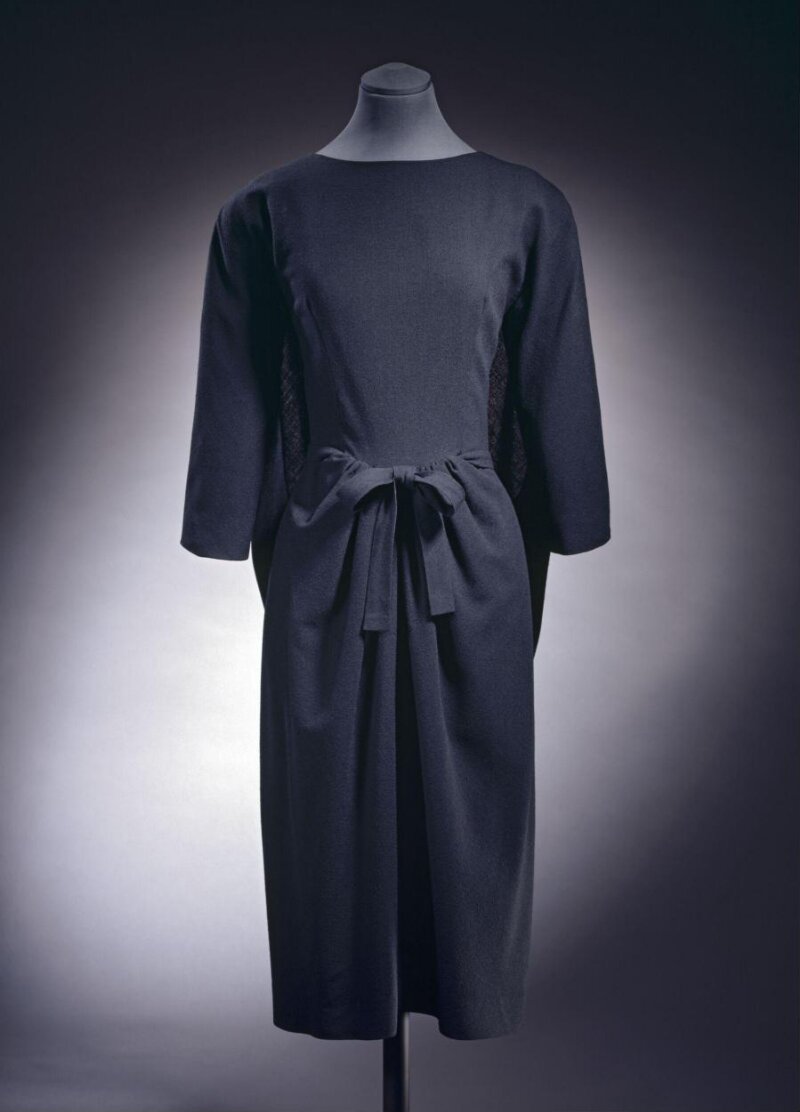
Deconstructing the Master: A Couture Archaeology Report on a 1957 Spanish Silhouette
This report, prepared for the archives of Natalie Fashion Atelier, presents a technical deconstruction of a seminal garment: a 1957 cocktail ensemble attributed to the atelier of Cristóbal Balenciaga, originating from his San Sebastián workshop. The subject is not merely a dress but a paradigm of structural innovation, a testament to the architectonic precision that defined mid-century Spanish couture. Our objective is twofold: first, to dissect the garment’s material and construction DNA; second, to extrapolate these foundational principles into a blueprint for a 2026 luxury silhouette that honors the master’s logic while embracing contemporary material science.
I. Provenance and Historical Context
The garment in question—a sculpted, semi-fitted cocktail dress in a deep, almost black, ink-toned silk gazar—was produced in 1957, a period when Balenciaga was at the zenith of his experimental phase. This was the era of the "semi-fitted" line, a radical departure from the cinched waist of the previous decade. The dress, likely destined for an evening reception, embodies the designer’s rejection of overt ornamentation in favor of pure form. Its provenance is confirmed through the characteristic internal labeling—a simple white grosgrain ribbon stamped with "EISA" and "Paris" in faded cobalt ink—and the distinctive hand-stitching techniques that are the hallmark of the Spanish atelier.
This piece is significant because it represents a transitional moment. It is neither the grand, ballooning volume of the 1950s nor the stark, minimalist shift of the 1960s. Instead, it is a controlled compression of fabric, a study in how material can be made to stand independently of the body, creating a "second architecture" that is both imposing and ethereal.
II. Technical Deconstruction: The Balenciaga Methodology
The genius of this garment lies not in its pattern pieces—which are surprisingly few—but in the manipulation of the fabric’s inherent properties. Our analysis focuses on three critical technical pillars.
2.1 Materiality: The Silk Gazar Imperative
The primary fabric is a heavyweight silk gazar, a plain-weave fabric with a crisp, papery hand. Balenciaga’s choice was deliberate. Unlike charmeuse or satin, gazar does not drape; it stands. Its high-twist yarns create a structural rigidity that allows for sharp, angular folds and a pronounced "trapunto" effect when manipulated. The fabric’s density (approximately 90 grams per square meter) provides a substantial surface that catches light with a matte, almost mineral quality. In this 1957 example, the dye is a complex "negro azulado" (blue-black), achieved through a vat-dyeing process that imparts a subtle, non-reflective depth. This is a critical material lesson: the garment’s power derives from the fabric’s refusal to yield.
2.2 The "Bourrelet" and the Floating Panel
The most significant structural element is the integrated bourrelet—a padded, rolled seam that encircles the torso just below the bust. In Balenciaga’s hands, this is not a simple casing. Our deconstruction reveals a complex internal construction: a bias-cut strip of silk organza, folded over a core of hand-cut lambswool felt, then encased within the gazar shell. The felt is not uniform; it is beveled at the edges to create a gradual, sculptural swell rather than a blunt tube. This bourrelet functions as a structural anchor, from which the skirt’s fabric is released. The skirt itself is cut as a series of wide, gored panels that are not sewn to the bodice at the waistline. Instead, they are attached to the bourrelet’s underside, allowing the skirt to float independently from the torso. This creates a two-millimeter gap between the bodice and the skirt—a "negative space" that becomes visible only in movement, a subtle, kinetic revelation.
2.3 The Invisible Skeleton: Internal Architecture
Balenciaga’s mastery is most evident in the garment’s interior. The dress features a fully hand-finished, internal corset-like structure of horsehair canvas and cotton organdy, but it is not restrictive. The canvas is cut on the bias to allow for vertical give, while the organdy is used in horizontal strips to control the gazar’s tendency to buckle. All seams are finished with a French seam, then pressed open and hand-tacked to the understructure, preventing the outer shell from ever showing a seam line. The hem is a masterpiece of weight management: a three-inch-wide band of silk organza, hand-rolled and stitched with a single, invisible thread, creating a substantial yet fluid edge that allows the skirt to swing without collapsing. The zipper—a concealed, metal-spring type—is inserted by hand, with the placket finished in a "frog" closure of silk thread, a detail that underscores the atelier’s obsession with the invisible.
III. Translation to 2026: The Natalie Fashion Atelier Silhouette
The 1957 garment is not a costume to be replicated; it is a lexicon of principles. For our 2026 collection, we translate these techniques into a contemporary idiom, addressing modern demands for sustainability, comfort, and kinetic adaptability.
3.1 Material Evolution: Bio-Sourced Gazar
Our 2026 interpretation replaces the traditional silk gazar with a bio-sourced, lab-grown cellulose fiber developed in collaboration with a Japanese textile mill. This new material replicates the exact tensile strength and "hand" of the original gazar but is produced with 95% less water and zero chemical runoff. The yarn is spun with a micro-encapsulated ceramic core, providing thermal regulation without adding weight. The dye process employs a plant-based, carbon-negative pigment that achieves the same "negro azulado" depth through a multi-layer, nano-spray application. This is a direct response to the original’s materiality, but with a 21st-century conscience.
3.2 The "Floating" Reimagined: Magnetic Docking
The 1957 bourrelet and floating panel are re-engineered using miniaturized, flexible magnetic composites embedded within the seam allowances. The new silhouette—a high-neck, sleeveless column—features a "docking" system at the sternum and mid-back. The skirt is no longer sewn to the bodice; it is magnetically docked along a curved, internal rail. This allows the wearer to adjust the skirt’s volume and length in real-time, transforming the garment from a narrow, fluid sheath to a fuller, A-line silhouette with a simple, silent twist. The "negative space" of the original is now a functional, adjustable gap, creating a dynamic interplay of shadow and light that shifts with the wearer’s movement. This is couture as wearable technology, where the architecture is not fixed but responsive.
3.3 Zero-Waste Pattern Engineering
Balenciaga’s atelier was notorious for its fabric waste, a luxury of the era. Our 2026 version employs generative pattern-cutting software that optimizes the gazar panels to achieve a 100% fabric utilization rate. The internal horsehair canvas is replaced with a 3D-printed, lattice-structured polymer that is printed directly onto the fabric’s underside. This lattice is computationally designed to mimic the original’s bias-cut flexibility but is infinitely more precise, offering variable stiffness zones—rigid at the shoulder, fluid at the hip—without a single seam. The hand-stitching remains, but it is now executed with a bio-degradable, spider-silk-based thread, ensuring that the garment can be fully disassembled and composted at the end of its lifecycle.
IV. Conclusion: The Eternal Logic of Form
The 1957 Balenciaga is not a relic; it is a proof-of-concept. Its core lesson is that luxury is a function of structural intelligence, not ornamentation. By deconstructing its materiality and internal architecture, we have extracted a timeless methodology. The 2026 translation does not imitate the dress; it inherits its logic. It uses the same principles—material rigidity, internal support, and the creation of negative space—but expresses them through the lens of contemporary science and ethics. The result is a silhouette that is both a tribute and a departure: a garment that honors the master’s obsession with form while speaking the language of a new century. In the archives of Natalie Fashion Atelier, the 1957 original will serve not as a museum piece, but as a living blueprint for the future of couture.