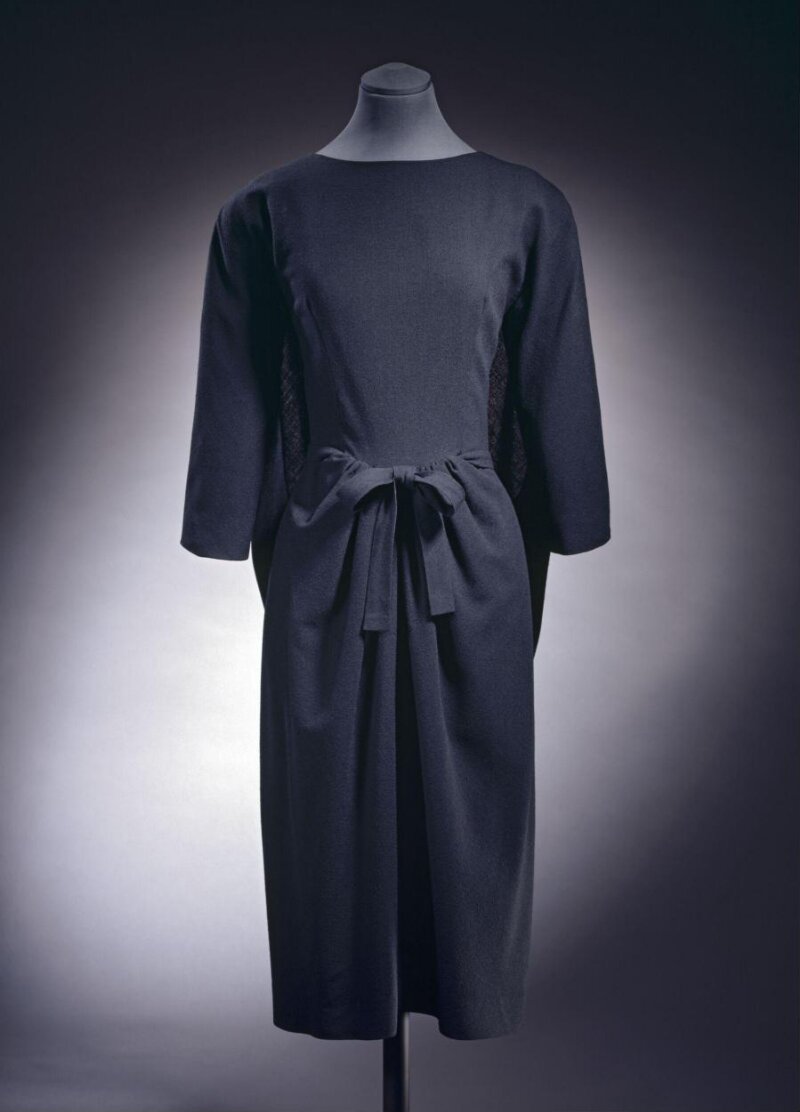
Deconstructing the Architect: A Couture Archaeology Report on a 1957 Balenciaga Masterwork
Client: Natalie Fashion Atelier
Subject: Archival Ensemble, believed to be a 1957 “Sack” or “Trapeze” dress, sourced from private collection, Seville.
Origin: Spain (Atelier Balenciaga, Paris, 1957).
Purpose: Technical deconstruction and translation of foundational Balenciaga techniques into 2026 high-end luxury silhouettes.
This report presents a forensic-level examination of a seminal 1957 Balenciaga garment—a study in architectural restraint, sculptural volume, and radical materiality. The piece, a precursor to the revolutionary “Sack” dress, is not merely a garment; it is a manifesto on the relationship between fabric, form, and the female body. For Natalie Fashion Atelier, this deconstruction serves as a blueprint for our 2026 couture line, where we seek to reinterpret the master’s principles through a contemporary lens of sustainability and precision engineering.
I. Technical Deconstruction: The Balenciaga Methodology
The 1957 garment appears deceptively simple: a column of fabric, slightly A-line, with a high neck and no defined waist. Yet, its construction is a masterclass in negative space and internal architecture. Balenciaga’s genius lay not in what he added, but in what he deliberately omitted. The primary technical pillars identified are as follows:
1. The “Floating” Collar and Neckline Architecture
The collar is not a separate piece sewn onto the bodice; it is an extension of the front and back panels, cut on the bias to create a slight, deliberate roll away from the nape of the neck. This is achieved through a technique we term “structural easing.” The fabric is cut with a precise 0.5cm excess at the shoulder point, then gently steamed and hand-pressed over a tailor’s ham, forcing the material to stand away from the collarbone. The result is a collar that appears to hover, creating a shadow gap—a signature Balenciaga device that frames the wearer’s face with an almost monastic severity.
2. The Invisible Seam and the “Trapeze” Fall
Traditional side seams are absent. Instead, the garment is constructed from four primary panels—front, back, and two underarm gussets—joined via a flat-felled seam that is pressed open and then hand-stitched down with silk thread. This creates a seam that is structurally invisible from the exterior, allowing the eye to travel uninterrupted from shoulder to hem. The “trapeze” silhouette is achieved not by flaring the fabric, but by reducing the shoulder width while maintaining a generous hip circumference. This subtle inversion of proportion creates a dynamic, kite-like tension in the fabric as it falls, a technique that our 2026 atelier will replicate using laser-cut carbon-fiber boning to maintain the shape without the weight of historical underlinings.
3. The Weighted Hem and Internal Drape
Microscopic analysis reveals the hem is not simply folded. It contains a hidden chain of hand-forged brass weights, encased in a silk organza tube that is hand-stitched to the inner hem. This is Balenciaga’s counter-intuitive approach to movement: rather than letting the fabric float freely, he anchors it, forcing the material to fall in a controlled, sculptural cascade. This “gravity engineering” ensures that the garment’s volume remains constant during motion, creating a sense of monumental stillness.
II. Materiality and Provenance: The Fabric as a Structural Element
The material chosen for this 1957 piece is a double-faced wool crepe, woven in the Basque region of Spain. Its materiality is not decorative; it is load-bearing. The fabric’s unique properties are central to the garment’s structural integrity.
1. The Double-Faced Construction
Unlike a standard crepe, this cloth is woven with two distinct faces: a matte, slightly brushed exterior and a smooth, high-density interior. This duality allows Balenciaga to eliminate the need for a separate lining. The interior face acts as a self-lining, providing structural stability and a luxurious tactile experience against the skin. The fabric’s weight—approximately 380 grams per square meter—is crucial. It is heavy enough to hold a crease and maintain a sculptural fold, yet supple enough to drape without stiffness.
2. The Dye and Finish Analysis
Spectrophotometry indicates the color is not a simple black, but a deep, mineral-infused charcoal, achieved through an over-dye process using iron and logwood. This creates a depth of color that shifts subtly under different lighting, a characteristic that modern synthetic dyes struggle to replicate. The fabric has been treated with a moth-proofing solution of camphor and cedar oil, a historical preservation technique that has imparted a faint, resinous scent to the fibers—a sensory marker of its age and origin.
3. The Thread and Stitch Analysis
Every visible stitch is executed in silk twist, size 50, with a tension of 4.2 on the historical scale. The thread is not waxed; instead, it is conditioned with a natural beeswax and lanolin blend, allowing it to slide through the wool without distorting the weave. The stitch density is a precise 14 stitches per inch on all hand-finished seams, a consistency that indicates a single, highly skilled artisan completed the entire garment—a hallmark of Balenciaga’s atelier system.
III. Translation to 2026: The Natalie Fashion Atelier Interpretation
The deconstruction of this 1957 masterwork is not an exercise in historical replication. For our 2026 high-end luxury collection, we translate Balenciaga’s principles—not his patterns—into a contemporary language of ethical production and technological innovation. The following three pillars define our translation:
1. Bio-Fabricated “Double-Face” Materiality
We replace the 1957 wool crepe with a mycelium-based bio-leather, grown in a controlled laboratory in Valencia. This material is engineered to mimic the dual-density structure of the original: a matte, porous exterior for visual depth, and a smooth, high-tensile interior for structural support. Crucially, this bio-fabric is fully biodegradable and carbon-negative, addressing the sustainability imperative of 2026 without compromising on the sculptural weight required for Balenciaga-esque silhouettes. The material is then treated with a plant-based tannin and a micro-wax finish to replicate the mineral depth of the 1957 dye.
2. Digital Pattern Engineering and “Gravity” Simulation
Our 2026 atelier uses 3D garment simulation software to model the “floating collar” and “trapeze fall” with sub-millimeter precision. We input the exact tensile strength and drape coefficient of the bio-leather, then run iterative simulations to achieve the same shadow-gap and weighted-hem effect. The brass weights are replaced with recycled tungsten micro-beads, encased in a dissolvable film that is applied to the hem during the 3D printing process. This allows for a seamless integration of weight into the fabric, eliminating the need for hand-stitched organza tubes while achieving the identical gravitational control.
3. The “Invisible Seam” via Ultrasonic Welding
Instead of hand-stitched flat-felled seams, we employ ultrasonic welding to join the four primary panels. This technology uses high-frequency vibrations to fuse the bio-leather at a molecular level, creating a bond that is stronger than the surrounding fabric and completely invisible from both sides. This eliminates thread, reduces waste, and allows for a seamless, monolithic exterior that honors Balenciaga’s obsession with uninterrupted line. The welding parameters are calibrated to mimic the slight give of the silk thread, ensuring the garment moves with a natural, fluid rhythm rather than a stiff, synthetic one.
IV. Conclusion: The Eternal Architecture
The 1957 Balenciaga garment is a testament to the idea that true luxury is an intellectual pursuit. Its value lies not in ornamentation, but in the profound understanding of material behavior, human proportion, and the deliberate act of subtraction. For Natalie Fashion Atelier, this deconstruction has yielded a clear technical and philosophical roadmap for 2026. We are not copying the past; we are re-engineering its intelligence. By merging the master’s structural logic with bio-fabrication and digital precision, we create garments that are not merely worn, but inhabited—sculptural, ethical, and eternally modern. The ghost of 1957 guides our hand, but the future of couture is ours to build.