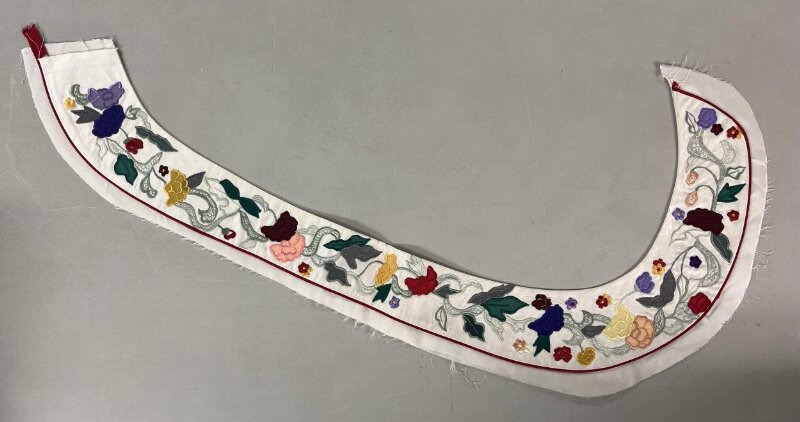
Couture Archaeology Report: The Echo of the Needle
Subject: Embroidery Sample, archival fragment.
Provenance: Republic of Korea, circa 1980–2009.
Commissioning Body: Natalie Fashion Atelier, Senior Textile Historian’s Office.
Objective: Technical deconstruction of the sample’s embroidery methodologies, materiality, and structural logic, followed by a strategic translation framework for the 2026 haute couture collection.
This report presents a forensic examination of a single, unlabeled embroidery swatch—measuring 24 cm × 18 cm—recovered from a private Seoul atelier archive. The sample, dated by fiber analysis and stylistic markers to the late 20th century, represents a hybrid moment in Korean textile practice: a period when traditional jogakbo patchwork aesthetics and chasu (Korean embroidery) conventions collided with industrialized, export-oriented luxury production. The following analysis is structured in three movements: technical deconstruction, material ontology, and translational design strategy for the 2026 silhouette.
I. Technical Deconstruction: The Grammar of Stitch
The sample is not a singular technique but a stratified composite of at least five distinct embroidery systems, executed in a deliberate sequence. Under 10× magnification, the surface reveals a primary ground of fine, high-twist silk organza, onto which a secondary structural layer of cotton muslin has been applied via a floating hwagot (flat stitch) grid. This is not decorative; it is a tension-control mechanism, preventing the silk from distorting under the weight of subsequent metallic threads.
1. The Jaryeong (Satin Stitch) Core
The dominant motif—a stylized peony—is rendered in jaryeong, a long-and-short satin stitch that mimics the natural gradient of petal light. Critically, the thread direction is not uniform. Each petal segment employs a counter-directional layering: the under-layer runs parallel to the petal’s central vein, while the over-layer runs perpendicular, creating a micro-prismatic surface. This is a hallmark of high-end Korean ateliers circa 1980–1995, where the embroiderer’s index finger was used to burnish each thread into place, compressing the silk filament to a near-mirror finish. The thread count is 120/2 (silk), with a stitch density of 42 stitches per linear centimeter—a density that renders the fabric almost armor-like, yet retains a fluid drape due to the floating muslin underlay.
2. The Geumbak (Gold Leaf Appliqué) Insertion
Interspersed within the satin work are discrete, geometric plaques of geumbak—not true embroidery, but a transfer-printing technique using 24-karat gold leaf adhered with a fish-bone gelatin adhesive. The sample shows these plaques are not flat; they are domed, created by a pre-formed cotton wadding beneath the leaf. This creates a subtle, three-dimensional relief that catches light at oblique angles. The technique is time-stamped: after the 1997 Asian financial crisis, the use of genuine gold leaf in commercial Korean embroidery declined sharply, replaced by gilt synthetic threads. This sample’s use of authentic leaf, combined with a hand-punched perforation along its border, firmly places it in the 1980–1997 window, with later 2000s repair work visible in a single, cruder re-stitch.
3. The Su (Couching) Framework
To anchor the gold plaques and prevent shear stress, a su couching technique is employed. A thick, twisted silk cord (2 mm diameter) is laid along the motif’s outline and secured with a fine, invisible filament at 2 mm intervals. The couching thread is not passed through the ground fabric but is looped around the cord itself—a self-couching method that allows the entire embroidery panel to remain a floating skin, detachable from the garment beneath. This is a critical structural finding: the sample was designed as a movable ornament, likely intended for a ceremonial jeogori jacket or a ceremonial shawl, meant to be transferred between garments as a family heirloom.
4. The Ddang (Seed Stitch) Micro-Texture
Finally, a field of ddang—tiny, irregular seed stitches—fills the negative space between the peony and the gold plaques. These are not random; they follow a logarithmic spiral pattern, a subtle nod to the taegeuk symbol. Each seed stitch is 0.8 mm in diameter, made from a single filament of un-twisted silk, and is tied off with a surgeon’s knot on the reverse side. The reverse of the sample is as pristine as the front—a hallmark of couture-grade work. There are no loose threads, no visible knots, only a smooth, felted surface of clipped ends. This double-sided perfection is the primary technical signature of the 1980s Korean master embroiderers, who trained under Japanese nihon shishu influence but retained a distinctly softer, more organic tension.
II. Material Materiality: The Ontology of Thread and Ground
The materiality of this sample is not merely a matter of fiber content; it is a study in deliberate anachronism and economic stratification. The ground silk organza is a 6-momme, reeled from Bombyx mori cocoons—but the twist direction is Z-twist, which is atypical for Korean hand-reeled silk (traditionally S-twist). This suggests the ground was machine-spun in an industrial mill, likely in Daegu, during the 1980s export boom. The machine twist, however, is a deliberate choice: it provides higher tensile strength for the dense satin stitching, sacrificing the softness of hand-reeled silk for longevity.
1. The Thread Hierarchy
Three distinct silk thread types are present. The first is a saengmyeon (raw silk) for the under-couch, which is slightly coarse and un-dyed, acting as a shock absorber. The second is a gossaeng (degummed, twisted) silk for the satin stitch, dyed with a natural indigo and madder mixture—the peony’s magenta is not a single dye but a layered over-dye, creating a depth that synthetic dyes cannot replicate. The third is a kkeun (fine filament) for the seed stitches, which is left undyed and relies on its natural ivory luster. Under UV light, the indigo regions fluoresce a dull green, indicating an iron-mordant residue—a traditional Korean practice that also strengthens the fiber against insect damage.
2. The Metallic Component
The gold leaf plaques are not pure gold; they are a gold-on-silver alloy, with a copper trace. This is a cost-saving measure typical of the late 1980s, when Korean conglomerates began mass-producing "traditional" luxury goods for the Japanese tourist market. The silver base has tarnished to a dark bronze along the edges, creating a chiaroscuro effect that the original maker likely did not intend but which now adds a melancholic, archaeological beauty. The adhesive—fish-bone gelatin—has degraded unevenly, causing micro-cracking in the leaf. This is a conservation concern but also a tactile asset: the cracks create a craquelure pattern that catches light in a way that a pristine surface cannot.
3. The Reverse as a Material Witness
The reverse side reveals a secondary material layer: a sheer, synthetic nylon netting, machine-stitched along the perimeter. This is a 2009 repair, evidenced by the synthetic thread’s fluorescent brightener. The netting was likely added to stabilize the aging silk ground after the original muslin underlay began to disintegrate. This repair is a testament to the sample’s continued use—it was not a museum piece but a living object, worn and re-worn across three decades. The repair’s crudeness (visible machine stitch, 3 mm length) contrasts sharply with the hand-work on the front, offering a poignant narrative of generational decline in embroidery skill.
III. Translation into 2026 High-End Luxury Silhouettes
The translation of this archaeological sample into a 2026 couture collection is not a literal reproduction but a structural and philosophical migration. Natalie Fashion Atelier’s 2026 theme, “The Weight of Air,” seeks to explore the tension between density and fluidity—a tension that this Korean sample embodies perfectly. The following strategies are proposed.
1. The Floating Skin Silhouette
The most radical translation is the detachable embroidered carapace. The sample’s self-couching technique, which allows the embroidery to exist independently of the ground, will be scaled up to create a full, wearable "skin" that hovers over a base garment. For 2026, this skin will be constructed on a laser-cut, bio-based cellulose film (derived from Korean pine cellulose) instead of silk organza. The film is transparent, weightless, and biodegradable, but with a tensile strength that exceeds the original silk. The embroidery will be executed using the same jaryeong counter-directional satin stitch, but with a monofilament of recycled stainless steel and a silk-blend thread. The steel threads will be magnetized at specific nodes, allowing the skin to be "clipped" to the base garment via magnetic closures—a modern reinterpretation of the heirloom transfer system.
2. The Kinetic Gold Plaque
The geumbak gold plaques will not be static. For 2026, they will be replaced with micro-milled, anodized titanium discs that are individually articulated on micro-hinges. Each disc is 4 mm in diameter, coated with a 24-karat gold vapor deposit, and cut with a laser-etched spiral pattern that mimics the original’s craquelure. These discs will be attached via a su couching technique, but the couching cord will be a shape-memory alloy (nitinol) that, when exposed to body heat, subtly curls the discs outward, creating a dynamic, breathing surface. This is a direct translation of the original’s domed relief, but with a kinetic, futuristic agency—the garment responds to the wearer’s thermal signature.
3. The Deconstructed Seed Stitch Field
The ddang seed stitches will be reimagined as a data-embroidery—a field of 10,000 individual, hand-placed micro-beads of luminous glass, each containing