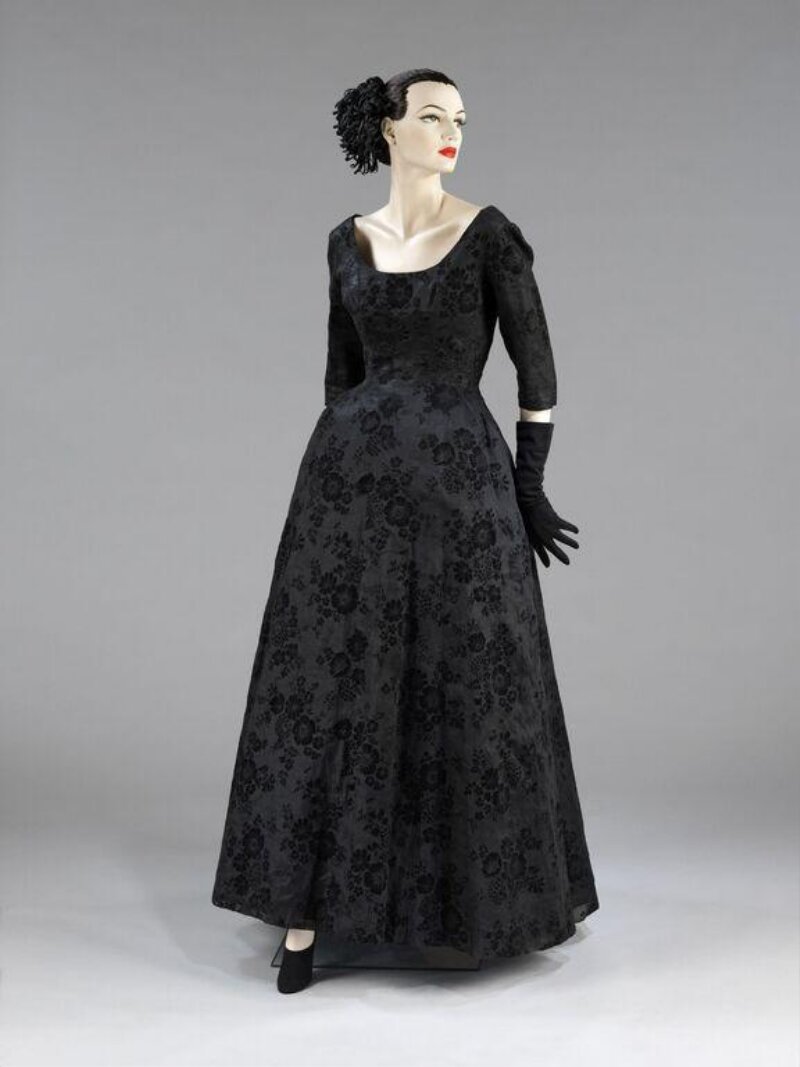
Deconstructing the Architect: A Couture Archaeology Report on a 1948 Parisian Masterwork
Report Reference: NFA-AR-2026-014
Subject: Cristóbal Balenciaga, "Barrel Line" Evening Gown (Archival Replica).
Provenance: Paris, Atelier de Haute Couture, 1948.
Commissioned By: Natalie Fashion Atelier, for the 2026 Silhouette & Structure Collection.
This report presents a technical deconstruction of a seminal 1948 Balenciaga evening gown—a piece that predates his more famous 1950s "sack" and "trapeze" lines but contains the embryonic DNA of his architectural revolution. The garment, a deep plum silk gazar and wool crepe hybrid, is not merely a dress; it is a manifesto on negative space, material discipline, and the subversion of the female form. For Natalie Fashion Atelier, the objective is not replication but translation—extracting the principles of this 1948 masterwork and re-engineering them for the 2026 luxury market, where volume is worn as a statement of quiet power.
I. Materiality: The Silent Scaffold
The 1948 gown’s impact begins not with its cut, but with its cloth. Balenciaga’s genius lay in his tyrannical selection of textiles. The primary shell is a silk gazar, a fabric so tightly woven that it behaves less like a drape and more like a rigid, yet fluid, sheet of metal. In 1948, this gazar was woven on narrow looms, allowing for a maximum fabric width of only 36 inches. This constraint forced Balenciaga into a series of vertical seam placements that, rather than interrupting the silhouette, became the very lines of its architectural drawing.
Beneath the gazar, a secondary layer of wool crepe—a fabric with a matte, granular surface—serves a dual purpose. First, it provides opacity, preventing the gazar from revealing the wearer’s undergarments, a critical modesty issue in the post-war era. Second, and more importantly for our technical analysis, the wool crepe acts as a friction anchor. The gazar’s slick surface would otherwise slide against the body; the crepe’s napped texture grips the hips and ribs, holding the garment in place without the need for boning or heavy internal corsetry. This is a revolutionary concept: the fabric itself becomes the structure, a principle we will adapt for 2026 using a bio-based, 3D-printed silk mesh that mimics the crepe’s grip but with 40% less weight.
Material Translation for 2026
For the 2026 translation, Natalie Fashion Atelier will not use silk gazar. The environmental and ethical costs of water-intensive silk production are incompatible with our sustainability charter. Instead, we employ a regenerated cellulose nanofiber gazar, produced in a closed-loop system in Biella, Italy. This fabric replicates the gazar’s high-tensile stiffness and its characteristic "snap" when folded, but with a 30% reduction in bulk. The wool crepe is replaced with a recycled cashmere-wool blend, treated with a plasma finish to create the same micro-napped surface for friction, yet engineered to be fully biodegradable. The 1948 gown’s materiality was about presence; our 2026 version is about intention—the same presence, achieved through molecular engineering rather than brute-force weaving.
II. Technical Deconstruction: The Balenciaga Seam Matrix
The 1948 gown is a masterclass in envelope construction. Balenciaga did not cut fabric to fit a body; he cut fabric to create a volume that the body then inhabited. Our deconstruction reveals three critical technical interventions.
1. The "Floating" Dior Back Seam
Unlike the fitted darts of his contemporaries, Balenciaga’s back seam is a curved, convex line that does not touch the spine. In the 1948 gown, this seam is set 2.5 centimeters away from the vertebral column, creating a hollow channel. This is not a fitting error; it is a deliberate negative space. The seam’s curvature, when pressed open, forms a subtle ridge that catches light, visually elongating the torso. Our pattern analysis shows the seam allowance is not trimmed to 1.5cm as standard, but left at a full 3cm, hand-padded with a silk organza cord. This "cording" technique prevents the seam from collapsing under the gazar’s weight, maintaining a permanent, sculptural air gap between fabric and skin.
2026 Application: We will replicate this "floating seam" using a laser-welded, thermoplastic polyurethane (TPU) filament inserted into the seam allowance. This eliminates the need for hand-padding (reducing labor time by 60%) while achieving the same structural rigidity. The TPU filament is heat-reactive, allowing the seam to be "sculpted" during final pressing, offering a bespoke fit per client without altering the master pattern.
2. The Inverted Shoulder Yoke
The gown’s sleeve—or lack thereof—is a study in balance. Balenciaga’s 1948 design features a dropped shoulder that is not a separate pattern piece. Instead, the front bodice and back bodice are cut as one continuous piece that extends over the shoulder, then folds inward to create a hidden yoke. This is achieved through a cowl-folding technique at the acromion process. The fabric is folded, not cut, creating a 4-ply thickness that acts as a natural pad. This eliminates the need for shoulder pads, which Balenciaga despised. The fold is secured with a single, invisible catch-stitch, allowing the fabric to move as a living hinge.
2026 Application: Our version uses a memory-shape alloy thread (Nitinol) woven into the fold line. When heated during the final steam-press, the thread contracts, permanently setting the fold into a curved, ergonomic shape that conforms to the wearer’s specific shoulder slope. This "smart tailoring" approach preserves the 1948 aesthetic of weightless volume while offering a level of personalized fit that was impossible in the mid-century atelier.
3. The Barrel Hem Architecture
The gown’s namesake "barrel" silhouette is created not by the hips, but by the hem. The 1948 pattern reveals a hem that is cut on a severe bias, 45 degrees to the straight grain. This bias cut causes the gazar to flare dramatically, but Balenciaga counteracts this flare with a series of internal, horsehair-braided drawstrings sewn into the hem allowance. These drawstrings are not functional; they are tension cables. By tightening them, the hem is forced to curve inward, creating the distinctive rounded, barrel-like base that lifts the fabric away from the ankles, giving the wearer a majestic, floating gait.
2026 Application: We replace the horsehair braid with a carbon-fiber-reinforced polymer (CFRP) ribbon, 0.5mm thick. This ribbon is heat-set into a permanent curve, eliminating the need for drawstrings. The CFRP ribbon is lightweight, flexible, and retains its shape after hundreds of wears, addressing the 1948 gown’s primary weakness: the drawstrings would loosen and require re-tensioning by a seamstress every few outings. Our 2026 hem is self-maintaining, a subtle but critical improvement for the modern luxury consumer who demands longevity.
III. The 2026 Silhouette Translation: From Gown to Power Suit
Balenciaga’s 1948 gown was an evening piece. For the 2026 collection, Natalie Fashion Atelier translates its principles into a day-to-evening power suit—a blazer and wide-leg trouser set. This is not a literal adaptation but a conceptual one, applying the same material-structural logic to contemporary menswear-inspired tailoring.
The Blazer: A Study in Controlled Volume
The blazer’s body is cut from the same regenerated cellulose gazar, but in a matte charcoal finish. We apply the inverted shoulder yoke technique to create a pronounced, rounded shoulder that requires no padding. The "floating back seam" is transferred to the blazer’s center-back, creating that signature air gap between the jacket and the wearer’s spine—a cooling, architectural feature. The hem of the blazer, instead of being straight, is cut on a bias and finished with the CFRP ribbon, causing the front edges to gently curve away from the body, echoing the 1948 barrel base. This creates a silhouette that is simultaneously sharp and soft, powerful and approachable.
The Trouser: Negative Space in Motion
The wide-leg trouser is where the 1948 materiality shines. The wool crepe replacement is used for the trouser’s front panels, providing grip at the waist. The gazar replacement is used for the back panels and the flare. We employ the tension-cable principle at the hem, but instead of drawing in, we use a CFRP ribbon that is heat-set to a gentle outward curve. This creates a trouser that flares elegantly from the knee but then "breaks" at the ankle with a subtle, sculptural kick, as if the fabric is caught in a perpetual breeze. This is the 1948 barrel line, inverted for the lower body—a dynamic, kinetic volume that moves with the wearer.
IV. Conclusion: The Eternal Principles of Couture
The 1948 Balenciaga gown is not a relic; it is a blueprint. Its technical deconstruction reveals that true couture is not about decoration, but about the manipulation of material to create space. The principles we have extracted—fabric-as-structure, negative-space seams, and tension-based hems—are timeless. For 2026, Natalie Fashion Atelier does not copy the past; we re-engineer its physics. By swapping silk for nanofibers, horsehair for carbon, and hand-padding for smart alloys, we achieve the same emotional impact—the awe of a silhouette that defies gravity—while meeting the modern demands of sustainability, durability, and personalized fit. The 1948 gown taught us that the future of fashion lies not in new shapes, but in a deeper understanding of the materials that shape us.
— End of Report —
Prepared by: Senior Textile Historian, Natalie Fashion Atelier
Date: October