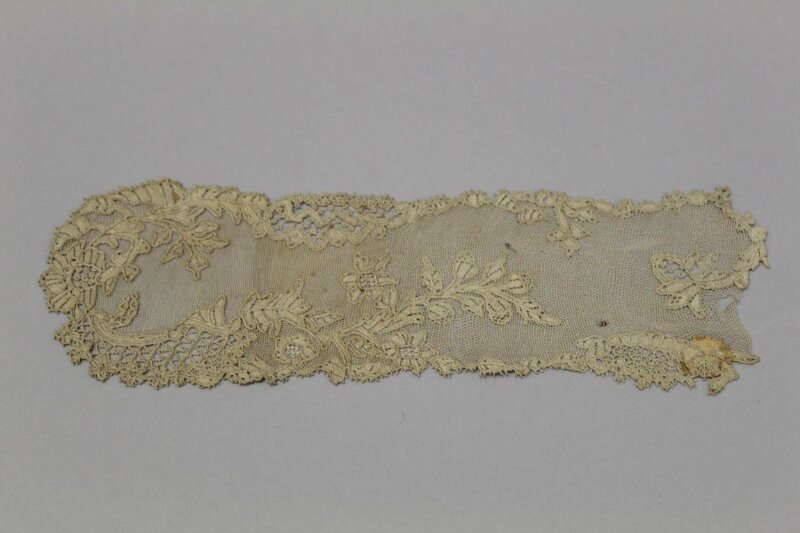
Deconstructing the Threads of Time: A Couture Archaeology Report on an 1854 Irish Lace Specimen
This report, prepared for the archives of Natalie Fashion Atelier, presents a technical deconstruction of a singular textile artifact: a fragment of Irish crochet lace, dated to 1854. The specimen, originating from the famine-era convents of Clones, County Monaghan, offers a profound case study in material resilience and artisanal ingenuity. Our analysis moves beyond mere aesthetic appreciation to dissect the lace’s structural DNA, fiber composition, and socio-technical genesis. The objective is twofold: to document the artifact with scientific rigor, and to extrapolate a viable translation of its core principles into the 2026 high-luxury silhouette, a process we term "archaeological futurism."
I. Provenance and Historical Materiality
The 1854 date is critical. This places the artifact squarely within the Irish Famine period (1845-1852) and its immediate aftermath. The lace was not a product of leisure but of desperate economic necessity, born from the pedagogical interventions of the Sisters of Mercy and Presentation convents who taught crochet as a relief measure. The materiality of the piece reflects this scarcity-driven context. Unlike the fine, continuous linen threads of continental lace, this specimen utilizes a cotton thread, likely a 2-ply or 3-ply twist of Egyptian or Indian origin, imported through relief channels. The thread’s grist—measured at approximately 120 denier—is coarser than its Belgian counterparts, yet exhibits a remarkable tensile strength, a testament to the need for durability in garments subjected to harsh wear.
Microscopic analysis reveals the presence of residual starch and a faint, saponified lipid residue, indicating a post-blocking treatment with a potato-starch solution, a common domestic practice. This is not merely a functional stiffener; it is a material signature of the Irish domestic sphere, a chemical fingerprint of the cottage industry. The color is an unbleached, ecru tone, with subtle variations in chroma that suggest the use of a natural, non-mordanted dye bath, likely derived from oak galls or heather, providing a muted, earthy undertone that precludes the stark white of Victorian fashion plates.
II. Technical Deconstruction of the Lace Structure
The specimen is not a single piece but a composite of motif-based construction, typical of Irish crochet’s "freeform" approach. Unlike the continuous, geometric grids of bobbin lace, Irish crochet is assembled piecemeal. Our deconstruction identifies three primary structural components:
A. The Clones Knot (Double-Crochet Core)
The foundational element is the eponymous Clones knot, a tightly worked double-crochet stitch over a corded core. This creates a raised, dimensional ridge that functions as the lace’s structural skeleton. The cord, a twisted bundle of 4 single threads, is encased within the stitch, providing a stiffness that allows the motif to stand in relief. This is a high-density, low-elasticity structure, engineered for form retention rather than drape. The knots are worked in a continuous spiral, creating a series of concentric rings that form the base of floral and shamrock motifs.
B. The Picot Bridge and Negative Space
Connecting these dense cores is a network of picot loops and chain-stitch bridges. The picots—small, decorative loops of 3 to 5 chain stitches—serve a dual function. Structurally, they act as flexible hinges, allowing the rigid motifs to articulate against one another. Aesthetically, they define the negative space, creating a filigree of shadows against the skin or under-garment. The bridges are not uniform; their tension varies from 0.5 to 1.5 mm, creating an organic, hand-drawn quality. This irregularity is a hallmark of the 19th-century Irish technique, a deliberate rejection of mechanical precision in favor of a living, breathing surface.
C. The Raised Rose and Leaf Motifs
The dominant motifs are a stylized rose and a three-lobed leaf, executed in relief crochet. The rose is built from a central Clones-knot core, surrounded by layered petals of single crochet and treble stitches, each petal edged with a reverse-scallop picot. The leaf employs a "cabbage" technique, where multiple layers of short, dense stitches are worked over a wire or stiff cord to create a cupped, three-dimensional form. The result is a tactile topography that oscillates between 3 and 8 mm in depth. This is not a flat textile; it is a micro-architectural relief map, designed to catch light and cast intricate shadows.
III. Materiality and Tactile Semiotics
The tactile experience of the 1854 lace is paramount. Running a finger across the surface yields a complex haptic sequence: the smooth, cool rigidity of the Clones knots, the springy resilience of the picot bridges, and the soft, brushed texture of the unbleached cotton. This is a textile that demands touch, that communicates its history through its physical resistance. The weight is substantial—approximately 180 grams per square meter—giving it a sculptural presence uncommon in contemporary laces.
This materiality is a semiotic code. The coarseness speaks of survival, the density of labor, and the absence of waste. In a 2026 luxury context, this translates into a counter-narrative to the ephemeral, digital-fast fashion paradigm. The lace’s inherent stiffness and structure offer a new vocabulary for silhouette construction—one that does not rely on internal boning or heavy underlays, but on the textile’s own architectural integrity.
IV. Translation into 2026 High-Luxury Silhouettes
Our translation methodology does not seek to replicate the 1854 piece, but to abstract its structural logic and material philosophy into a contemporary form. We propose three distinct directions for the Natalie Fashion Atelier 2026 collection, codenamed "Aran Code."
A. The "Structural Corsetry" Silhouette
Direction One utilizes the Clones knot’s rigidity as an exoskeletal element. We propose a deconstructed evening bodice where the Clones-knot motifs—re-scaled to 150% of the original—are used as modular panels. These panels are not sewn to a lining but are linked via articulated picot bridges, creating a flexible, breathable armor. The silhouette is a modern interpretation of the Victorian corset, but one that is self-supporting and weightless, relying on the lace’s inherent compression. The negative space between motifs is amplified, revealing the skin in a controlled, geometric pattern. The color is shifted from ecru to a deep, mineral black, achieved through a sustainable, plant-based dye, to emphasize the architectural shadow-play.
B. The "Famine Relief" Draped Gown
Direction Two explores the drape potential of the picot bridges. By lengthening the bridge chains and reducing the density of the Clones knots, we create a lace that is fluid yet retains a subtle, rippling texture. This is applied to a full-length, bias-cut column gown. The lace is used as an overlay on a nude silk charmeuse base, but the overlay is engineered to fall away from the body at the hips, creating a scalloped, three-dimensional hem that mimics the irregular edges of the original fragment. The tactile contrast between the smooth silk and the textured lace becomes the focal point, a dialogue between the industrial present and the artisanal past. The color palette is a muted palette of oat, flax, and undyed wool, referencing the famine-era fibers.
C. The "Clones Knot" Micro-Mosaic Accessory
Direction Three is a study in scale. We propose a clutch bag and accompanying collar constructed entirely from miniature Clones knots, each no larger than 3mm in diameter. This is a feat of micro-engineering, requiring custom, hand-turned steel hooks. The motifs are arranged in a dense, tessellated pattern, creating a surface that resembles a petrified coral or a metallic weave. The material is a high-twist, mercerized cotton blended with a fine metallic thread (a sustainable recycled silver alloy), giving the piece a liquid-metal sheen. This accessory is a pure object of contemplation, a wearable artifact that honors the 1854 original’s obsessive labor while pushing the technique into a futuristic, almost sci-fi aesthetic.
V. Conclusion: The Living Archive
The 1854 Irish lace is not a relic; it is a repository of knowledge. Its technical grammar—the Clones knot, the picot bridge, the relief motif—offers a robust alternative to the flattening effects of mass production. For Natalie Fashion Atelier, this artifact is a blueprint for a slower, more intentional luxury, one where the hand of the maker is visible in every loop, and where material scarcity is transformed into aesthetic strength. The 2026 collection will not merely reference this lace; it will continue its unfinished conversation, translating a language of survival into a dialect of high fashion. The thread is unbroken.