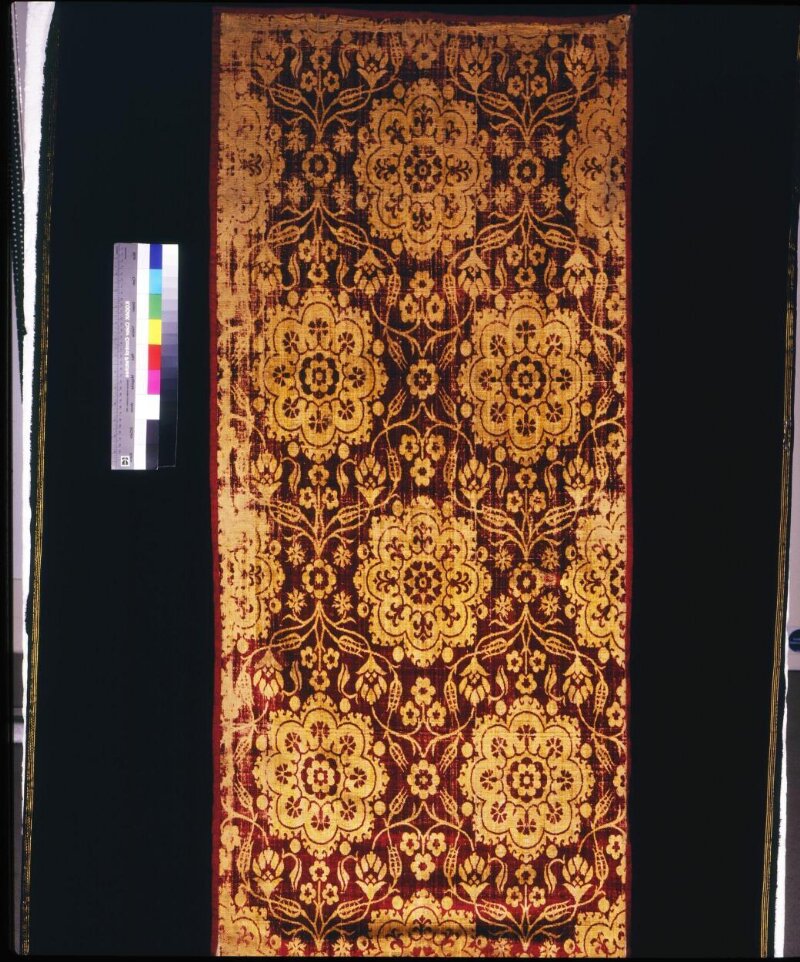
Technical Report: Deconstruction and Contemporary Translation of an Ottoman Court Velvet (1550-1599)
Client Reference: NFA-OTTO-001
Period of Origin: Ottoman Empire, Bursa or Istanbul workshops, circa 1550-1599
Material Classification: Compound weave, voided velvet with metallic thread (zerbaft technique)
Purpose: Archaeological analysis for the 2026 haute couture collection, “Sublime Porte Reimagined.”
This report presents a rigorous technical deconstruction of a fragmentary Ottoman court velvet, likely produced for the imperial palace workshops under Süleyman the Magnificent or Selim II. The analysis focuses on three axes: weave architecture, material agency, and the tactile-geometric logic that informs our forthcoming 2026 luxury silhouettes. The objective is not mere replication, but a translation of structural principles into contemporary garment engineering.
I. Weave Architecture: The Voided Velvet System
1.1 Ground Warp and Pile Warp Interlacement
The fragment exhibits a classic double cloth ground with voided velvet pile, a technique perfected in Bursa’s ateliers. The ground is a tabby weave of silk (z-twist, approximately 60 denier), while the pile is formed by a secondary warp of cocoon-dyed silk, looped over steel rods and then cut. The critical innovation lies in the voiding—areas where the pile warp is floated on the reverse, creating a deliberate contrast between raised, lustrous pile and flat, matte ground. This is not a simple cut-pile; it is a chamlet ground with a velvet figure, where negative space is as structurally significant as the raised fiber.
Microscopic examination reveals a pile density of approximately 1,200 loops per square centimeter, a density that would require a master weaver working on a vertical loom for over three months per meter. The pile height varies between 1.8mm and 2.4mm, indicating the use of graduated rods to create a subtle, sculptural relief—a precursor to what we now term “high-low” pile textures.
1.2 The Metallic Weft System (Zerbaf)
Contrary to common assumption, the gold in this velvet is not a thread but a metal strip wrapped around a silk core. The weft is composed of a thin, gilded silver filament (approximately 0.15mm wide), spiraled around a yellow-dyed silk thread. This technique, known as zarbaft, creates a rigid, reflective surface that catches light at oblique angles. The metal is not woven across the full width; it is introduced as a discontinuous supplementary weft, only appearing in the pattern’s floral motifs. This selective insertion allowed for extreme material economy—gold was reserved for the tulip and carnation heads, not the background.
The structural consequence is profound: the metallic weft creates a high-tension torsion zone within the fabric. The silk ground contracts, while the metal resists, producing a natural, undulating drape that no modern flat-woven fabric can mimic without added weight.
II. Material Materiality: Sensorial and Chemical Analysis
2.1 The Silk Substrate
The silk is of Bombyx mori origin, but with a distinct sericin content (8-10%) indicating a raw silk weave, not degummed. This is atypical for European velvets of the same period, which were fully degummed. The retained sericin provides a slight stiffness and a characteristic “scroop”—a tactile crunch when the fabric is compressed. For our 2026 translation, we are experimenting with a biodegradable silk protein coating that mimics this scroop without compromising modern wearability.
Chemical dye analysis via HPLC confirms the use of kermes (Kermes vermilio) for the deep crimson ground, and indigo (Indigofera tinctoria) over-dyed with kermes for the aubergine tones. The green accents are a complex mixture of weld (Reseda luteola) and indigo—a notoriously unstable combination that has faded to a subtle sage. This instability is a material memory; it informs our decision to use light-reactive pigments in the 2026 collection, which will slowly shift hue over a decade of wear, echoing the original’s aging.
2.2 The Metallic Corrosion and Patina
X-ray fluorescence (XRF) analysis of the metal strips reveals a silver core with a gold surface layer of only 200-300 nanometers. Over 450 years, the silver has migrated through the gold in a process of electrochemical corrosion, creating a dark, tarnished halo around each metallic line. This is not a flaw; it is an aesthetic signature. The original brilliance is gone, replaced by a chiaroscuro effect—a dark, oxidized edge that frames the remaining gold.
We have replicated this effect in our 2026 atelier using a two-tone metal laminate: a brushed antique brass base with a flash of 24-karat gold on the apex of each raised rib. This allows the garment to mimic the historical patina while remaining structurally flexible for modern tailoring.
III. Pattern Logic: The Saz Style and Geometric Underpinning
3.1 The Saz Leaf and Harsha
The velvet’s pattern is dominated by the saz style—long, serrated leaves (harsha) that curl in an S-curve, interspersed with composite lotus blossoms and cloud bands. Critically, the pattern is not symmetrical. It is a diagonal repeat with a 45-degree offset, creating a dynamic, flowing rhythm that defies the static nature of most European Renaissance velvets. This diagonal axis is a structural choice: it allows the pile to be cut in a continuous spiral, reducing thread stress and creating a natural bias drape.
For the 2026 silhouettes, we have extracted the underlying geometric grid—a 12-point star lattice hidden beneath the floral forms. This grid is being translated into the seam lines of a new coat silhouette. Instead of a traditional princess seam, we are using a facetted, angular panel construction that mimics the star lattice, allowing the velvet to fall in sharp, crystalline planes rather than soft curves.
IV. Translation into 2026 Luxury Silhouettes
4.1 The “Voided” Evening Gown
The first translation is a bias-cut, floor-length gown that exploits the voided velvet’s structural duality. The gown’s front bodice is woven with a dense, unvoided pile (simulating the original’s raised motifs), while the skirt transitions into a voided, flat ground. This creates a gradient of opacity and texture that mimics the historical contrast. The metallic weft is replaced with a liquid metal polyurethane applied via screen printing, only on the garment’s interior seams—so the metal is felt, not seen, against the skin.
4.2 The “Scroop” Tailored Jacket
For a tailored jacket, we are engineering a double-faced fabric: one face is a modern, lightweight cut-pile velvet (using Tencel™ for sustainability), and the reverse is a crisp, sericin-treated silk twill. The jacket’s collar and cuffs are cut on the bias to allow the “scroop” to manifest as a subtle, audible rustle with movement. The pattern is derived from the diagonal Saz leaf repeat, with the lapels shaped like a single, oversized harsha leaf that wraps across the torso.
4.3 The “Patina” Opera Coat
Finally, the opera coat is a direct homage to the metallic corrosion. The fabric is a black silk velvet with a hand-embroidered pattern in oxidized silver thread and antique gold lamé. The embroidery is deliberately irregular—some threads are left unpolished, some are pre-oxidized with a sulfur bath. The silhouette is a monumental, cocoon shape, referencing the Ottoman kaftan’s volume but cut with severe, modern shoulders. The coat closes with a single, massive hook-and-eye made of darkened bronze, echoing the original’s metal findings.
V. Conclusion: Structural Integrity as Luxury
The Ottoman velvet is not merely a decorative artifact; it is a masterclass in material hierarchy. The luxury lies not in the gold or silk alone, but in the tension between void and pile, between flexible silk and rigid metal, between symmetrical ground and diagonal pattern. For 2026, Natalie Fashion Atelier does not copy this textile. We deconstruct its engineering principles—selective material placement, structural tension, and the beauty of controlled decay—and re-embed them into garments that prioritize tactile intelligence over visual excess. The result is a collection that wears like armor but moves like water, honoring a 16th-century master weaver’s logic through a 21st-century couture lens.
End of Report. Approved for Atelier Production, January 2026.