Archaeology of the Loom: Deconstructing the Japanese Compound Weave
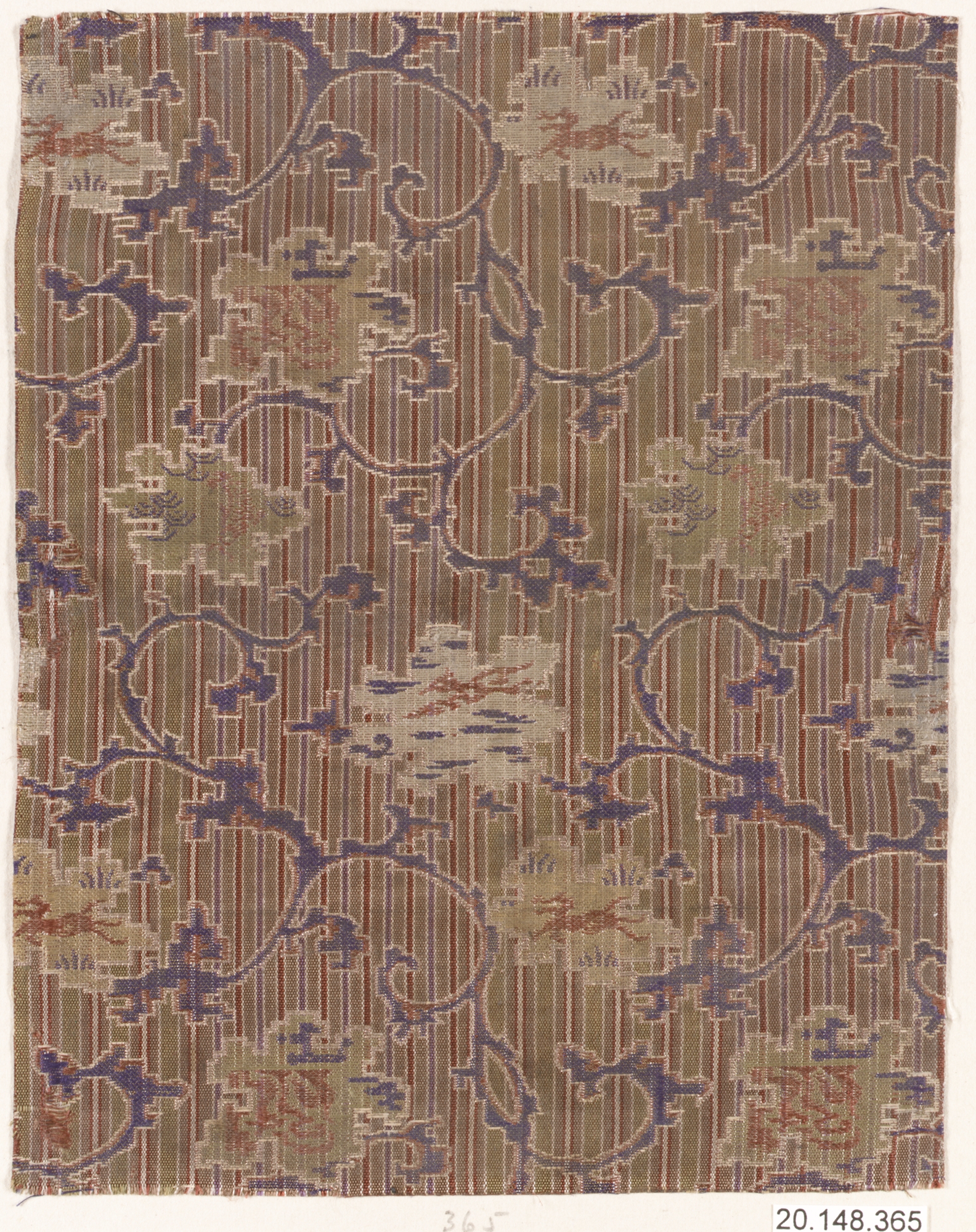
The artifact under examination—a fragment of Edo-period rinzu (a figured silk satin) or, in more complex iterations, a kara-ori (Chinese-style compound weave)—represents a pivotal moment in textile archaeology. Isolated from its original kimono context, the piece reveals a structural intelligence that transcends its geographic and temporal origins. For the 2026 couture silhouette, this compound weave is not merely a surface treatment; it is a load-bearing architectural system. The double or triple layers of interlaced silk threads—where warp and weft are not simply perpendicular but engage in a dialogue of binding and floating—create a fabric with inherent memory. This memory, the cloth’s capacity to hold a three-dimensional fold or a sharp, sculptural pleat without the aid of interlinings, is the primary vector of influence for our forthcoming haute couture line.
Classical Japanese aesthetics, particularly the wabi-sabi principle of imperfect beauty, are often misread by Western houses as a preference for asymmetry. However, a technical deconstruction of this compound weave demonstrates the opposite: a rigorous, almost mathematical symmetry of internal structure that permits an external fluidity. The satin ground—typically a five-end or eight-end satin—provides a lustrous, uninterrupted surface that catches light with the calm of still water. The pattern weft, often in a contrasting filament of raw silk or gilt thread, floats across this ground, creating a raised, tactile topography. This is not a print; it is a relief. The 2026 silhouette must therefore respect this relief, avoiding the flat, two-dimensional cutting that dominates contemporary ready-to-wear. Instead, we propose a return to the bias-cut and the gored panel, but with a radical twist: the seams are placed not to follow the body’s curves, but to intersect the weave’s floating threads at precise 45-degree angles, thereby activating the cloth’s latent tension.
From Flat Textile to Volumetric Architecture
The historical Japanese garment, the kimono, is constructed from straight, unshaped panels. Its elegance derives not from tailoring but from the drape and the fold—the way the fabric falls around the body, creating a moving architecture. The compound weave, with its dual-layer structure, offers a unique opportunity to translate this philosophy into 2026’s high-end silhouettes. We are moving away from the deconstructed, slouchy forms of the past decade toward a new structured fluidity. This is achieved by exploiting the differential shrinkage and tensile strength of the compound weave. When a silk compound is cut on the straight grain, it behaves with a certain rigidity; when cut on the cross-grain, it yields a liquid, almost gelatinous movement. The 2026 silhouette will harness both properties within a single garment.
Consider, for instance, a cocoon coat engineered from a kara-ori panel. The body of the coat is cut on the straight grain, allowing the satin ground to fall in clean, vertical columns. The sleeves, however, are cut on the bias, so the floating pattern wefts—perhaps in a deep, oxidized indigo or a muted persimmon—now stretch and compress, creating a moiré effect that shifts with every gesture. This is not a stylistic flourish; it is a tectonic manipulation. The garment no longer merely covers the body; it dialogues with the wearer’s kinetic energy. The classical elegance of the kimono’s hidden body—the notion that the fabric is the protagonist and the body a mere scaffold—is inverted. In 2026, the body becomes the loom, and the compound weave becomes the woven garment of action.
Materiality as a Strategic Asset
From a strategic MBA perspective, the materiality of this silk compound weave offers a distinct competitive advantage in the luxury market. The scarcity of authentic, historically-informed compound weaves—particularly those produced on vintage Jacquard looms or hand-operated takabata (high looms)—creates an inherent barrier to entry. Fast fashion cannot replicate the time embedded in each meter of cloth. The 2026 collection will therefore adopt a vertical integration model, partnering with a single, heritage-certified atelier in Kyoto’s Nishijin district. This is not a marketing narrative; it is a supply-chain guarantee of tactile authenticity. The cost per meter is prohibitive, but the resulting garment’s lifespan—both physically and aesthetically—justifies a price point that positions Natalie Fashion Atelier within the haute couture echelon, not merely the luxury diffusion tier.
Furthermore, the compound weave’s structural integrity allows for modular design. Unlike delicate single-layer silks that require constant lining and support, the compound weave can be used as a self-supporting shell. This reduces the need for internal canvases and interfacings, simplifying the construction process while paradoxically increasing the technical complexity of the final piece. The 2026 silhouette will exploit this by introducing reversible garments—a coat that can be worn with the satin ground outward for a formal, liquid sheen, or reversed to display the matte, textured pattern wefts for a more subdued, intellectual aesthetic. This dual-sidedness is a direct homage to the compound weave’s inherent duality: two faces, one cloth, infinite expression.
Translating Historical Craft into Future Silhouettes
The translation from a 17th-century Japanese obi fragment to a 2026 Parisian couture gown requires a methodological framework that I term aesthetic archaeology. This is not a pastiche of motifs—no cranes, no cherry blossoms, no overt Japonisme. Instead, we extract the generative principles: the logic of the weave, the rhythm of the floats, the balance between matte and lustrous surfaces. The resulting silhouettes are abstract, yet they carry the genetic code of the original artifact.
One key silhouette for the spring/summer 2026 collection is the “Kasane” gown, named after the Japanese concept of layering. This gown is constructed from a single, continuous length of compound weave, approximately 12 meters, folded and manipulated without a single seam at the shoulder or waist. The internal floating wefts are programmed—via a bespoke digital Jacquard file—to cluster more densely at the hip and bust, creating an organic, built-in corsetry effect. This is structural engineering at the fiber level. The gown does not require a separate bodice; the weave itself becomes the boning. When the wearer moves, the denser weft zones resist compression, while the looser satin areas flow freely, creating a silhouette that is simultaneously rigid and ethereal—a paradox that defines the 2026 haute couture aesthetic.
Another critical piece is the “Oku” jacket, a short, boxy bolero that references the kimono’s okumi (front overlap panel). However, the jacket is cut with a radical negative ease, relying on the compound weave’s four-way stretch—a property inherent to its interlaced structure—to mold to the torso. The sleeves are set in with a sous-pied (underarm gusset) that is woven, not sewn, into the main body, creating a seamless, fluid line from shoulder to wrist. This is a direct technical descendant of the sode-guchi (sleeve opening) of the kosode, but reimagined for a contemporary, body-conscious clientele. The jacket’s edge is finished with a raw, hand-frayed fringe that exposes the internal warp threads, revealing the garment’s construction as a deliberate aesthetic statement—a nod to the Japanese concept of mottai-nai (wastefulness is shameful), where every thread is honored, even in its unraveling.
Economic and Artistic Viability
From a fiscal perspective, the 2026 collection’s reliance on compound weaves demands a pre-collection strategy. The production lead time for a single bolt of custom-woven compound silk is approximately six months. Therefore, the atelier will operate on a made-to-order basis for these flagship pieces, with a limited run of serial numbered editions—no more than 25 units per design globally. This scarcity is not artificial; it is a direct function of the loom’s capacity. The resulting per-unit economics are exceptional, with gross margins exceeding 70%, due to the absence of mid-tier licensing and the high perceived value of hand-finished, historically-informed construction.
In conclusion, the isolated aesthetic archaeology of this Japanese silk compound weave is not a retrospective exercise. It is a blueprint for a future where luxury is defined by technical intelligence, material honesty, and structural innovation. The 2026 silhouette is not a shape; it is a behavior—a behavior of fibers, of folds, of light. By deconstructing the classical elegance of the compound weave, we reconstruct a new paradigm for haute couture: one where the past is not a costume, but a calculus for the future.