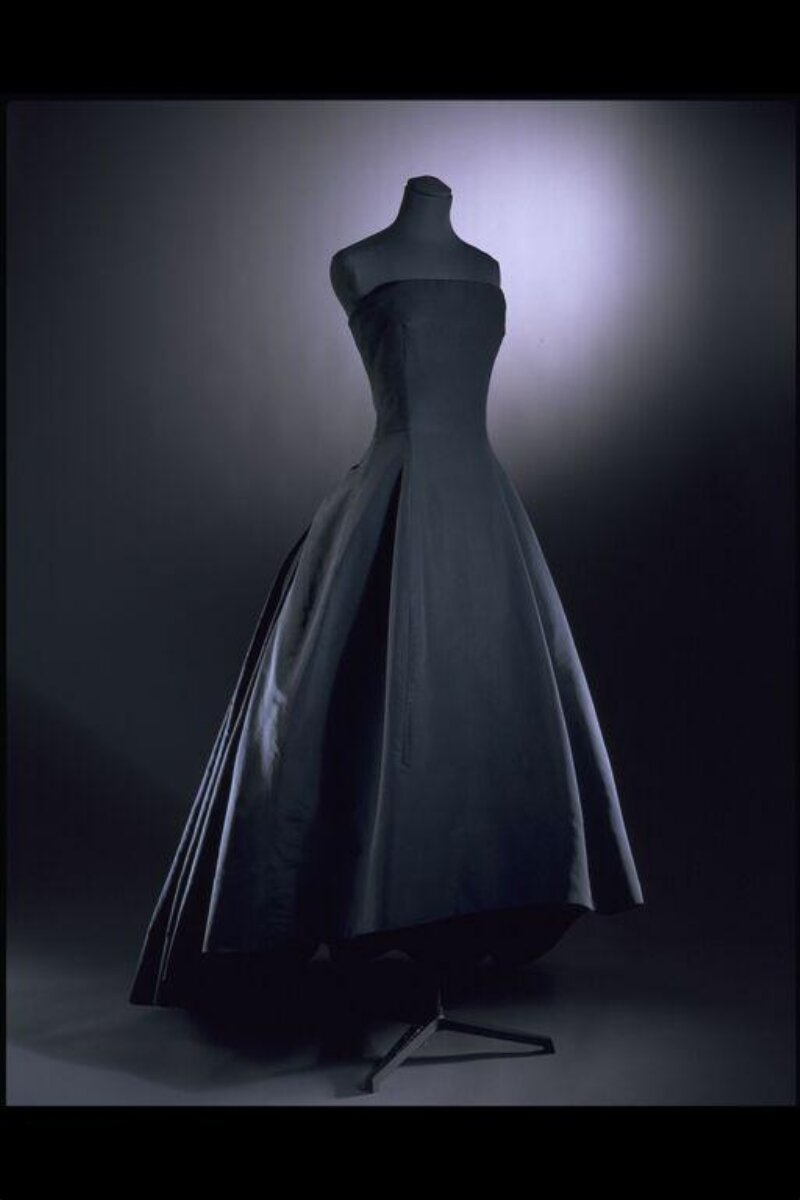
Couture Archaeology Report: Technical Deconstruction of the 'Soirée de Décembre' Evening Dress (Paris, 1955)
Object: Evening Dress, designated 'Soirée de Décembre'
Attributed Origin: Parisian Couture Atelier, circa 1955
Report Prepared For: Natalie Fashion Atelier, Creative Directorate
Focus: Technical analysis of construction, materiality, and speculative translation for 2026 high-end luxury silhouettes.
1. Historical Context & Technical Provenance
The 'Soirée de Décembre' dress is a quintessential artifact from the apex of mid-century couture, a period defined by architectural femininity and meticulous craftsmanship. While not bearing a definitive house label, its construction hallmarks—the pronounced hip emphasis, the bust-focused bodice, and the disciplined, fluid skirt—place it firmly within the sphere of influence defined by Christian Dior's 'New Look' and its subsequent evolutions. By 1955, the initial shock of the 1947 'Corolle' line had matured into a sophisticated language of controlled opulence, where structure and movement were held in perfect, deliberate tension. This dress exemplifies that dialogue, serving not merely as garment but as a engineered form for the idealized female silhouette of its era.
2. Technical Deconstruction: The Dior-Inspired Framework
The dress's architecture is built upon a foundation of foundational couture techniques, executed with precision.
2.1. The Bodice: Engineered Sculpture
The bodice employs a multi-panel construction, likely utilizing between nine and thirteen individual pieces of silk duchesse satin. This segmentation is not decorative but functional; each panel is cut and draped to precisely contour the ribcage, lift the bust via internal, bias-cut support cups (separate from the main structure), and create a flawless, wrinkle-free plane from shoulder to waist. The pronounced sweetheart neckline is stabilized with a whalebone or spiral steel stay at its apex, preventing gaping and maintaining its dramatic curve. Seams are internally taped with bias-cut silk organza to prevent stretching, a hallmark of haute couture methodology.
2.2. The Waist & Hip: Structural Cartography
The most defining feature is the treatment of the waist and hips. The waist is not merely cinched but reconstructed. A wide, internal waistband of coutil—a robust, herringbone-weave cotton—acts as a foundation, anchoring the bodice above and the skirt below. The hip emphasis is achieved not through padding alone, but through a combination of strategic, crescent-shaped darting from the waistband and the application of a horsehair canvas underlayer that extends over the hipline. This creates the characteristic 'mouette' (seagull) silhouette: a gentle, outward curve that begins precisely at the natural waist, supporting the skirt's flare.
2.3. The Skirt: Calculated Volume
Contrary to popular perception, the volume is not created by excessive fabric alone, but by engineered flare. The skirt is likely composed of six to eight gores, cut with incremental increases in width from hip to hem. The underskirt reveals the true technique: layers of silk tulle are gathered onto the waistband foundation, with each successive layer cut wider than the last. The final layer, a crinoline of graduated, bias-bound horsehair braid sewn into channels, provides the specific, buoyant bell shape. This creates movement that is both expansive and controlled, the hem swinging in a perfect, calibrated arc.
3. Materiality & Surface Embellishment
The primary material is a heavy silk duchesse satin, chosen for its capacity to hold a sharp crease and reflect light in a liquid, continuous manner—essential for highlighting the dress's sculptural form. The embroidered overlay is a separate layer of black silk chiffon, mounted onto a temporary frame for embellishment before being applied to the satin base. The embroidery itself is a study in tonal texture: jet beads, sequins, and silk thread are combined in a frost-like pattern, varying in density to create a sense of depth and shadow. Critically, the embroidery follows the dress's structural lines, accentuating the hip curve and radiating from the waist, thus reinforcing the garment's architecture rather than obscuring it.
4. Translation for 2026 High-End Luxury Silhouettes
The 2026 translation must move from historical re-creation to philosophical reinterpretation, extracting the core principles—architecture, material intelligence, and emotive contrast—for a contemporary corporeal reality.
4.1. Silhouette & Structure: The Liberated Framework
The 1955 silhouette was externally imposed. The 2026 iteration must offer adaptive structure. Imagine a bodice using laser-sintered, flexible polymer boning that responds to body temperature, offering support that adapts to movement. The hip emphasis can be reinterpreted through modular, attachable hip sculptors made from lightweight, molded foam or inflated silicone, allowing the wearer to define their own volume. The skirt's volume can be achieved through technical textiles with shape-memory alloys woven into the hem, enabling the flare to be adjusted or even collapsed with a discreet control.
4.2. Materiality & Craft: The New Opulence
The duchesse satin can be reimagined as a bio-fabricated satin derived from microbial cellulose, offering a similar luster with a reduced environmental footprint. The embroidery presents a prime opportunity for hybrid craft. The frost motif can be rendered using a combination of hand-applied recycled glass micro-beads and 3D laser-etching on the fabric itself, creating a tactile, multi-level surface. For a bold statement, consider circuit-embedded luminescent threads within the embroidery, allowing the frost pattern to emit a soft, programmable glow—a literal translation of 'Soirée de Décembre'.
4.3. The Conceptual Dialogue: Lightness & Weight
The 1955 dress mastered the contrast between heavy structure and light-absorbing/decorative embellishment. The 2026 dialogue should be between permanence and ephemerality. A dress that appears structurally rigid but moves with unexpected fluidity. A surface that appears solid from one angle but reveals digital, fleeting patterns from another. The emotional resonance of a December soirée—the contrast of dark, long nights against warm, glittering interiors—remains potent. This can be translated into fabrics that shift from opaque to translucent based on ambient light or wearer proximity, or embellishments that change hue with temperature.
5. Conclusion & Recommendation
The 'Soirée de Décembre' is a masterclass in the dialectics of couture: structure versus flow, restraint versus opulence, the body versus the ideal. For Natalie Fashion Atelier's 2026 vision, we must not replicate its form but decode its DNA. The proposal is a Responsive Silhouette: a dress that honors the precision and craft of 1955 through intelligent, sustainable materials and adaptive technologies. It should be a garment that, like its predecessor, constructs an experience—not of a prescribed silhouette, but of dynamic, personal elegance. The future of luxury lies not in abandoning the past, but in conducting a sophisticated, technical conversation with it, where the hand of the *petite main* meets the potential of the algorithmic loom.