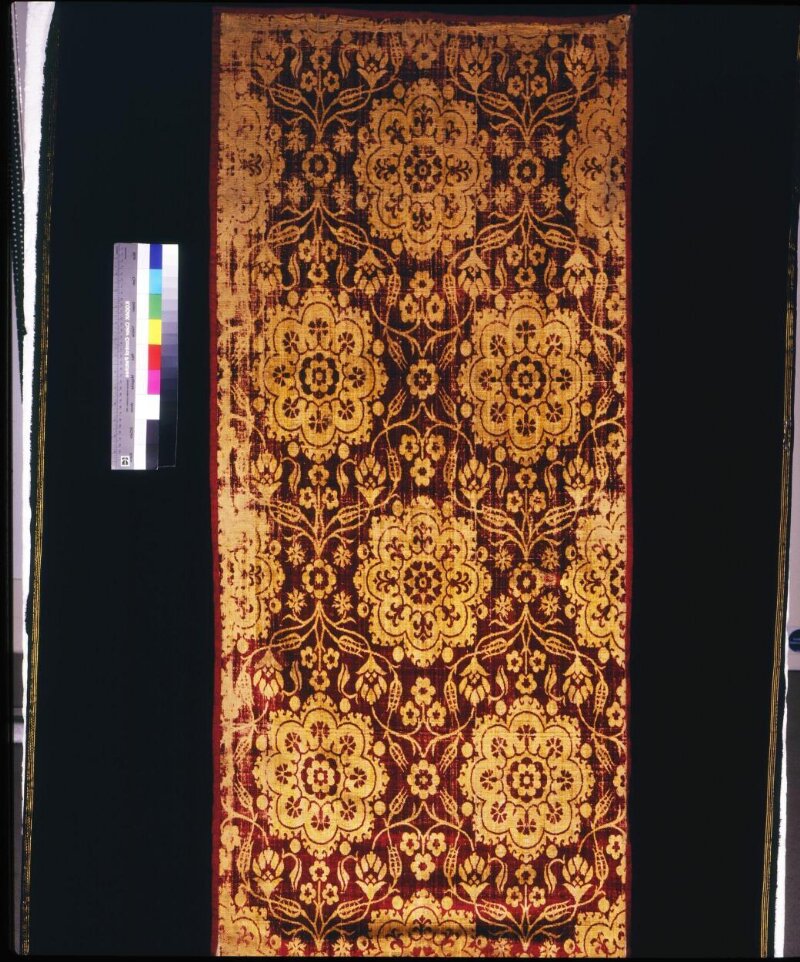
Couture Archaeology Report: Ottoman Velvet, 1550-1599
Subject: Technical Deconstruction of Ottoman Court Velvet
Origin: Imperial Workshops (Nakkaşhane), Bursa and Istanbul, Ottoman Empire
Era: 1550-1599 (High Renaissance Period, Reign of Suleiman the Magnificent and Selim II)
Report Prepared For: Natalie Fashion Atelier
Objective: Material and technical analysis to inform the 2026 High-End Luxury Collection
I. Historical Context and Materiality
The velvet produced in the Ottoman Empire during the latter half of the 16th century represents the apex of pre-industrial textile luxury. Bursa, the empire's silk hub, and the imperial nakkaşhane (design ateliers) in Istanbul, operated under a vertically integrated system controlling quality from cocoon to finished cloth. The materiality of these velvets was defined by three core elements: Chinese raw silk for the warp and pile, prized for its unparalleled tensile strength and luminous sheen; silver and silver-gilt-wrapped threads (çift-i sim) for the ground weft, providing structural rigidity and a scintillating base; and madder root, indigo, and later cochineal for dyes, achieving a legendary depth of color—particularly the iconic "Turkish red" and profound sapphire blues.
The material hand-feel was one of substantial weight and dense plushness, with a pile height meticulously calibrated to both reflect light and resist crushing. This was not a passive fabric but an architectural textile, designed to articulate status through its physical presence and acoustic texture—the sound of movement was part of its performative luxury.
II. Technical Deconstruction: The Three-Dimensional Loom
Ottoman velvet was a compound weave, a complex structure built on a foundation of technical mastery.
A. The Pile Mechanism: Wires and Loops
The defining feature was the use of flat wire drawplates, not round rods. A supplementary pile warp was lifted over these thin metal strips inserted with each pick of the weft. Upon reaching the desired pile length (often consistent within a section), the wire was carefully withdrawn, leaving a series of precise, uncut loops. This technique created a resilient, textured surface. For cut velvet areas, a different wire with a grooved edge was used; withdrawing this wire would cut the loops, creating the signature plush, light-absorbing sections. The mastery lay in the simultaneous integration of cut and uncut pile within the same weave, creating patterns of contrasting luminosity and texture without appliqué.
B. Structural Weave and Metallic Ground
Beneath the pile, the foundation was a taffeta or satin weave. The true luxury was the integration of metal-wrapped threads as the ground weft. These were not merely decorative; they provided a rigid, stable base for the dense pile, preventing distortion. The metallic ground would glint through the strategically placed cut-velvet areas, creating a play of matte and shine, depth and surface. This resulted in a fabric with three distinct visual planes: the shimmering metallic ground, the deep shadow of cut velvet, and the textured highlight of uncut loops.
C. Pattern Execution: The Çatkı System
Large-scale, sophisticated patterns—saz style with serrated leaves, hatayî (stylized florals), and complex latticework—were achieved through a drawloom system with a çatkı (pattern harness) mechanism. This allowed for the meticulous control of thousands of warp threads, enabling repeat patterns of remarkable scale and fluidity. The design was not printed or embroidered but woven into the very architecture of the cloth, making it integral and inseparable from its structure.
III. Translation for 2026 High-End Luxury Silhouettes
The 2026 translation must move beyond pastiche, focusing on the core principles of structural integrity, multi-sensory engagement, and integrated pattern. The goal is not replication but re-interpretation through a contemporary technological lens.
A. Material Innovation
Replace traditional silk and metal thread with advanced alternatives that uphold the principle of multi-materiality. Propose: Bio-engineered spider silk for the pile, offering superior strength, a lighter weight, and an ethical provenance, achieving an even more luminous sheen. For the metallic ground, employ laser-etched, anodized titanium foil laminated onto silk organza. This provides the requisite rigidity and reflective quality while being featherlight and capable of achieving iridescent color shifts impossible with 16th-century metals. Dye technology will utilize structural color techniques and nano-pigments to achieve depths that change with the viewer's perspective, honoring the Ottoman love of chromatic intensity.
B. Silhouette and Construction
The weight and rigidity of the historical fabric naturally created architectural forms. For 2026, we invert this relationship. We will use the new, lighter material to create volume through construction, not cloth weight. Imagine:
• The Floating Cage Gown: A bias-cut column of bio-silk cut velvet (matte) is suspended within an exoskeleton of uncut velvet loops (textured) stretched over a minimalist titanium-threaded tulle. The dress exists in the space between these layers, a play on the three-plane structure.
• The Asymmetric Kaftan Coat: Reinterpreted as a lean, elongated silhouette. One side features a bold, woven saz pattern in dense cut velvet, while the other transitions to sheer, uncut pile netting, revealing the garment's construction and the body beneath.
• The Sculptural Bustier: Built using a technique derived from the wire-draw process, where thermo-formed polymer "wires" are integrated into the weave, then removed to leave permanent, garment-shaping cavities and tunnels.
C. Pattern Integration
Abandon the repeat. Utilize AI-assisted parametric design tools to generate unique, fluid patterns based on the hatayî motif that are specifically mapped and woven to flow over the contours of the 2026 silhouette. The pattern density will be algorithmically varied—dense at structural seams, dispersing into transparency at movement points—making the design dynamic and responsive to the individual form. This achieves the Ottoman ideal of an inseparable pattern-weave relationship, but with a modern, bespoke dimension.
IV. Conclusion
The Ottoman velvets of 1550-1599 were not merely decorative fabrics but engineered systems of light, structure, and symbolism. For the Natalie Fashion Atelier 2026 collection, the legacy lies not in reproducing the artifact, but in embracing its core tenets: the strategic dialogue between texture and light, the integrity of woven-in design, and the creation of a multi-sensory material presence. By deconstructing the historical technique and rebuilding it with tomorrow's materials—bio-silk, smart metals, algorithmic patterning—we create a new language of luxury. This translation honors the past by advancing its most ambitious principles, resulting in a collection that is both an archaeological homage and a definitive statement of 2026 avant-garde couture.