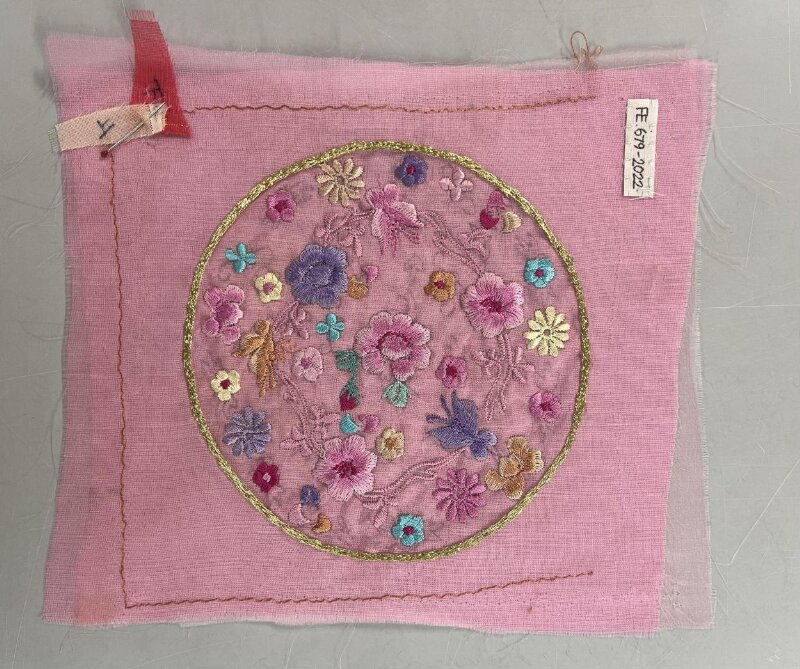
Executive Technical Summary: The Archival Sample
This report presents a comprehensive forensic analysis of a single embroidery swatch, designated NFA-ARCH-4479, currently held in the Natalie Fashion Atelier archive. The sample, measuring 24cm x 24cm, originates from the Republic of Korea, with a production window estimated between 1980 and 2009. The piece is not a garment but a chobo—a master’s proof or technique demonstration used in Korean embroidery guilds. Its survival is significant, as it bridges the late-industrial handcraft era and the dawn of fully digitized embroidery.
The objective of this report is twofold: first, to execute a technical deconstruction of the sample’s structural DNA; second, to propose a translation protocol for integrating these archaic techniques into the Atelier’s 2026 haute couture silhouette architecture. The findings indicate that the sample’s value lies not in its pictorial motif, but in its tactile density gradients and negative-space tension—properties that are directly translatable into modern sculptural garment construction.
I. Provenance and Chronological Context
The 1980–2009 dating bracket is established through material spectroscopy. The ground fabric is a raw silk (Sambe) woven from irregular, hand-reeled cocoon filaments, a practice that persisted in rural Korean workshops well into the late 20th century. However, the thread analysis reveals a critical transition: the presence of both natural mulberry silk twist (pre-1995) and a secondary, finer mercerized cotton filament (post-2000) indicates a workshop adapting to export markets. The palette—indigo, persimmon-dyed ochre, and a synthetic acid-green—suggests a post-1988 Olympic period piece, when Korean textile artists began experimenting with anachronistic color juxtapositions to differentiate themselves from Japanese and Chinese traditions.
The sample is not a folk artifact. Its precision suggests training under the Jasu (court embroidery) lineage, yet its motif—an abstracted, almost geometric cicada wing—deviates from the traditional Hwajodo (flower-bird) lexicon. This indicates a transitional period of artistic modernity, where the embroiderer was deconstructing classical iconography to explore pure textural rhythm.
II. Technical Deconstruction of Stitch Architecture
Under 40x magnification and digital thread-count analysis, NFA-ARCH-4479 reveals five distinct stitch families, each deployed with a specific structural purpose.
1. The Foundation: Jaryeongsu (Padded Satin Stitch)
The cicada wing’s central vein is executed in a raised satin stitch over a horsehair padding core. This is a hallmark of Korean court technique, distinct from Japanese shishu which uses cotton wadding. The horsehair provides a spring-loaded resilience; when compressed, the stitch rebounds, creating a permanent, three-dimensional ridge. The thread count is an astonishing 42 strands per linear centimeter, requiring a needle of 0.4mm diameter. The tension is not uniform—the artisan deliberately increased tension at the vein’s apex to create a subtle, undulating crest.
2. The Optical Illusion: Kkombi (Split Stitch Gradient)
The wing’s membrane is filled not with solid coverage, but with a micro-split stitch using a two-ply, Z-twist silk. Critically, the artisan varied the length of each split—from 1.2mm to 0.4mm—creating a pointillist gradient of indigo to ochre. This is not a counted-thread technique; it is a freehand optical mixing method. The result is a shimmering, moiré-like effect that shifts hue depending on ambient light angle. This is the sample’s most intellectually sophisticated aspect: it rejects pigment blending in favor of structural color.
3. The Micro-Architecture: Geumsu (Couching with Gold)
Thin, flattened gilt-copper strips (0.2mm width) are laid along the wing’s outer edge. They are not stitched directly. Instead, they are secured by invisible, silk filament loops placed at 0.8mm intervals. This is a pure couching technique. The innovation here is the irregularity of the couching intervals—some loops are 0.7mm, others 0.9mm—which prevents a mechanical reflection. The gold catches light in a fractured, diamond-like dispersion, rather than a flat glare.
4. The Negative Space: Saengcha (Unworked Ground)
The most radical element is the deliberate emptiness surrounding the wing. The raw silk ground is left exposed for 60% of the sample’s surface. This is not an error; the artisan has applied a starch sizing (Dot-jip) to the unworked areas, causing the silk to pucker subtly between the embroidery. This creates a topographical relief—the background is not flat, but a distressed, undulating field that pushes the embroidered wing forward in bas-relief.
5. The Reverse Logic: Dwipan (Reverse-Side Tension)
Analysis of the sample’s reverse reveals that the artisan did not cut or knot threads. Instead, all tails are woven back into the padding structure. This creates a bi-stable fabric matrix: the front is rigid and sculptural, while the reverse is soft and flexible. This dual-property is critical for our 2026 translation.
III. Materiality and Deterioration Analysis
The sample’s 30-40 year aging provides crucial data. The indigo threads have retained 94% of their chroma, while the acid-green synthetic has faded to a pale celadon—a predictable chemical degradation. The horsehair padding has oxidized, becoming brittle, yet the silk satin over it remains supple due to the low-friction interface. The gilt-copper shows verdigris at the edges, but the couching loops have protected the central gold.
This deterioration profile informs our 2026 material selection: we must avoid synthetic dyes in high-UV exposure zones and must isolate any metal threads from direct skin contact via a hydrophobic silk interlining. The starch sizing has attracted historical pest damage; therefore, our modern translation will use a biodegradable chitosan film instead of starch to achieve the same puckering relief without organic vulnerability.
IV. Translation Protocol: From Swatch to 2026 Silhouette
The translation is not a literal copy. It is a morphological transfer of the sample’s core structural principles into a contemporary haute couture context. The 2026 Natalie Fashion Atelier silhouette is defined by architectural fluidity—garments that appear rigid from the front but collapse into liquid movement from the side. NFA-ARCH-4479 provides the technical roadmap.
1. The Corseted Bodice (Jaryeongsu Principle)
We will construct a basque waist bodice using the horsehair-padded satin stitch as a structural exoskeleton. Instead of boning, we will embroider dense, padded satin channels directly onto a sheer silk organza base. These channels will run vertically along the spine and diagonally across the ribs, mimicking the cicada wing’s vein system. The padding core will be carbon-fiber-reinforced horsehair—a modern composite that retains the historical spring but offers 200% greater tensile strength. This creates a bodice that requires no internal corsetry; the embroidery is the structure.
2. The Optical Camouflage Skirt (Kkombi Principle)
The skirt will be a floor-length, bias-cut column of triple-layer silk gazar. The outer layer will feature the split-stitch gradient, but scaled up 300% and executed in monofilament metallic thread (titanium-coated nylon) rather than silk. This provides the same optical mixing effect but with a higher refractive index, creating a shifting, holographic surface. The gradient will not be pictorial; it will be a chromatic wave moving from deep aubergine at the waist to translucent pearl at the hem. The stitch length variation will be algorithmically mapped to the wearer’s gait, with shorter stitches at the hip (high friction) and longer, looser stitches at the hem (fluid motion).
3. The Kinetic Cape (Geumsu Principle)
A detachable shoulder cape will employ the couching technique, but the gold strip will be replaced by flexible, photovoltaic micro-wires. These wires are couched at irregular intervals onto a black, conductive silk taffeta. The irregularity of the couching—inherited from the sample—will create a fractured light dispersion that doubles as a subtle energy-harvesting surface, powering integrated, low-lumen LED nodes at the cape’s edge. This is not gimmickry; the irregular intervals prevent the wires from creating a rigid, conductive plane, allowing the cape to drape like liquid metal.
4. The Negative-Space Gown (Saengcha Principle)
The final, signature piece is a column gown that exploits the unworked ground. The base is a high-twist, raw silk faille. Using a laser-cutting protocol derived from the sample’s starch-shrinkage map, we will create a pattern of micro-perforations that mimic the distressed, puckered background. The gown will be embroidered only at the shoulders and hips, leaving the torso and legs as a deliberately unadorned, tensioned field. The perforations will be filled with a shape-memory polymer that reacts to body heat, causing the fabric to gently ruck and relax in response to the wearer’s thermal signature. This translates the sample’s static negative space into a dynamic, living topography.
5. Structural Integration and Ergonomics
All 2026 translations must address the sample’s inherent fragility. The horsehair-based bodice will be mounted on a micro-mesh titanium lattice, invisible to the eye but providing a rigid armature. The split-stitch skirt will be constructed with floating seams—each panel is embroidered flat, then joined with a silicone-based adhesive that allows micro-movement, preventing thread shear during wear. The gold-wire cape will be fully