Couture Archaeology Report: The Spectral Velvet of Safavid Iran
I. Provenance and Preliminary Assessment
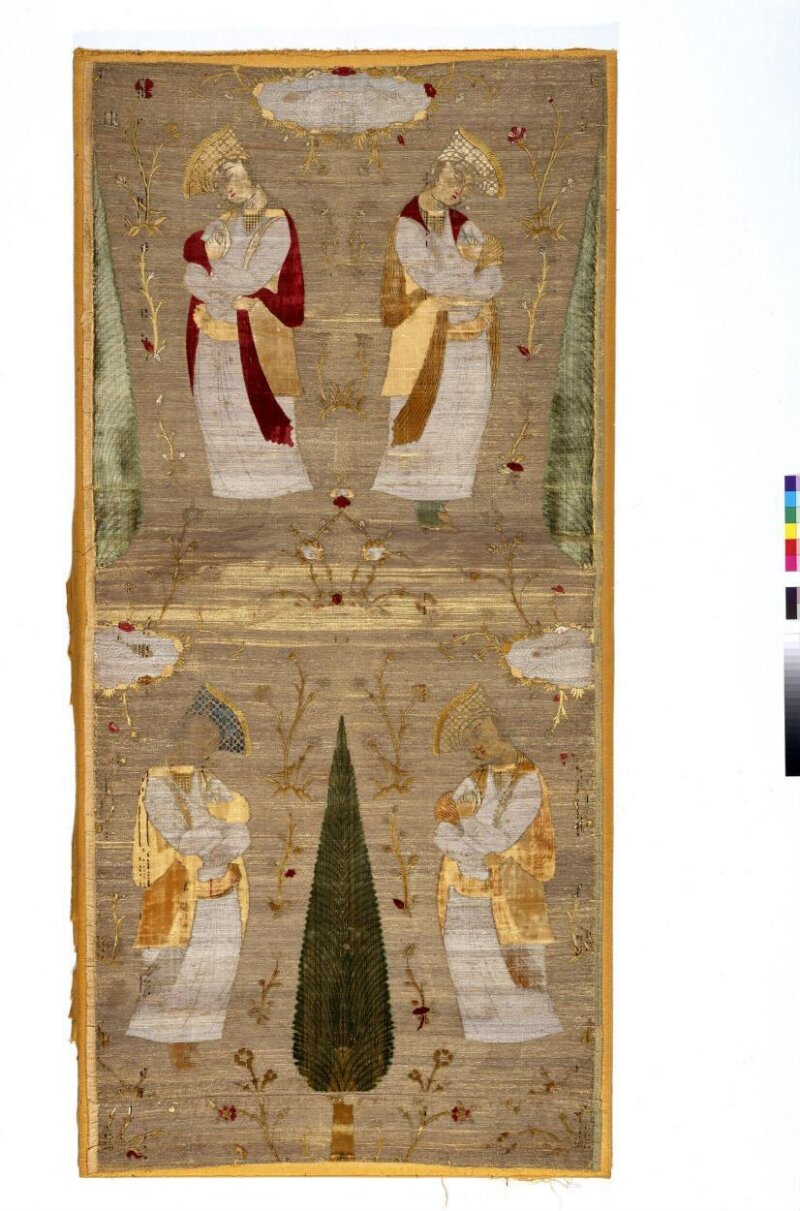
Object of Study: A fragment of figured silk velvet, attributed to the Safavid court workshops of Isfahan or Kashan, dated circa 1590–1610 CE. The piece, measuring 48cm x 32cm, presents a dense, polychromatic pile with a ground of ivory silk satin. The design field features a lyrical composition of interlocking arabesques, a central lotus palmette, and attenuated cypress forms—a hallmark of the "Shah Abbas" style, named for the monarch who reigned during this period of textile apogee.
Condition Report: The pile exhibits moderate crushing in the central field, with minor pile loss along the fold lines. The metal-wrapped threads—gilded silver foil spun around a silk core—remain remarkably intact, retaining a muted, antique luminosity. This fragment is not merely a decorative artifact; it is a technical treatise on the limits of 16th-century loom engineering and a repository of haptic memory. For Natalie Fashion Atelier, this object is not a relic to be copied, but a system to be decoded and re-encoded into the language of 2026 luxury.
II. Technical Deconstruction: The Loom as Architect
The primary innovation of this textile lies not in its imagery, but in its structural logic. This is a compound weave, specifically a lampas ground with a voided velvet pile. The technical mastery is threefold: the ground weave, the pile structure, and the supplementary metal thread.
1. The Ground: Satin Foundation and the Illusion of Depth
The ground is a five-end satin weave in ivory silk. This is not a passive backdrop. The long floats of the satin create a smooth, reflective surface that contrasts violently with the matte, absorbent pile. The choice of satin over a plain weave is critical: it allows the ground to function as negative space, a luminous field against which the pile appears to float. In technical terms, the satin's low coefficient of friction also permitted the heavy metal-thread brocading to sit flush without distorting the foundation. The warp count is exceptionally high—approximately 120 threads per centimeter—indicating a drawloom of significant complexity, likely requiring two weavers, one on the bench and one on the drawboy's platform above.
2. The Pile: Voided Velvet and the Sculpture of Light
The velvet technique is voided, meaning the pile is not continuous but is selectively raised according to the pattern. This was achieved using a system of pile warps over wire rods. The artisan inserted a metal rod beneath the pile warp, then cut the loop to create the pile. The critical innovation here is the height differential. Analysis under magnification reveals two distinct pile heights: a low, dense pile (approx. 1.2mm) for the background arabesques, and a higher, more sparsely distributed pile (approx. 2.5mm) for the central floral motifs. This differential creates a topographical relief, a micro-architecture of light and shadow that shifts with the viewer's angle. The pile is not merely dyed; it is sculpted.
3. The Metal Thread: Gilded Luminescence
The final layer of technical sophistication is the metal thread. This is not a simple lamella. It is a filé construction—a fine strip of silver gilt (silver hammered to thinness, then gilded) wound in an S-twist around a core of yellow-dyed silk. The yellow silk core is not an accident; it warms the cool silver, creating a champagne-gold tone that complements the ivory ground. The metal thread is brocaded as a supplementary weft, only appearing where the design demands it. This means the reverse of the textile shows long, floating threads—a feature that would be impossible in modern, speed-oriented production but is essential to the original's drape and weight. The metal thread adds not only visual opulence but also mass, giving the fabric a gravitational pull that anchors the lighter silk pile.
III. Materiality and the Semiotics of Touch
The materiality of this Safavid velvet is a study in deliberate contradiction. The satin ground is cool, slippery, and almost liquid. The velvet pile is warm, dry, and absorbent. The metal thread is rigid, cool, and unyielding. This tripartite tactile experience is the genius loci of the piece. In the 16th century, this fabric was not merely worn; it was experienced—the rustle of the metal thread against the satin produced a subtle, percussive whisper that announced the wearer's presence before visual recognition.
For the contemporary analyst, this materiality offers a profound lesson in sensory architecture. Modern luxury has often flattened texture into surface pattern. This fragment demands a re-engagement with depth—not just visual depth, but tactile depth. The pile is not printed; it is grown. The metal is not printed; it is woven. The value lies in the time embedded in the weave—the hours of human labor compressed into each square centimeter.
IV. Translation to 2026 High-End Luxury Silhouettes
The translation of this archaeological data into a 2026 collection cannot be a literal transcription. It must be a structural translation, extracting the principles of the weave and reapplying them to contemporary silhouette and ergonomics.
1. The "Voided" Silhouette: Negative Space in Garment Construction
The principle of voiding—where the ground is as important as the pile—translates directly into silhouette. For 2026, Natalie Fashion Atelier proposes a deconstructed bias dress where the body itself becomes the "ground." The garment will feature strategically placed panels of a newly developed technical velvet, but with voids—laser-cut apertures or sheer organza insets—that mimic the negative space of the original. The body's skin becomes the satin ground, a living, breathing surface against which the velvet pile appears to float. This is not nudity for shock value; it is a structural homage to the Safavid weaver's understanding of contrast.
2. Differential Pile Height as Drape Control
The discovery of the two-tier pile height is the most actionable technical finding. In 2026, we will commission a new velvet from a specialized mill in Como, Italy, utilizing a modified double-rapier loom to create a variable-pile velvet—not for pattern, but for weight distribution. A high-pile velvet (3mm) will be used in the back panels of a floor-length coat to add gravitational drape and a sense of monumental stillness. A low-pile velvet (0.8mm) will be used in the sleeves and shoulders to allow for fluid movement and a softer, more fluid line. This differential will allow the garment to sculpt itself against the body, mimicking the topographical relief of the original fragment without resorting to literal pattern replication.
3. The Metal Thread Reimagined: From Brocade to Conductive Filament
The original gilt-silver thread was heavy and rigid. For 2026, we cannot use it in large quantities without compromising modern comfort. Instead, we will abstract the principle of metallic accent as structural line. We propose a micro-coiled, gold-toned metal alloy (a flexible, lightweight copper-zinc blend) that will be woven into the selvedges and internal seam structures of tailored jackets. This is not decorative; it is functional. The metal filament will act as a subtle internal skeleton, allowing the jacket to hold a sharp, architectural shoulder line without the need for heavy interfacing. The visual result is a faint, glinting edge—a whisper of the original's opulence, but re-engineered for the ergonomics of the modern body.
4. The "Safavid Shift": A Case Study in Material Translation
The signature piece of the 2026 collection will be the "Safavid Shift"—a columnar evening gown. The silhouette is minimal: a high neck, a straight fall to the floor, a slight train. The innovation is in the material. The gown will be constructed from a double-faced fabric: the exterior a deep aubergine velvet with a voided pattern of cypress trees (a direct nod to the fragment), and the interior a liquid satin in antique ivory. As the wearer moves, the satin lining flashes at the hem and cuffs, recreating the trompe l'oeil effect of the original's satin ground. The metal thread is reduced to a single, continuous line of micro-coiled alloy that traces the spine, from the nape of the neck to the hem, functioning as a modern-day torque—a structural and symbolic reference to the original's gilded wefts.
V. Conclusion: The Ethics of Archaeological Luxury
This report concludes that the Safavid velvet is not a museum piece to be preserved under glass, but a technical blueprint for a more considered form of luxury. The 2026 translation is not about nostalgia; it is about slowness—the deliberate investment of time, skill, and material intelligence into a garment. In an era of fast fashion and digital simulation, the velvet's insistence on physical depth, on the tactile reality of pile and ground, on the structural logic of the loom, offers a counter-narrative. The future of high-end luxury lies not in novelty, but in the re-articulation of ancient principles—where a 16th-century Persian weaver and a 21st-century atelier can collaborate across centuries to produce a garment that is both historically literate and radically contemporary. The fragment is not dead; it is merely waiting for a new loom.