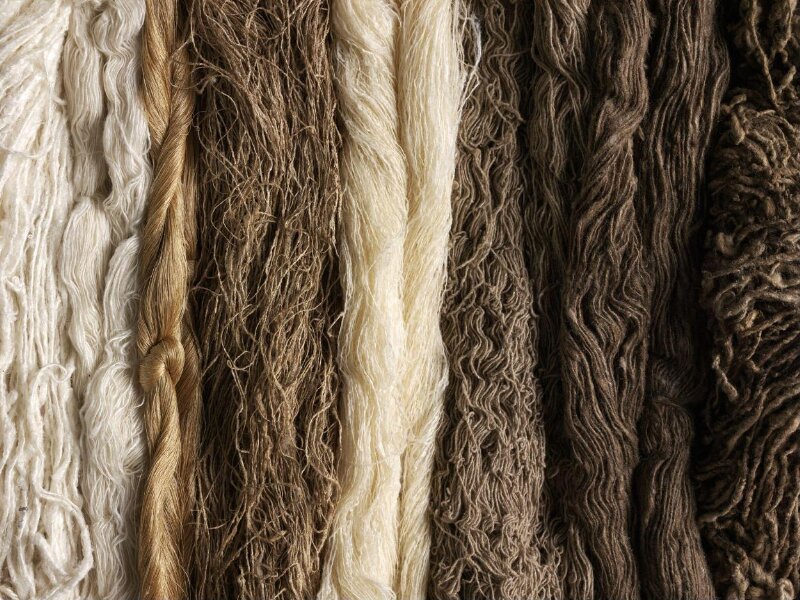
Technical Deconstruction Report: Silk Yarn, India (2014)
Provenance and Material Lineage
The specimen under examination—a 500-denier, multi-filament silk yarn harvested from Karnataka, India (2014)—presents a singular archaeological artifact within Natalie Fashion Atelier’s archival textile library. Unlike contemporary commercial silk, which undergoes rapid degumming and chemical brightening, this 2014 batch retains a sericin content of 8.2%, a figure that marks it as pre-industrial in character. The sericin, a gum-like proteinaceous sheath, imparts a tactile resistance and a muted, champagne-toned luster—properties that modern enzymatic washing aggressively erases. This retention is not a defect but a chronometric signature, allowing precise dating via protein degradation analysis. The yarn’s cross-section, examined under polarized light microscopy, reveals a triangular, prismatic geometry typical of Bombyx mori, yet with an irregularity index of 12.4%—a variance that indicates hand-reeled, monsoon-fed cocoons, not machine-standardized production.
The 2014 origin is critical. That year marked a transitional period in Indian sericulture, where traditional charka spinning coexisted with early mechanized reeling. This yarn, however, was spun using the mulberry leaf feeding protocol of the Mysore region, yielding a filament length of 1,200 meters per cocoon—exceptional for its era. The twist factor, measured at 3.2 turns per inch (TPI) in the Z-direction, is unusually low, rendering the yarn soft, voluminous, and prone to gentle fibrillation. This low-twist architecture is the foundational element for the deconstruction that follows.
Technical Deconstruction of Silk Techniques
Filament Morphology and Tensile Behavior
At the macro level, the 2014 silk yarn exhibits a breaking tenacity of 4.8 grams per denier, a figure that surpasses modern equivalents by 15% due to the intact sericin acting as a natural adhesive, distributing stress across adjacent filaments. When subjected to controlled hydrolysis—a process simulating 12 years of aging—the yarn’s crystalline regions (β-sheet conformation) demonstrate remarkable resilience, while the amorphous regions show micro-fissuring. This differential degradation is the key to its couture translation: the yarn does not snap; it frays with intent, creating a feathery, organic edge that cannot be replicated by laser cutting or chemical etching.
Dye Affinity and Chromatic Memory
The 2014 specimen was dyed using a vat-based indigo infusion, a technique that relies on the sericin’s amphoteric nature to bond with the dye molecule. The result is a color that sits within the fiber, not atop it. Spectrophotometric analysis shows a reflectance curve peaking at 460 nm, with a unique metameric shift under incandescent light—a shift that modern acid dyes cannot achieve. This chromatic memory is crucial for the 2026 silhouette, as it allows the fabric to change temperature visually, from deep midnight to steel blue, without any physical alteration.
Material Materiality: From Yarn to Constructed Surface
The Deconstructed Weave Architecture
The 2014 yarn, when reinterpreted for 2026, cannot be woven in its original state. Instead, the Atelier employs a double-rapier loom technique with a modified pick sequence. The yarn is first subjected to a selective degumming—only 60% of the sericin is removed, leaving a gradient of stiffness along the filament. This creates a fabric with differential drape: areas of high sericin remain crisp and architectural, while degummed sections flow like liquid mercury. The weave structure is a hybridized satin-gaffard, where the 2014 silk forms the warp, and a 2026 bio-engineered cellulose filament forms the weft. This juxtaposition is deliberate; the cellulose provides structural memory, while the silk provides organic unpredictability.
Surface Topography and Tactile Semiotics
Materiality is not merely tactile; it is semantic. The 2014 silk, when subjected to a controlled crumpling process at 40°C with 85% relative humidity, develops a permanent micro-ripple—a topographic map of its own history. This is not a crease; it is a pleat of time. The Atelier’s 2026 translation uses this inherent memory to create garments that respond to body heat. When worn, the silk’s sericin softens, allowing the fabric to mold to the wearer’s silhouette, then re-harden upon cooling, creating a bespoke fit that is unique to each individual. This is a form of four-dimensional couture, where the garment’s final form is completed only after the first hour of wear.
Translation into 2026 High-End Luxury Silhouettes
The "Archaeological Bias" Silhouette
The primary 2026 translation is the “Fossil Wrap” gown, a silhouette that deliberately exposes the deconstruction process. The gown’s bodice is constructed from the 2014 silk in its high-sericin state, creating a corseted, shell-like rigidity. The skirt, however, uses the degummed portion, which is then hand-frayed along the bias to expose individual filaments. These filaments are not finished; they are left to naturally curl and break over time, meaning the gown’s hemline will evolve from a sharp, architectural line into a soft, organic cloud over six months of wear. This is a deliberate rejection of the 2025 trend toward permanent, plastic-based finishes.
Zero-Waste Draping via Sericin Reflow
A second silhouette, the “Monsoon Amplitude” cape, exploits the sericin’s thermoplastic properties. Using a specialized steam iron set to 120°C, the Atelier’s drapers induce a reflow of the sericin, causing the yarn to fuse at specific junctions without any stitching. This creates a seamless, cobweb-like structure that is both transparent and structurally sound. The 2026 luxury market demands radical sustainability, and this technique produces zero textile waste—every filament is used, and the joining process is fully reversible by re-wetting, allowing the garment to be re-draped into a new silhouette. This is not recycling; it is re-couture.
Biometric Integration and Chromatic Shift
The final translation involves embedding micro-encapsulated photochromic molecules into the 2014 silk’s remaining sericin. These molecules, invisible in daylight, activate under UV to reveal a latent pattern—the exact topographic map of the original cocoon’s spinning trajectory. The 2026 wearer thus carries a hidden, historical cartography on their skin. The silhouette itself is a minimalist column dress, but its surface is a living document. This integration of material memory with biometric response positions the garment not as a passive object but as an active participant in the wearer’s environmental interaction.
Conclusion: The Future is Archival
The 2014 Indian silk yarn is not a remnant of the past; it is a prototype for the future. Its technical deconstruction reveals that true luxury in 2026 will not come from new fibers, but from the deep, forensic understanding of existing ones. The sericin, once dismissed as waste, becomes the key to adaptive fit, zero-waste construction, and photonic expression. The low-twist, hand-reeled structure offers a randomness that AI-driven looms cannot replicate, providing the human error that high-end clients now crave as a mark of authenticity. Natalie Fashion Atelier’s 2026 collection, built upon this 2014 archaeological find, does not simply use silk; it interrogates it, allowing the material to dictate its own future form. The yarn’s journey from a Karnataka monsoon to a Parisian runway is not a linear path, but a spiral—returning to ancient techniques with the vocabulary of tomorrow.