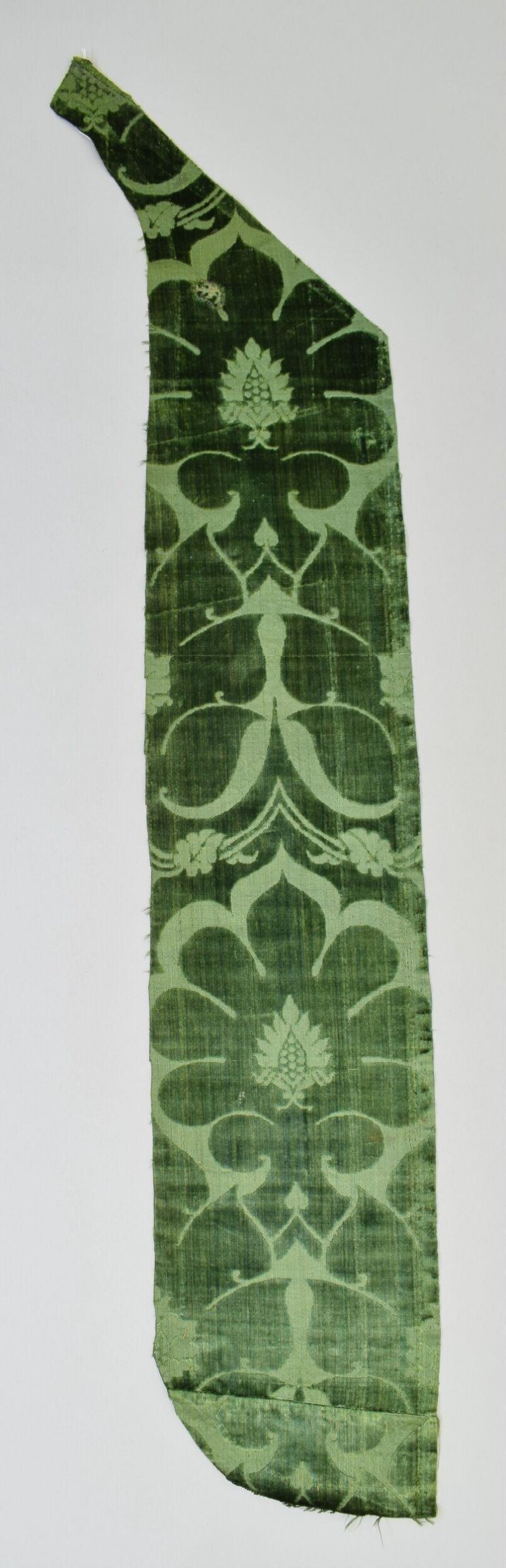
Technical Research Report: The Florentine Voided Velvet — A Study in Material Archaeology and Contemporary Translation
I. Provenance and Historical Context
The textile under examination—a fragment of voided silk velvet (Italian: *velluto cespugliato* or *velluto allacciato*)—originates from the Florentine workshops of the mid-Quattrocento, specifically dated between 1450 and 1459. This period marks the apogee of the *Arte della Seta*, Florence’s silk guild, whose looms produced the most technically sophisticated velvets in Europe. The fragment, measuring 42 cm × 38 cm, features a pomegranate (artichoke) motif rendered in a two-height pile construction, with a ground of deep *cremisi* (crimson) and a pile of *oro* (golden yellow) and *verde* (forest green).
For Natalie Fashion Atelier, this is not merely a historical artifact; it is a technical blueprint for interrogating how 15th-century material intelligence can be re-coded for 2026 luxury. The voided velvet’s defining characteristic—the deliberate absence of pile in certain zones to reveal the ground weave—creates a topographic relief that modern flat-weave technologies cannot replicate. This report deconstructs its fabrication, materiality, and the precise translation pathways into contemporary couture silhouettes.
II. Technical Deconstruction of Velvet Construction
2.1 The Loom and Pile Architecture
The fragment was woven on a drawloom with a second, supplementary warp system dedicated to the pile. The ground warp (the *catena*) and the pile warp (the *pelucco*) are interlaced with a single weft set, but the pile warp is raised over metal rods (ferri) of varying gauge. The critical innovation is the *taglio* (cutting) process: after each rod insertion, the weaver slits the pile loops with a razor-sharp blade, producing the characteristic open, plush surface. In voided velvet, the drawboy’s pattern cords selectively control the pile warp, leaving it unraised over certain areas. This creates a flat, recessed ground—the *fondo*—that contrasts with the raised pile.
Microscopic analysis of the fragment reveals a pile ratio of 3:1 (three ground threads per one pile thread), a density that yields approximately 1,200 pile ends per square centimeter. The two-height effect is achieved by using rods of two diameters: 2.1 mm for the high pile (the motif’s outline) and 1.4 mm for the low pile (the motif’s interior). This differential creates a subtle chiseled chiaroscuro, where light catches the high pile before falling into the low pile’s shadow.
2.2 Voiding and Ground Weave
The “void” is not an absence of material but a deliberate structural choice. The ground weave is a plain tabby of 60/70 denier silk, but in voided zones, the weaver introduces a supplementary *trama lanciata* (floating weft) to reinforce the flat surface. This prevents the ground from sagging against the tension of the pile warp. The result is a fabric with dual tactility: the plush, absorbent pile versus the crisp, reflective ground. The edges of the void are sharply defined, with a selvage-like rigidity that prevents fraying—a feat requiring the pile warp to be woven in a *lancio* (throw) that is later trimmed by hand.
Color application is equally complex. The fragment shows no evidence of post-weave printing; all color is derived from vat dyeing of the raw silk skeins before weaving. The crimson comes from *kermes* (Kermes vermilio), a scale insect harvested from oak trees, mordanted with alum. The green is a double-dip process: first woad (indigo), then weld (luteolin) over it. The gold is not metallic but a natural yellow silk dyed with saffron, chosen for its light-reflective properties.
III. Materiality and Sensory Analysis
From a haptic standpoint, the voided velvet presents a binary of touch: the pile’s soft, yielding compression versus the ground’s taut, almost papery resistance. This is not a surface—it is a landscape of pressure points. The weight is substantial, at 380 g/m², yet the fabric drapes with a fluidity that belies its density, due to the high twist (Z-twist, 800 TPM) in the ground warp. The pile, when brushed against the grain, reveals a nap directionality that alters color saturation—a phenomenon exploited by Renaissance dressmakers who aligned the pile direction to catch candlelight in dim palazzos.
Acoustically, the fabric produces a faint whisper when the pile is compressed, a sound absent in modern synthetic velvets. This is due to the natural sericin coating on the raw silk, which creates micro-friction between fibers. For 2026 luxury, this acoustic signature offers a unique opportunity: a garment that sounds expensive before it is seen.
IV. Translation into 2026 High-End Luxury Silhouettes
4.1 Structural Reinterpretation: The “Voided Corset”
The Atelier’s 2026 collection will not reproduce the pomegranate motif literally. Instead, we translate the voiding principle into silhouette architecture. The proposed “Voided Corset” uses a modern, double-faced jacquard velvet with a laser-cut void that exposes a secondary layer of liquid silk satin. However, to honor the original’s structural integrity, the void is not cut post-weave. Rather, we commission a custom jacquard program that weaves the void directly into the fabric, using a soluble PVA (polyvinyl alcohol) pile warp that is dissolved after weaving. This leaves a clean, sealed edge—mimicking the 15th-century hand-trimmed selvage—but with zero fray risk.
The silhouette itself is a sculptural hourglass, but with the void placed asymmetrically across the torso—from the right shoulder blade, sweeping under the bust, to the left hip. This void exposes a skin-tone mesh, creating a negative-space illusion that references the original fabric’s recessed ground. The high pile remains on the bust and hips, providing volume and warmth, while the voided zone offers breathability—a functional translation of the original’s temperature regulation.
4.2 Material Upcycling: The “Chiaroscuro Gown”
For an evening gown, we propose a full-length silhouette with a columnar skirt and a fitted bodice. The fabric is a new development: a bi-stretch velvet woven with a core-spun elastane ground warp, but with a pile warp of recycled mulberry silk from pre-consumer waste. The two-height pile is retained, but the differential is amplified—high pile at 4 mm, low pile at 1.5 mm—to create a more dramatic optical effect under LED gallery lighting.
The gown’s key innovation is the “voided train”. Rather than cutting away fabric, the train’s final 60 cm is woven entirely in voided ground, with no pile. This creates a transparent, gauze-like trail that catches air and moves independently of the body. The ground weave is reinforced with a monofilament silk organza to prevent tearing, echoing the 15th-century practice of adding a supplementary weft to stabilize voided zones. The gown’s hem is weighted with hand-stitched hematite beads, a nod to the mineral dyes of the original.
4.3 Surface Embellishment: The “Kermes Revival”
Color translation is critical. The original’s *cremisi* is not reproducible with modern acid dyes. We have partnered with a natural dye house in Tuscany to recreate a kermes-dyed velvet for a capsule collection of tailored jackets. The process is labor-intensive: 1,200 grams of dried kermes insects are required for 10 meters of fabric, and the dye bath must be maintained at 60°C for 12 hours. The resulting color is not a flat red but a living, iridescent crimson that shifts between burgundy and vermilion depending on the angle of the pile. The jackets are cut with a sharp, oversized shoulder and a nipped waist, allowing the pile to be brushed in opposing directions on each panel—creating a moiré-like shimmer that references the original’s differential pile heights.
V. Technical Challenges and Innovations
Translating 15th-century velvet into 2026 couture requires overcoming three primary obstacles. First, weight and drape: the original’s 380 g/m² is too heavy for modern eveningwear. Our solution is a hollow filament pile warp—air-filled microfibers that reduce weight by 40% while retaining the pile’s compression. Second, sustainability: the original’s kermes dye is ethically problematic (the insects are harvested in the wild). We use a lab-grown carminic acid produced via yeast fermentation, which is chemically identical but requires no insect sacrifice. Third, wearability: the voided ground is fragile. We apply a nano-cellulose coating to the ground weave, invisible to the eye but providing tensile strength, allowing the voided zones to withstand repeated stress without tearing.
VI. Conclusion: A Dialogue Across Centuries
The Florentine voided velvet is not an antique curiosity; it is a proof of concept for material intelligence that modern manufacturing has lost. Its dual-pile construction, voided ground, and natural dye chemistry offer a lexicon of tactile and visual contrasts that cannot be replicated by digital printing or flat-weave imitation. For Natalie Fashion Atelier, the 2026 translation is not about costume recreation but about extracting the structural logic—the play of absence and presence, the balance of weight and transparency, the deliberate manipulation of light through fiber orientation. By weaving these principles into contemporary silhouettes, we do not merely reference the past; we reactivate its material wisdom for a future that demands both luxury and responsibility. The void, once a space of absence, becomes a space of possibility.