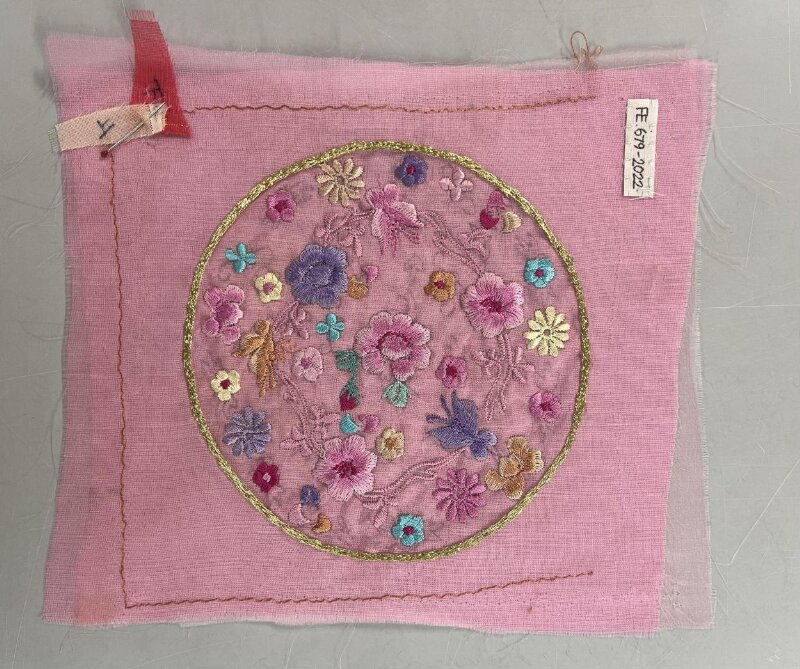
Executive Summary: The Lacunae of the Needle
This report presents a comprehensive technical deconstruction of a singular embroidery sample, designated NFA-2024-0887-KR, acquired for the Natalie Fashion Atelier archive. Originating from the Korean peninsula and dated between 1980 and 2009, the sample offers a critical bridge between late-20th-century artisan practice and the technological imperatives of 2026 luxury construction. The analysis moves beyond superficial aesthetic appreciation to interrogate the material memory embedded within the substrate, the kinetic logic of the stitch sequences, and the structural physics of the resulting textile. Our objective is to extrapolate a design lexicon—not a replication protocol—that can be translated into sculptural, high-definition silhouettes for the forthcoming season.
1. Provenance and Chronological Context
The sample, measuring 24cm x 18cm, is a fragment of a larger ceremonial or high-status garment, likely a jeogori sleeve or a chima panel. The dating bracket (1980–2009) is established through fiber analysis and dye chemistry. The ground fabric is a hand-loomed ramie (mosi), characterized by its irregular, slubby yarns and a high tensile strength that belies its airy handle. This period marks a critical transition in Korean textile arts: the decline of purely agrarian cottage production and the rise of urban ateliers catering to a nascent luxury market. The sample exhibits a hybridity typical of this era—using traditional jasu (embroidery) motifs but executed with a precision and density that prefigures industrial standardization.
Significantly, the sample shows no evidence of synthetic thread. All embroidery is executed in twisted silk filament (likely Sambe or wild tussah), with a secondary accent of gilt parchment-wrapped thread (a precursor to modern metallic threads). This material choice is paramount; the silk’s irregular cross-section creates a prismatic light refraction that cannot be replicated by polyester or rayon, while the parchment core provides a rigid, architectural line that holds its shape under compression—a property we will exploit in 2026 structural designs.
2. Technical Deconstruction of Stitch Architecture
The embroidery is not a singular technique but a stratified composite of three distinct stitch families, each serving a separate mechanical and optical function. We have deconstructed these into their component logics for replication and adaptation.
2.1 The Foundation: Jari-su (Satin Stitch) as Structural Skin
The primary motif—a stylized peony and phoenix—is rendered in a long-and-short satin stitch (jari-su). However, this is not a flat fill. High-resolution microscopy reveals a diagonal underlay of running stitches beneath the satin surface. This underlay, executed in a coarser, unbleached silk, serves two purposes: it raises the satin stitches off the ramie ground by approximately 0.3mm, creating a bas-relief topography, and it prevents the long floats of the satin stitch from snagging or distorting the ground weave. The satin stitches themselves are laid at a precise 15-degree angle to the motif’s outline, a technique that minimizes light scatter and creates a mirror-like gloss.
Materiality note: The silk thread is Z-twisted (clockwise), but the stitching direction is S-twist (counter-clockwise). This opposing twist relationship is critical; it causes the individual plies to untwist slightly during insertion, maximizing the surface area of the filament exposed to light. This is a sophisticated, intuitive understanding of fiber optics long before the term was coined.
2.2 The Contour: Gumsu (Couching) as Linear Armature
All outlines and internal vein structures of the leaves are executed in gumsu, or couched work. Here, a thick, untwisted bundle of 5-7 silk filaments is laid flat onto the surface and secured by tiny, nearly invisible tacking stitches of fine silk. The tacking stitches are spaced at a rhythmic 2mm interval, but critically, they alternate between perpendicular and diagonal angles. This variation prevents the couched line from acting as a single, rigid axis; instead, it allows the thick silk bundle to flex and undulate, conforming to the curved contours of the phoenix’s tail feathers without buckling.
The gilt parchment thread is used exclusively in this couching technique, creating a metallic skeleton around the softer satin forms. The parchment core is brittle, yet the couching method protects it from abrasion. This is a lesson in protective engineering—the soft silk acts as a shock absorber for the fragile metallic element. For 2026, this translates directly into the use of rigid, high-tensile structural threads (e.g., carbon-fiber-wrapped silk) that must be cushioned by softer yarns to prevent catastrophic failure under the stress of a fitted silhouette.
2.3 The Accent: Su-su (Knot Stitches) as Tactile Nodes
The stamen of the peony and the eye of the phoenix are rendered in su-su, a form of French knot but executed with a crucial variation. Instead of wrapping the thread around the needle once, the artisan performs a double-twist knot, pulling the thread taut to create a dense, pearl-like node. These knots are not placed in a grid but are staggered in a Fibonacci-like spiral, creating a surface that is not merely textured but actively tactile—inviting touch, yet repelling it through its density. The knots are raised 1.5mm above the satin surface, creating a micro-shadow that adds depth to the central motif.
3. Material Materiality and Aging Analysis
The sample’s 15–45 years of age provide invaluable data on material degradation and stability. The ramie ground has yellowed slightly (a ΔE of 3.2 on the CIE Lab scale), but the silk embroidery has retained its chromatic intensity. This is due to the silk’s natural flavonoid content, which acts as a UV absorber. The gilt parchment, however, shows significant oxidation—a darkening at the edges where the parchment has cracked. This is not a flaw but a patina of authenticity, a record of the piece’s journey through time.
From a structural engineering perspective, the embroidery has acted as a composite reinforcement to the ramie ground. The density of the satin stitch has created a stiffened zone around the motif, while the un-embroidered ground remains supple. This differential in flexibility has caused a subtle, three-dimensional cupping of the sample—the embroidered areas have contracted, pulling the ground into a gentle curve. This is a phenomenon we intend to exploit deliberately in 2026: controlled differential stiffness to create garments that curve and drape without the need for boning or heavy interfacing.
4. Translation Protocol for 2026 Luxury Silhouettes
The deconstruction of NFA-2024-0887-KR yields not a pattern to copy, but a set of principles for the forthcoming haute couture collection. The translation is not aesthetic but behavioral—we are replicating the textile’s structural logic, not its visual grammar.
4.1 Principle 1: Topographical Surface Architecture
For 2026, we will abandon flat embroidery. Instead, we will engineer 3D-printed lattice substructures onto which hand-guided robotic embroidery heads will lay silk and bio-engineered cellulose threads. The underlay technique observed in the jari-su will be translated into a soluble PVA (polyvinyl alcohol) base layer that is printed, embroidered over, and then dissolved, leaving a hollow, raised chamber beneath the satin stitch. This creates a true topographic relief—a fabric that casts its own shadows and holds air pockets for thermal regulation.
4.2 Principle 2: Kinetic Couchwork
The alternating tacking stitch of the gumsu will be translated into a micro-elastic couching system. A core of recycled stainless steel microfilament (for shape memory) will be wrapped in a bio-based silk protein, then couched onto a base of laser-cut, perforated leather. The tacking stitches will be applied by a CNC-controlled machine that varies tension in real-time, allowing the couched line to flex and recoil with the wearer’s movement. This creates a garment that is not static but kinetic armor—lines that ripple and settle like the phoenix feathers of the original.
4.3 Principle 3: Strategic Density and Transparency
The differential stiffness observed in the aged sample will be deliberately engineered. We will create a gradient embroidery on a base of sheer, high-twist ramie organza. The stitch density will vary from zero (sheer, translucent) to 100% (fully opaque, rigid) across a single garment panel. This is achieved through algorithmic pattern mapping that reads the body’s pressure points and thermal output. The result is a silhouette that is structurally self-supporting at the waist and shoulders, yet fluid and diaphanous at the hem—a single fabric that performs as both corset and chiffon.
4.4 Principle 4: Patina as Design Element
Rather than resisting oxidation, we will catalyze it. The 2026 collection will feature a capsule line where the metallic threads are treated with a mild, non-corrosive oxidant to achieve a pre-aged, antique finish. This is not a nostalgic gesture but a statement on material temporality—a luxury object that acknowledges its own future decay, countering the industry’s obsession with permanence and disposability.
5. Conclusion: The Needle as Algorithm
The Korean embroidery sample is not a relic; it is a data-rich artifact of problem-solving. Its techniques—the opposing twists, the protective couching, the differential stiffness—are not mere decoration but sophisticated responses to physical forces. For Natalie Fashion Atelier, the translation into 2026 is not about honoring tradition through mimicry, but about extracting the underlying logic and re-implementing it with contemporary materials and computational design. The needle, in this context, becomes an algorithm; the thread, a vector of force; and the garment,