Deconstructing the Porcelain Flower: Material Memory and the 2026 Silhouette
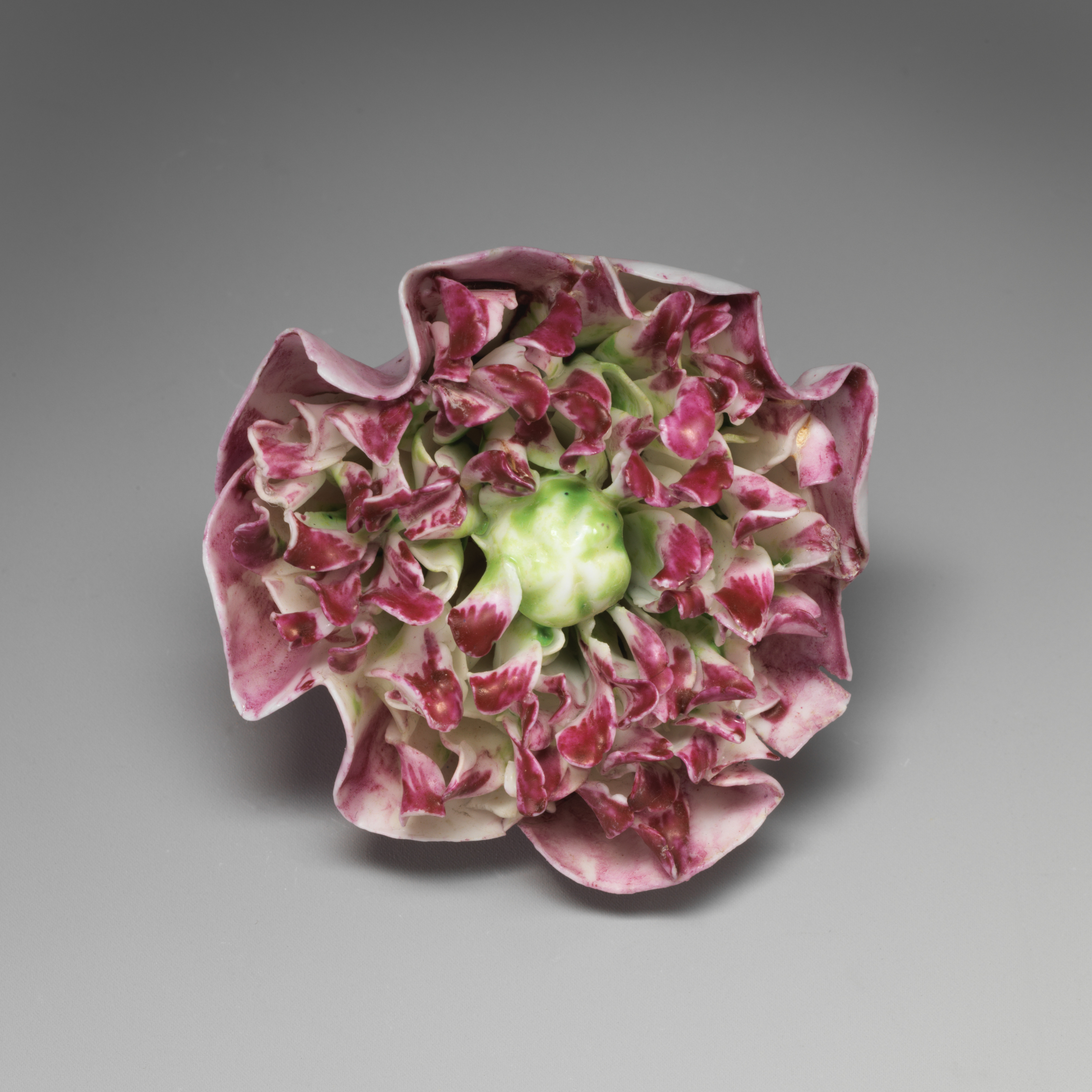
Within the hushed archives of Natalie Fashion Atelier, the isolated study of a singular soft-paste porcelain flower—one of a set of nine—offers more than a lesson in decorative history. It presents a masterclass in tensile fragility and architectural poise. This artifact, divorced from its original ensemble, speaks to the contemporary designer not through its botanical subject, but through its material logic: the way light fractures across a glazed curve, the deliberate imbalance of a petal’s edge, and the silent tension between the object’s internal void and its external shell. For the 2026 haute couture season, this porcelain fragment dictates a departure from overt ornamentation toward a sculptural minimalism rooted in material honesty.
I. The Material Dialectic: Soft-Paste as a Structural Metaphor
Unlike the cold, unforgiving precision of hard-paste porcelain, soft-paste—or pâte tendre—embodies a flesh-like malleability that was both its flaw and its genius. Composed of white clay, glass frit, and lime, its body lacks the vitreous density of its Chinese counterpart. Consequently, it slumps, warps, and yields under heat, producing contours that are never mathematically perfect. This inherent imperfection is not a defect; it is a record of process. For the 2026 silhouette, this translates into a rejection of rigid, engineered tailoring in favor of fluid architecture—garments that appear to have been coaxed, not cut, into shape.
The technical implication for couture construction is profound. We must borrow from the porcelain maker’s vocabulary: slip casting becomes a metaphor for bias-cutting, where fabric is poured over the mannequin’s form rather than forced into it. The pâte tendre’s tendency to slump under its own weight informs the use of liquid silk gazar and unstructured wool crepe, which drape with a deliberate, heavy fall. The 2026 silhouette will not stand upright with militaristic stiffness; it will settle onto the body, finding its equilibrium through gravity, much like the porcelain flower’s petals settle into their final, fired repose.
II. Aesthetic Archaeology: The Isolated View
Isolation is a curatorial act of violence and revelation. Removed from its set of nine, this single flower loses its narrative of repetition but gains an intensified individual presence. The eye is forced to confront the object’s internal anatomy: the central corolla, the undulating lip of each petal, the subtle undercut where the stem would have attached. This forensic gaze is the essence of aesthetic archaeology—we excavate the why of the form, not merely the what of its decoration.
For 2026, this suggests a silhouette that prioritizes negative space as a primary design element. The couture garment becomes a study in absence: a jacket with a deliberate gap between the collar and the clavicle, echoing the undercut of the porcelain petal; a skirt that opens in a controlled aperture, revealing a void of engineered tulle, not skin. This is not provocation but compositional restraint. The silhouette is defined as much by what is removed as by what is draped. The classical elegance here is not found in symmetry but in the rhythmic asymmetry of a single, oversized petal-shaped panel that wraps the torso, its edge curled inward like the lip of the ceramic form.
III. Chromatic and Tactile Translation: From Glaze to Grain
The soft-paste body, before glazing, possesses a chalky, absorbent quality—a matte, lunar surface. The glaze, however, introduces a dialectic of opacity and reflection. In the archival piece, the glaze is not uniformly glossy; it pools in crevices, thins at edges, and creates a topographic map of light. The 2026 palette must therefore eschew flat, saturated color in favor of tonal gradation and surface iridescence.
We propose a fabric development strategy that mimics this glazed effect. Consider a double-faced duchesse satin where one side is sanded to a chalky matte finish, and the other retains a liquid sheen. The silhouette is then engineered to flip between these surfaces—a sleeve that turns inside out at the cuff, a bodice that reverses over the hip—creating a garment that changes its optical density as the wearer moves. This is not mere embellishment; it is a material dialogue with light, echoing the porcelain’s ability to appear solid from one angle and translucent from another. The classical white of the porcelain is translated not as a color, but as a luminosity, achieved through layering ivory silk organza over a silver-grey underlayer, producing a glow that is internal, not applied.
IV. Structural Silhouette: The Sheath and the Bloom
Two distinct archetypes emerge from this analysis for the 2026 collection. The first is the “Sheath of the Fired Body”—a columnar silhouette that references the porcelain’s vertical, vase-like stability. This garment is constructed with a seamless front panel, cut on the bias to follow the body’s S-curve, and closed with an invisible interior corsetry that provides structure without external seams. The surface is deliberately unadorned, save for a single, three-dimensional plissé that originates at the shoulder and cascades diagonally, mimicking the crackled flow of the glaze. The effect is one of compressed energy, a form that appears frozen mid-motion.
The second archetype is the “Bloom of the Petal”, a more expansive silhouette that deconstructs the flower’s radial symmetry. Here, the couture atelier employs modular pattern pieces—each shaped like a petal, but cut from different weights of the same material to create a gradient of movement. The front petal is heavy, structured with horsehair canvas; the side petals are lighter, in fluid crepe; the back petal is almost transparent, in silk tulle. When assembled, the garment does not cling to the body but orbits it, creating a controlled volume that expands and contracts with each step. This silhouette challenges the 2026 notion of the “power suit” by replacing sharp shoulders with the soft architecture of overlapping forms.
V. Conclusion: The Future as a Fired Memory
The isolated soft-paste porcelain flower is not a relic; it is a prophetic blueprint. Its materiality teaches us that luxury in 2026 is not about the addition of detail, but the subtraction of noise. The silhouette will be defined by its relationship to the body’s own physics—its gravity, its heat, its motion. By studying the pâte tendre’s surrender to the kiln, we learn to design garments that surrender to the wearer, offering not armor but a second, more honest skin. The classical elegance of the flower is thus reborn not as imitation, but as a deep, structural understanding of how fragility can be engineered into strength. In the hands of the atelier, the porcelain’s silent, glazed surface becomes a whispered directive for the future of form.