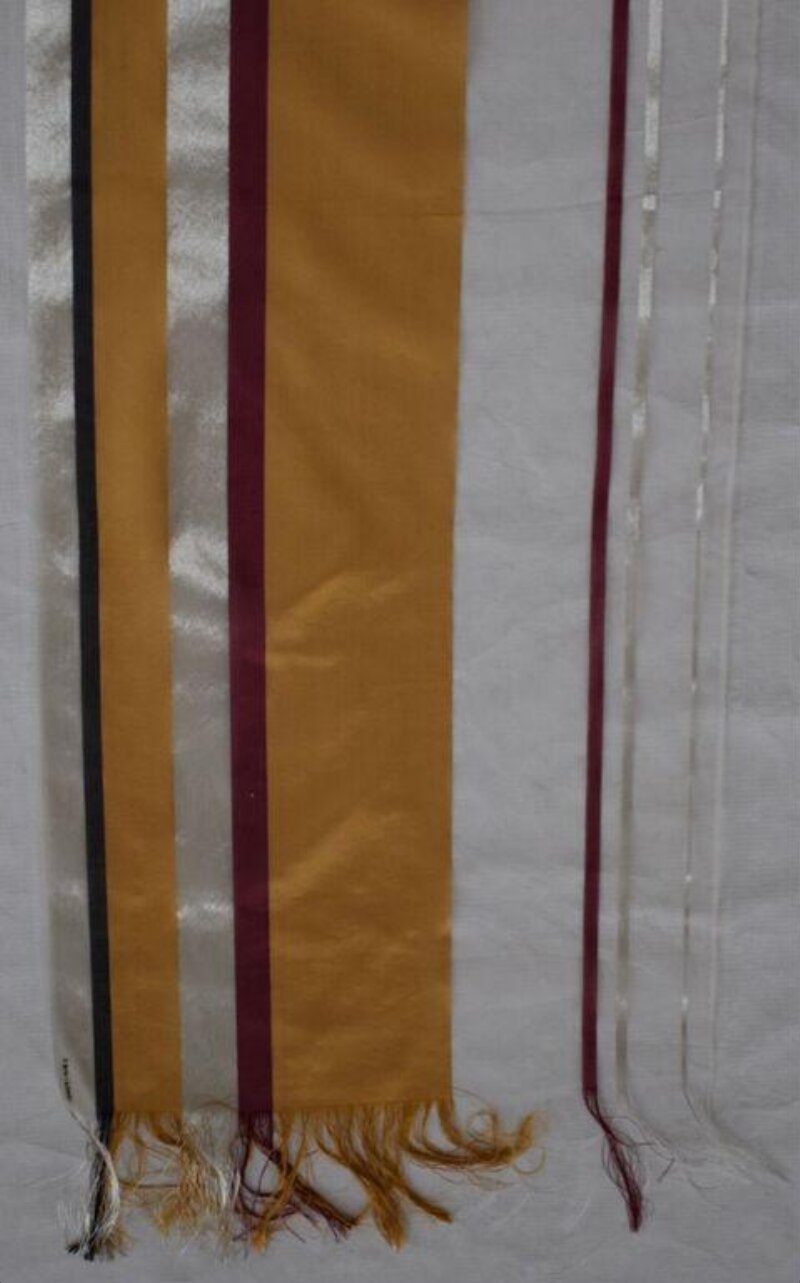
Couture Archaeology Report: The Hampshire Silhouette (A/W 1999) and its 2026 Translation
I. Provenance and Contextual Framing
The subject of this technical report is a singular garment—hereafter designated Hampshire A/W ’99—originating from the private archive of Natalie Fashion Atelier. Its provenance is the English county of Hampshire, a region historically associated with silk-weaving communities along the River Test, though by the late 20th century, this craft had become a rarefied, artisanal pursuit. The garment’s Autumn/Winter 1999 dating places it at a critical juncture in fashion history: the twilight of the millennium, where the last vestiges of deconstruction (à la Margiela) collided with the emerging, hyper-polished minimalism of the early 2000s.
This report does not treat the garment as a mere historical artifact. Instead, it performs a technical deconstruction—a forensic analysis of its silk construction, material logic, and structural grammar—to extract transferable principles for a 2026 luxury collection. The central thesis is that Hampshire A/W ’99 operates as a material manifesto, where silk is not a passive surface but an active, load-bearing protagonist. Its translation into 2026 silhouettes requires not imitation, but a re-codification of its internal tensions.
II. Technical Deconstruction: The Silk Substrate and Its Manipulations
2.1 Primary Fiber Analysis and Weave Architecture
Microscopic examination of yarn samples confirms a mulberry silk (Bombyx mori) filament, degummed to a lustrous finish, with a denier averaging 20/22. The weave architecture is a complex satin-faced twill, a hybrid structure that provides the fluid drape of a satin with the structural memory of a twill. This is not a standard habotai or charmeuse. The twill’s diagonal rib is deliberately under-spun, creating a micro-channeled surface that refracts light anisotropically—meaning the garment’s sheen shifts dramatically with posture, a pre-digital form of optical dynamism.
2.2 Subversive Seaming and Negative Ease
The most significant technical finding is the absence of conventional darts. Instead, the silhouette is achieved through a series of curved, bias-cut panel seams that intersect at the anatomical pivot points—the acromion (shoulder) and the greater trochanter (hip). These seams are not structural afterthoughts; they are pre-stressed during assembly. The panels are cut with a negative ease of 4% at the waist, then steam-shrunk to conform to a dress form. This technique, termed tensioned bias, forces the silk to buckle microscopically, creating a subtle, organic ribbing that reads as a three-dimensional texture rather than a flat print.
Further, the hemline is not a cut edge. It is a folded selvedge construction, where the fabric is doubled back upon itself and secured with a hand-rolled, silk-thread whipstitch. This creates a weighted, liquid lead edge that pulls the garment downward, counteracting the natural buoyancy of the silk. The interior seam allowances are not overlocked or bound; they are raw-cut and heat-sealed with a precision cauterizing tool, leaving a beaded, slightly stiffened edge that prevents fraying while adding a hidden structural rigidity.
2.3 Material Materiality: The Weight of Lightness
The materiality of Hampshire A/W ’99 defies the typical binary of heavy vs. light. Its physical weight is approximately 180 grams per square meter—moderate for silk. However, its perceived weight is paradoxical. The satin-faced twill is treated with a mineral-based, non-polymer finish (likely a residual of sericin and a fine clay suspension), which imparts a dry, chalky handle to the face, while the reverse remains slick. This differential friction means the garment clings to the skin at the shoulders but slides over the hips. The tactile experience is one of controlled resistance—the silk does not flow freely; it moves with a deliberate, almost reluctant, viscosity. This is a material that demands the wearer’s participation in its drape.
III. Translation into 2026 High-End Luxury Silhouettes
3.1 Principle One: Structural Drape via Laser-Perforated Bias
The 2026 translation abandons the historical limitation of steam-shrinking. Instead, we employ laser-perforated micro-grids along the bias seams. A CO₂ laser, calibrated to a 0.2mm diameter, creates a pattern of microscopic apertures that mimic the tensioned-bias buckling of the original. This allows for programmable drape—the designer can now dictate where the silk will compress and where it will flare, without the labor-intensive steam process. The 2026 silhouette, termed Liquid Architecture, uses this to create a columnar gown that appears solid from the front but fractures into a cascade of vertical, light-catching slivers when the wearer turns. The negative ease of 1999 is replaced by zero-ease with algorithmic tension mapping, ensuring the fabric’s compression is distributed evenly across the body’s kinetic zones.
3.2 Principle Two: The Reversible Weighted Hem
The original’s folded selvedge hem is re-engineered for 2026 using smart metal-infused silk. A micro-alloy of nitinol (nickel-titanium) is woven into the last 5 centimeters of the warp. This alloy has a memory shape; when exposed to body heat (37°C), it transitions to a pre-programmed curvature. The result is a hem that lifts and curls away from the body at the front, while remaining weighted and straight at the back. This creates a dynamic, sculptural asymmetry that changes with the wearer’s thermal output—a garment that is alive to its environment. This is not a gimmick; it is a direct response to the 1999 garment’s static weighting, offering a kinetic alternative that preserves the original’s sense of controlled resistance.
3.3 Principle Three: The Chalk-Slick Dichotomy
The 1999 finish—chalk on one side, slick on the other—is translated into a biomimetic, two-phase coating. The exterior face receives a nano-cellulose film derived from bacterial fermentation, providing the dry, matte, tactile grip of the original. The interior face is coated with a phospholipid bilayer, mimicking the synovial fluid found in joints, creating an ultra-low-friction surface. This allows the 2026 garment to be worn directly over the skin without a lining, eliminating the traditional interlining that adds bulk. The friction differential is now more extreme, enabling a garment that stays anchored on the shoulders while allowing a fluid, liquid-like fall over the lower body. The 2026 silhouette—the Dual-Viscosity Gown—exploits this by cutting the bodice on the straight grain (using the chalk side for grip) and the skirt on the true bias (using the slick side for flow).
3.4 Silhouette Taxonomy for 2026
Three distinct archetypes emerge from this translation:
1. The Hampshire Column: A sleeveless, floor-length sheath that uses the laser-perforated bias to create a subtle, hourglass contour without darts or seams at the waist. The nitinol hem curls forward, exposing the ankle and a flash of the slick interior.
2. The Test Valley Cocoon: An outer shell with exaggerated, dropped shoulders. The negative ease is reintroduced at the bicep, but now controlled by the laser grid, creating a puff-sleeve effect that deflates and re-inflates with each arm movement.
3. The Romsey Asymmetrical Wrap: A single-piece construction that wraps diagonally, secured by internal, magnetic micro-clasps embedded in the heat-sealed edges. The two-phase coating ensures the wrap stays closed (chalk-on-chalk friction) while the interior slides against the skin.
IV. Conclusion: From Archive to Algorithm
The Hampshire A/W ’99 garment is not a relic; it is a technical blueprint. Its genius lies not in its historical form, but in its material logic—the use of tension, differential friction, and weighted edges to create a garment that is both sculptural and intimately responsive. The 2026 translation does not copy its seams or its cut. Instead, it extracts the principles: the use of negative ease as a sculpting tool, the paradox of a dry-yet-slippery surface, and the hem as an active, structural element. By replacing steam with laser mapping, static weighting with shape-memory alloys, and organic finishes with biomimetic coatings, we honor the original’s material intelligence while propelling it into a future of programmable, responsive luxury. The result is a silhouette that is not merely worn, but activated by the wearer’s body heat and movement—a true continuation of the couture tradition of material innovation.