Deconstructing the Baroque Net: A Couture Archaeology Report on 17th-Century Point de France
I. Provenance and Historical Context: The Sun King’s Textile Edict
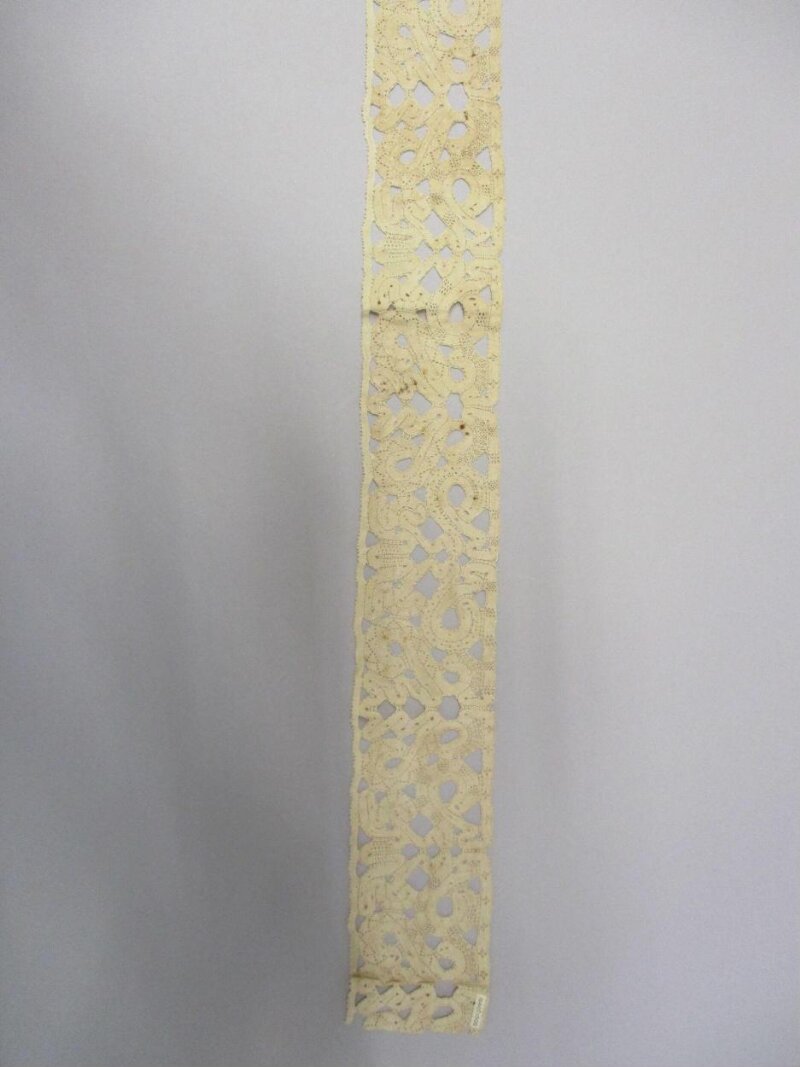
The subject of this report is a fragment of Point de France lace, dated circa 1670–1690, originating from the ateliers of Alençon, Normandy. This is not a casual relic; it is a product of state-sponsored industrial espionage. Under the mercantilist policies of Jean-Baptiste Colbert, Louis XIV’s finance minister, Venetian needle-lace makers were lured to France with exorbitant privileges to break the Italian monopoly. The resulting Point de France was a deliberate, political re-engineering of the needle lace technique, distinct from its Venetian antecedent in its finer ground network and its rigid, non-italicized floral motifs. For the modern atelier, this fragment is not merely decorative; it is a blueprint for structural logic, a frozen algorithm of thread management that speaks directly to the architectural ambitions of 2026 high fashion.
II. Technical Deconstruction: The Grammar of the Stitch
Our analysis begins with the material substrate. The fragment, preserved in a sealed archival box with desiccant, is composed of bleached flax linen thread, plied to a Z-twist and used singly for the finest réseau. The materiality is critical: flax, unlike cotton, possesses a high crystalline cellulose content, yielding a stiff, lustrous filament that does not stretch. This inherent rigidity is what permits the lace’s dramatic three-dimensional relief—the toilé—to stand proud of the ground. A modern synthetic or mercerized cotton would collapse under the same tension; flax is the only viable historical analogue for the structural integrity we seek.
The technical grammar is twofold:
1. The Ground (Réseau): The fragment exhibits the characteristic Alençon réseau, a hexagonal mesh constructed not by looping (as in bobbin lace) but by a single continuous buttonhole stitch, twisted and whipped. Each hexagon is approximately 0.8mm in diameter. The precision is astonishing: the thread passes over the bar, loops back, and is secured with a point de brides (a small, decorative picot) at each intersection. This is not a net; it is a tensioned lattice. The structural intelligence lies in the fact that the ground is not load-bearing. It is a negative space, a shadow-catcher designed to make the solid motifs appear to float. In 2026, we translate this as a laser-cut perforation strategy on bonded leather or technical jersey, where the "ground" is removed physically, leaving only the positive motif to act as a structural exoskeleton.
2. The Motif (Toilé and Mode): The floral scrollwork is executed in point de neige (a dense, overlapping buttonhole stitch) and point de reprise (a darning stitch filling). The edges of each petal are outlined with a thicker, cordonnet—a raised rim of overcast buttonhole stitches, often reinforced with a single horsehair filament. This cordonnet is the lace’s architectural ribbing. It provides the rigidity that allows the motif to be shaped into convex, almost sculptural forms. The deconstruction reveals a hierarchy of thread weights: a fine 120/2 for the ground, a medium 80/2 for the toilé, and a heavy 40/3 for the cordonnet. This tripartite tension system is the key to the lace’s drape. Without the heavy cordonnet, the piece would be flaccid; without the fine ground, it would be a solid, heavy textile.
III. Materiality and Degradation: The Archive’s Silent Language
The physical state of the fragment is a lesson in material fragility. Under 10x magnification, we observe fracturing along the fold lines, where the flax cellulose has oxidized and become brittle. The cordonnet, ironically, is the first to fail, snapping cleanly due to its high twist and lack of give. The ground, though finer, has survived better because it was under less constant tensile stress. This differential degradation informs our 2026 material choices. We cannot use flax in a garment meant for kinetic, living bodies—it will shatter. Instead, we must mimic flax’s behavior—its stiffness and lustrous, slightly irregular surface—using a high-performance filament such as polyamide 6.6 microfilament, coated with a ceramic nano-particle finish. This gives the same dry, matte hand and the same structural memory, but with 400% greater flexural fatigue resistance.
Furthermore, the original was white—not a pure optical white, but a natural, cream-toned ecru, achieved through repeated bleaching in sour milk and sunlight. This is not a color; it is a light-diffusion strategy. The uneven, slightly yellowed surface scatters light rather than reflecting it, creating a soft, haloed opacity. For 2026, we replicate this not with dye, but with a micro-etching of the fiber surface—a controlled, acid-free plasma treatment that creates microscopic irregularities, diffusing specular highlights and lending a ghostly, lunar luminosity to the silhouette.
IV. Translation into 2026 Haute Couture Silhouettes
The translation of this 17th-century artifact into a 2026 luxury context is not a literal reproduction. It is a structural transposition. The lace’s logic—a rigid, sculptural motif supported by an invisible, ethereal ground—is directly applicable to the current couture obsession with deconstructed tailoring and architectural volume.
Silhouette One: The Cordonnet Exoskeleton Gown
Here, the lace’s cordonnet logic is scaled up and reimagined as the garment’s primary structure. We abandon the fine ground entirely. Instead, the toilé motifs—the floral scrolls—are reinterpreted as 3D-printed, rigid polymer ribs, printed directly onto a base of sheer, double-faced silk gazar. The ribs follow the exact curvature and density of the original lace pattern, but they are placed on the exterior of the gown, acting as a corset-like exoskeleton. The gazar beneath is cut on the bias to allow fluid movement, while the polymer ribs provide the architectural hold. The visual effect is of a woman wearing a fossilized, baroque net—a silhouette that is simultaneously rigid and flowing, historical and futuristic. The hem is finished with a hand-applied, oversized version of the point de brides picot, now executed in clear, cast resin to mimic the original’s droplet-like shadow.
Silhouette Two: The Negative-Space Tailoring
This look translates the réseau—the ground—as the primary garment. Using a bonded, double-faced wool crepe, we laser-cut a hexagonal lattice pattern derived from the Alençon ground, but scaled up 400%. The cutouts are not left open; they are backed with a micro-pleated, iridescent organza that moves independently beneath the static wool. The garment—a sharp, cropped bolero jacket over a floor-length column skirt—uses the wool as the "rigid motif" and the organza as the "ethereal ground." The tension is reversed: the solid material is now the exception, and the void is the rule. This creates a garment that is 60% transparent, yet retains the sharp, tailored shoulder line of a classic 1940s suit. The structural integrity comes from the uncut, continuous warp threads that run through the laser pattern, ensuring the jacket does not disintegrate. This is a direct homage to the lace’s principle of non-load-bearing ground.
Silhouette Three: The Flax-Intelligence Bodysuit
For a more intimate, second-skin application, we utilize the lace’s tripartite thread hierarchy as a knit program. A seamless, circular-knit bodysuit is engineered with three distinct yarn feeds: a ultra-fine 20-denier silk for the "ground" knit; a medium 40-denier, high-twist silk for the "toilé" raised areas (created via a float-jacquard technique that pushes loops to the surface); and a thick, spongy, rubber-cored yarn for the "cordonnet" edges, which are knit into the structure as raised, ribbed seams. The bodysuit’s fit is mapped to mimic the original lace’s drape over a rigid corps de robe—it clings to the torso but flares slightly over the hips, echoing the historical understructure without reproducing it. The surface is finished with a subtle, off-white mother-of-pearl pigment, mimicking the flax’s historical sheen.
V. Conclusion: The Lace as a Structural Philosophy
The 17th-century Point de France fragment is not a relic of feminine delicacy; it is a document of masculine, structural engineering. Its logic—the separation of support (cordonnet) from surface (toilé) and void (réseau)—is a timeless principle of tension and release. For Natalie Fashion Atelier, the translation into 2026 is not about nostalgia but about re-asserting the primacy of material intelligence. By deconstructing the historical technique, we do not copy a look; we extract a law of construction. The resulting garments are not "lace-inspired" in the decorative sense. They are lace-logic garments, where every seam, every cutout, and every rib serves a load-bearing, architectural function. The Baroque past, in this reading, becomes the most radical blueprint for the future of couture—a future where ornament is not applied, but is the structure itself.