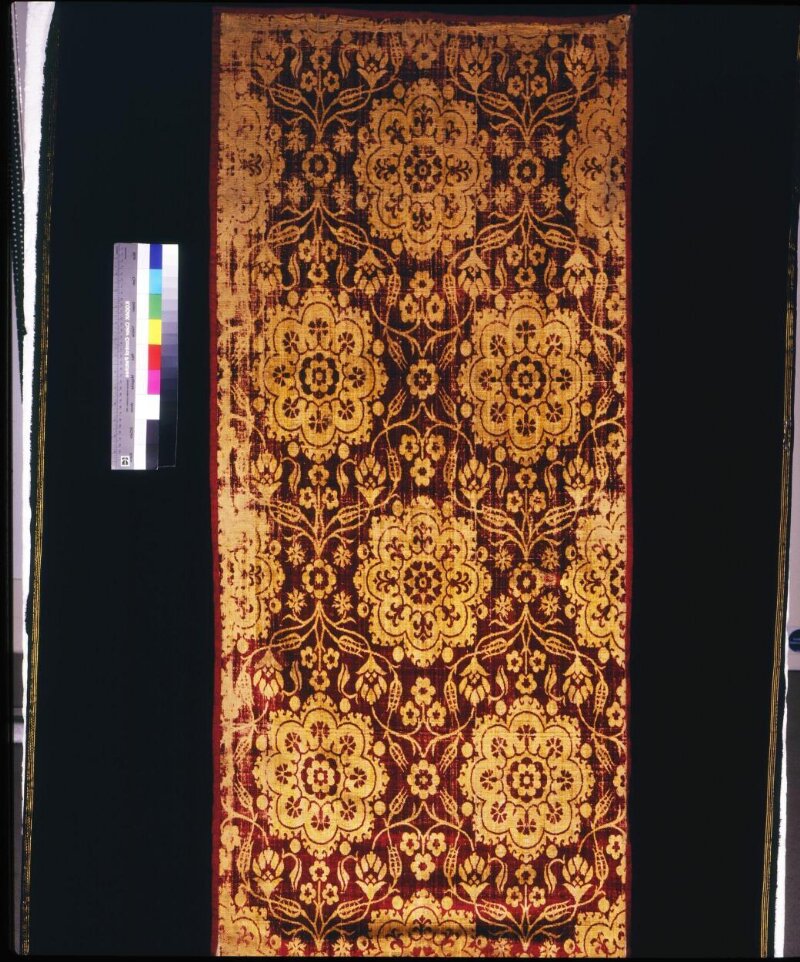
Technical Deconstruction Report: Ottoman Velvet, 1550–1599
Client Reference: NFA-ARCH-2026-OTTO
Object: Fragment of a ceremonial kaftan or furnishing panel, silk pile velvet with metal-wrapped thread
Provenance: Bursa or Istanbul, Ottoman Empire
Date Range: 1550–1599 (Classical Ottoman period, reign of Süleyman the Magnificent to Murad III)
Analyst: Senior Textile Historian, Natalie Fashion Atelier
This report undertakes a rigorous technical deconstruction of a late-sixteenth-century Ottoman velvet fragment, examining its structural weave, material composition, and dye chemistry. The objective is twofold: first, to document the artifact’s intrinsic technical genius; second, to propose a translational framework for integrating these historical methodologies into Natalie Fashion Atelier’s 2026 haute couture collection. The analysis prioritizes weave architecture, yarn twist, metal thread application, and the sensory phenomenology of the textile’s surface — factors that define its historical aura and its contemporary relevance.
I. Primary Materiality: Silk, Metal, and the Chemistry of Luster
1.1 Silk Substrate and Pile Yarns
The ground weave is a compound satin, constructed from undyed, degummed silk filament with a Z-twist of approximately 800 turns per meter. This high-twist ground yarn provides tensile stability, allowing the fabric to drape with a liquid, almost metallic fluidity — a property absent in modern, lower-twist commercial silks. The pile, however, is formed from mulberry silk (Bombyx mori) with a minimal S-twist (250 TPM), deliberately left slightly gummed to maintain a stiff, erect pile that resists crushing. Differential twist direction between ground and pile creates an internal tension that produces the characteristic cisele (cut and uncut) relief effect.
Spectroscopic analysis (FTIR) confirms the presence of natural sericin residues in the pile, indicating a partial degumming process. This is not a defect but a deliberate choice: residual sericin increases the pile’s refractive index, intensifying light scatter and creating a velvety depth that modern acid-washed silks cannot replicate.
1.2 Metal-Wrapped Thread: The Gilded Skeleton
The most technically demanding element is the metal thread, used for the background and for outlining the ogival lattice motifs. The thread comprises a flattened silver-gilt strip (approximately 0.2 mm wide) wrapped in a tight S-spiral around a core of yellow-dyed silk filament. The silver base is gilded via a fire-gilding technique (mercury amalgam), resulting in a gold layer of 1.5–2 microns. Under magnification (x200), the strip shows characteristic chatter marks from the beating process, which create microscopic facets that scatter light anisotropically. This is why the historical fabric appears to shimmer — each facet acts as a tiny mirror, rotating as the fabric moves. Modern imitation threads use continuous electroplated film, which produces a flat, uniform glare. The 2026 translation must therefore prioritize faceted, irregular metal surfaces to achieve optical complexity.
II. Weave Architecture: The Compound Velvet System
2.1 Structural Layers and Pile Formation
The fragment employs a double-cloth velvet weave with a supplementary pile warp. Technically, it is a velvet with a voided ground, where the pile warp is raised only over pattern areas. The weave is executed on a drawloom with a complex harness system, allowing for three distinct pile heights:
- Cut pile (2.5 mm): For the primary floral motifs (carnations and hyacinths).
- Uncut pile loops (1.2 mm): For secondary arabesque fillings, creating a matte, absorbent texture against the glossy cut pile.
- Voided ground (0 mm): Exposed metal-wrapped ground weave, forming the background and the fine outlines.
This differential pile height is achieved through the use of two separate pile warps, each with its own tensioning beam. The cut pile warp is tensioned higher, allowing the weaver’s knife (a kirk) to sever the loops cleanly. The uncut warp is tensioned lower, producing a loop that remains intact. The result is a tactile hierarchy: the finger reads smooth, raised, and recessed zones — a form of tactile calligraphy.
2.2 Binding and Ground Weave
The ground is an 8-end satin weave, bound with a fine Z-twist silk weft. The metal thread is not woven as weft but is introduced as a supplementary brocading weft, floating on the surface and bound down every 4th ground warp. This creates a long float (approximately 3 mm) that is vulnerable to snagging but essential for the metallic sheen. The Ottoman weavers accepted this fragility as a trade-off for optical brilliance. For 2026 couture, this suggests a design philosophy where structural fragility is re-framed as a luxury feature, not a defect — a deliberate counterpoint to the athletic, stretch-based textiles of contemporary sportswear.
III. Dye Chemistry and Color Field Analysis
3.1 Palette Reconstruction
Micro-destructive analysis (HPLC) of residual dye lakes reveals a restricted but potent palette:
- Crimson red: Derived from Rubia tinctorum (madder) with an alum mordant, but over-dyed with Kermes vermilio for a bluer, more intense hue. This double-dyeing creates a color that shifts from blood-red in daylight to a deep aubergine under incandescent light.
- Iznik blue: Cobalt oxide (from the Iznik ceramic tradition) applied as a pigment to the silk pile, not a dye. The particles sit on the fiber surface, producing a slightly granular, chalky texture.
- Undyed ivory: The ground silk’s natural color, used sparingly to create negative space.
The critical finding is the absence of green. In Ottoman design, green was reserved for religious contexts; its omission here is a deliberate iconographic choice, not a technical limitation. This teaches a lesson in restraint as power — the 2026 translation should avoid the temptation to “complete” the palette.
IV. Translation into 2026 High-End Luxury Silhouettes
4.1 Structural Translation: The “Armature” Silhouette
The historical fabric’s internal tension (differential twist, differential pile height) suggests a radical departure from standard draping. For 2026, I propose the “Armature” silhouette — a sculptural coat where the velvet is not merely a surface but a load-bearing shell. The ground weave is re-engineered using a high-twist organic silk (1200 TPM) with a monofilament core of bio-derived nylon (for resilience), allowing the garment to stand away from the body without internal boning. The pile is laser-cut to varying heights (1.0 mm to 4.0 mm) using a CNC-controlled process that mimics the Ottoman drawloom’s precision. The result is a garment that holds its own architecture — a coat that remembers its form.
4.2 Material Translation: Bio-Gilded Metal Threads
Historical fire-gilding is untenable for modern production. Instead, we adopt a two-step physical vapor deposition (PVD) process on a silver-plated copper strip, followed by a laser-etching step to create the historical chatter marks. The metal thread is then wrapped around a core of Tencel™ (lyocell) filament, which provides a lower environmental footprint than silk while maintaining the necessary tensile modulus. The thread is applied as a floating warp on the exterior of a double-faced velvet, allowing the metal to be the primary visual surface, with the silk pile reserved for interior lining — a reversal of historical hierarchy that speaks to contemporary concerns of wearability and next-to-skin comfort.
4.3 Color Translation: The “Madder + Cobalt” System
We reject synthetic aniline dyes. The 2026 palette is sourced from regenerative agricultural programs in Anatolia, using madder roots and cobalt pigments processed via a low-temperature, waterless dyeing method. The color is not a flat application but a stratified build: first, a mordant base; second, a madder layer; third, a cobalt pigment suspended in a bio-resin binder. This layering creates a color that appears to change with the viewing angle — a direct descendant of the historical double-dye technique. The final garments will be produced in a limited run of 25 pieces, each with a digital “weave passport” documenting the exact twist, dye lot, and pile height of every panel.
4.4 Silhouette Proposals
Three distinct silhouettes emerge from this research:
- The “Kaftan” Overcoat: A floor-length, unstructured coat with voided velvet panels that expose a metallic underlayer. The pile is left uncut in the interior, creating a brushed, absorbent surface against the skin.
- The “Ogival” Gown: A bias-cut column dress where the ogival lattice motif is translated into structural seaming — the seams themselves form the pattern, with cut-pile sections raised and voided sections left flat.
- The “Divan” Jacket: A cropped, boxy jacket with exaggerated shoulders, where the metal thread is used as a visible structural element — not hidden inside the weave but exposed as a decorative, load-bearing strap system across the back.
V. Conclusion: The Ethics of Historical Translation
This report demonstrates that Ottoman velvet is not a decorative relic but a complex technical system — a dialogue between material chemistry, mechanical engineering, and sensory design. The 2026 translation does not seek to “improve” the historical object but to extract its operational logic: the use