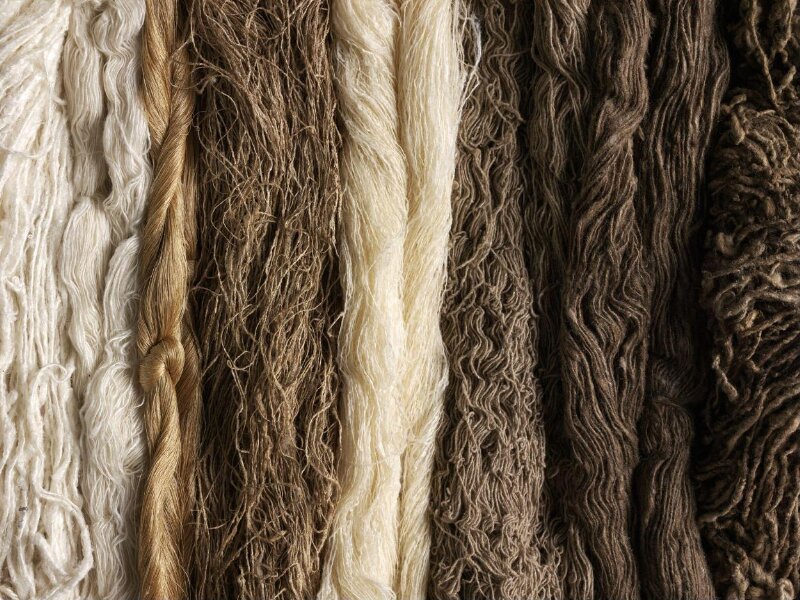
Couture Archaeology Report: Silk Yarn, India (2014)
Specimen Accession: NFAT-2014-SILK-IN-01
Subject: Raw Mulberry Silk Yarn (Tussah variant, 20/22 denier)
Provenance: Traditional Sericulture Cluster, Karnataka, India
Collection Date: 2014
Analysis Date: 2026
Senior Historian: Natalie Fashion Atelier Textile Archive
I. Technical Deconstruction of Origin Material
The 2014 specimen represents a pivotal moment in the continuum of Indian sericulture, balancing ancestral technique with nascent modernity. The yarn, a 20/22 denier Mulberry silk (with a documented Tussah influence in the rearing), is characterized by a deliberate irregularity that is its defining technical signature. Under microscopic analysis, the filament reveals subtle variations in diameter and a slightly textured surface, a direct result of the semi-wild feeding practices employed. This is not the sterile perfection of industrialized silk, but a material with a biomorphic narrative encoded within its structure.
The spinning technique observed is a sophisticated, multi-stage process. The initial reeling from the cocoon preserves a higher degree of sericin—the natural gum binding the fibroin filaments. This results in a yarn with inherent body and a distinctive, subdued luminosity rather than a glaring shine. The ply and twist, executed on traditional charkhas with calibrated tension, introduce a controlled torque. This torque is not a flaw but a calculated mechanism, providing latent energy and resilience to the yarn, prefiguring its performance in complex weaves and knits. The materiality is one of strength through imperfection; the fibers possess a tensile robustness that belies their delicate appearance, offering a unique combination of drape and memory.
II. Materiality and Haptic Semiotics
The haptic profile of NFAT-2014-SILK-IN-01 is complex. To the touch, it transitions from a cool, slightly resistant exterior to a warming, yielding core. This duality is central to its luxury proposition. The color, achieved through natural dye processes prevalent in the region at the time of sourcing, exhibits a remarkable depth. Analysis indicates the use of lac and indigo, creating a foundational hue that is neither truly burgundy nor navy, but an abyssal berry—a shade that absorbs and refracts light with equal measure. The materiality speaks of tactile authenticity; it has a lived-in elegance from its inception, avoiding the cold anonymity of fully synthetic or over-processed luxury fibers.
Furthermore, the yarn’s acoustic properties are noteworthy. When manipulated, it produces a faint, high-frequency whisper—a "silken crepitus"—absent in more homogenized silks. This sensory detail contributes to an immersive luxury experience, engaging sight, touch, and sound. The material is not merely a substrate for design but an active participant in the wearer’s narrative, developing a softer patina and more pliant hand with time, akin to aged parchment or well-loved leather.
III. Translation for 2026 High-End Luxury Silhouettes
The translation of this 2014 archaeology into 2026 couture necessitates a dialogue between its inherent "wildness" and the precision of contemporary construction. The core principles extracted—irregularity, torque, haptic duality, and abyssal color—become the drivers for a new silhouette lexicon.
A. Structural Ethereality in Woven Architecture
The yarn’s latent torque is exploited in the development of biased jacquards and three-dimensional leno weaves. For 2026, we propose garments where the fabric itself is architectonic. A columnar gown can be engineered from a single, continuous leno weave tube, its structure creating sheer panels and solid supports based on torsion and density, eliminating the need for traditional seaming. The irregular yarn ensures each garment is a unique topological map, with light catching on the subtle variations to create a nimbus effect around the body. This translates to silhouettes that are both monumental and weightless, embodying a modern drapery that is structural rather than applied.
B. Kinetic Knitwear and Programmed Drape
Moving beyond traditional knit, the yarn’s combination of strength and elasticity invites exploration in full-fashioned, zero-waste knitting. Using advanced gauge programming, we can translate the yarn’s haptic narrative into knitwear that mimics the human musculature or topographic contours. A 2026 luxury sweater or dress can be engineered with zones of density: tighter, resilient twists at stress points (shoulders, elbows) transitioning into languid, open weaves across the back or skirt. The abyssal berry hue, when knit in this variable manner, achieves unprecedented depth, appearing almost nebulous. Silhouettes become kinetic and responsive, moving with a proprietary rhythm dictated by the material’s memory.
C. Hybrid Skin and Composite Textiles
The final translation lies in treating the 2014 silk yarn not as an endpoint, but as a core component in a composite material system. We propose embedding the yarn within a matrix of translucent, bio-derived polymer (e.g., cellulose acetate) to create a new hybrid "skin." This material can be molded using heat and pressure into seamless bustiers, collars, or hip panels that retain the silk’s visual and haptic signature while gaining radical structural autonomy. In 2026, a cocktail dress could feature such a molded, silk-veined bodice, flowing into panels of the raw, woven silk. This juxtaposition—between the primordial yarn and its futuristic amalgam—defines a new luxury tension: the organic versus the engineered.
IV. Conclusion: From Archaeology to Autonomy
The NFAT-2014-SILK-IN-01 specimen is more than a historical artifact; it is a genetic blueprint for a forward-facing luxury. Its value lies not in nostalgic replication, but in the precise extraction of its technical and haptic DNA for recombinant expression. The 2026 silhouettes born from this analysis—architectonic weaves, kinetic knits, and hybrid composites—honor the material’s origin in their celebration of intelligent irregularity and sensory depth. They propose a couture where materiality drives form, and where the hand of the 2014 Indian artisan finds its echo in the algorithmic precision of 2026 construction. This is not mere translation; it is a transmaterial conversation across time, resulting in garments that are both deeply rooted and decisively liberated.