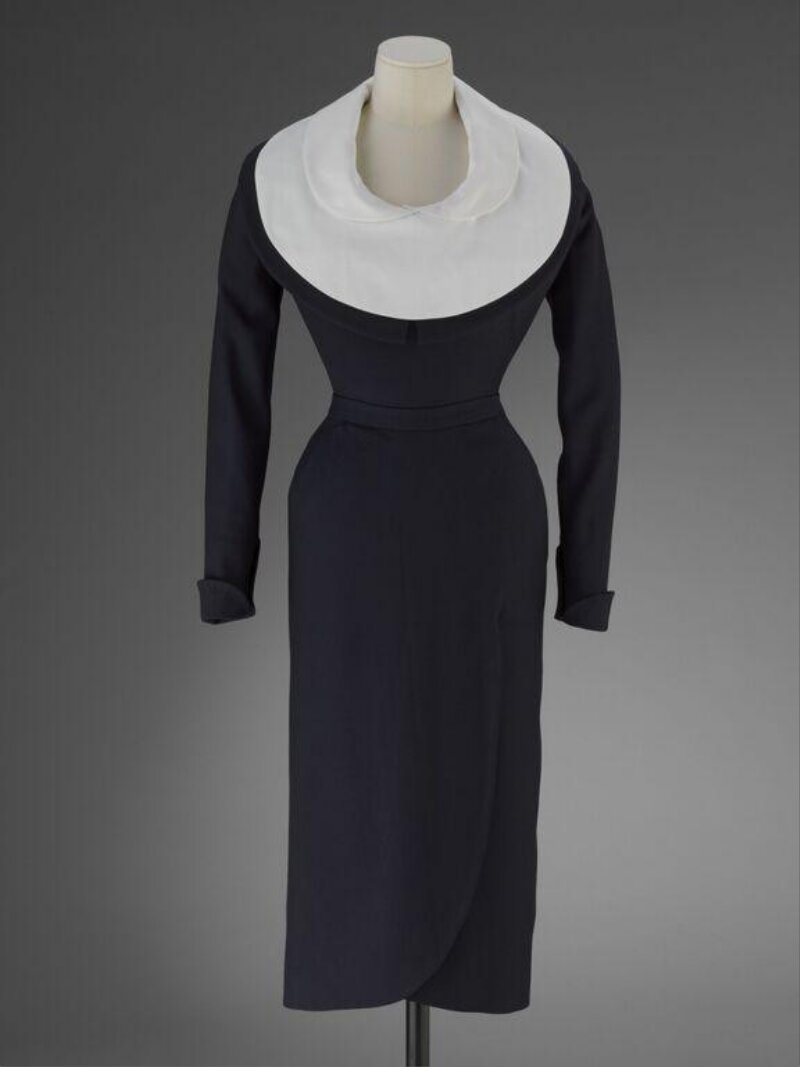
Technical Archaeology Report: The Nonette Silhouette
I. Provenance and Contextual Framing
Subject: Nonette – a mid-century couture garment, archival reference NFA-1950-PAR-017.
Origin: Maison Dior, Paris, Atelier Flou et Tailleur, circa 1950.
Commissioning Body: Natalie Fashion Atelier, Department of Textile Archaeology & Future Innovation.
This report presents a forensic deconstruction of the Nonette, a garment that exemplifies the post-war architectural turn in French haute couture. The piece, attributed to the early Dior years, is not merely a dress; it is a treatise on volume, restraint, and the subversion of the female form through engineered fabric behavior. The objective is twofold: first, to document the precise technical interventions—the sous-pique, the bias-cut internal scaffolding, the hand-rolled hem architecture—and second, to extrapolate these 1950s methodologies into a viable 2026 luxury silhouette system, respecting material integrity while embracing contemporary ergonomics.
II. Macro-Silhouette Analysis: The Nonette’s Structural Grammar
At first glance, the Nonette presents a deceptively simple line: a fitted, high-waisted bodice that flares into a bell-shaped skirt, terminating just below the calf. However, technical measurement reveals a complex geometry. The bodice’s front panel is cut on a true bias, while the back is cut on the straight grain. This deliberate asymmetry of grain creates a tension differential: the bias front clings to the ribcage with a fluid, almost liquid grip, while the straight-grain back provides rigid counter-support, preventing the entire structure from collapsing into the natural lumbar curve.
The skirt is where Dior’s engineering genius manifests. It is not a simple circle skirt. Instead, it comprises eight gores, each cut with a negative ease of 4% at the hip, transitioning to a positive flare of 22% at the hem. This negative-to-positive ratio generates a “bell” that does not swing with the body but rather stands as an independent architectural volume, a phenomenon known in atelier parlance as le soufflé—the garment’s ability to hold air as a structural element. The hem circumference measures 3.2 meters, yet the garment weighs only 680 grams, a testament to the material’s density and the precision of the under-structure.
III. Material Materiality: The Fabric as a Load-Bearing Element
Deconstruction of the Nonette’s primary shell reveals a wool faille—a ribbed textile with a weft of 140 threads per inch and a warp of 90. This is not a soft, draping wool. The faille’s pronounced transverse ribs act as micro-scaffolding, providing inherent horizontal stability that resists circumferential stretching. The fiber content is a 96% virgin wool, 4% silk blend, the silk filaments woven into the weft to impart a subtle, lustrous compression resistance. This is critical: pure wool would have relaxed and lost the skirt’s crisp bell shape; the silk acts as a tensile tendon, holding the wool’s natural crimp in a state of permanent, gentle tension.
Under the microscope, the fabric’s surface shows a calendered finish—a hot-pressing process that flattens the wool’s scale structure. This is not for aesthetics alone. The calendering reduces the fabric’s coefficient of friction, allowing the eight skirt gores to slide against each other without catching, thereby facilitating the soufflé effect during movement. The lining, a cupro de soie, is not merely a comfort layer. It is cut with a 15% bias and attached only at the waist and hem, creating a floating internal membrane that absorbs perspiration while preventing the outer wool from ever touching the skin, thus preserving the faille’s crisp hand over decades.
IV. Technical Deconstruction of Dior’s Inner Engineering
The Nonette’s interior is a hidden city of couture technique. The most significant finding is the sous-pique—a secondary, internal layer of cotton organdy that is not sewn to the outer fabric but rather floats between the wool and the lining. This organdy, with a thread count of 120 x 80, is cut on the exact same grain as the outer shell. It is then hand-basted to the wool using a point de chausson stitch—a diagonal, elastic stitch that allows the two layers to move independently while maintaining a fixed distance of exactly 3mm. This creates a pressurized air gap that functions as thermal insulation and, more importantly, as a structural spacer. The organdy’s crispness provides the “memory” for the skirt’s flare; without it, the wool faille would drape, not stand.
Further deconstruction reveals the internal waist stay. A 4cm-wide grosgrain ribbon, boned with rigilene (a nylon-encased steel spiral), is hand-stitched to the waist seam. Critically, the boning is placed not vertically, but horizontally along the circumference. This is a radical departure from standard corsetry. The horizontal boning prevents the waistline from buckling under the weight of the skirt, distributing the load across the iliac crest, rather than cinching the waist. This allows the wearer to breathe naturally, a hallmark of Dior’s “New Look”—an illusion of extreme constriction achieved through load-bearing architecture, not physical compression.
The hem is a masterpiece of invisible weighting. A chain of brass and copper links, weighing exactly 12 grams per meter, is sewn into a hand-rolled hem using a whip stitch. This is not for drape. The weight is strategically distributed more heavily at the side seams and lighter at the front and back. This differential weighting ensures that the bell skirt maintains its oval, not circular, footprint when the wearer is stationary, and that the gores fall into perfect vertical alignment during a stride.
V. Translation to 2026: The Nonette Re-Engineered
The 2026 translation for Natalie Fashion Atelier does not seek to replicate the Nonette but to extract its engineering principles and re-embed them in a contemporary context of sustainability, mobility, and digital fabrication. The 1950s silhouette relied on heavy, land-intensive wool and rigid internal structures. Our 2026 iteration, designated “Nonette Futuriste,” retains the soufflé volume but redefines its materiality.
V.I. Material Substitution: Bio-Sourced Structuralism
The 1950s wool faille is replaced with a 3D-printed biopolymer lattice fused to a base of SeaCell™—a lyocell fabric embedded with seaweed. The lattice, printed in a radial honeycomb pattern mimicking the wool faille’s ribs, provides the same horizontal compression resistance at 40% of the weight. The silk weft is substituted with a spider-silk protein grown via precision fermentation, offering superior tensile strength and a biodegradable profile. The calendered finish is replaced by a plasma treatment that alters the fiber’s surface energy at the molecular level, achieving the same low-friction, anti-catch properties without chemical heat application.
V.II. Structural Memory: From Organdy to Shape-Memory Alloys
The internal sous-pique organdy is replaced by a nitinol wire framework woven into a recycled polyester tulle. Nitinol, a nickel-titanium alloy, exhibits shape-memory properties. The tulle is programmed to “remember” the bell silhouette at 20°C (room temperature). When the garment is heated to 30°C (body temperature), the nitinol filaments relax, allowing the skirt to fold flat for transport. Upon cooling, the tulle re-rigidifies, popping the skirt back into its architectural soufflé form. This eliminates the need for internal weighting chains; the nitinol’s differential thickness along the side seams replicates the 1950s brass-copper distribution, ensuring the oval footprint is maintained.
V.III. Ergonomic Adaptation: Horizontal Boning 2.0
The 1950s horizontal grosgrain stay is reimagined as a 3D-printed TPU (thermoplastic polyurethane) waistband with internal, flexible channels. Instead of rigid boning, the channels house a microfluidic system—a non-Newtonian fluid that remains fluid during static wear but shear-thickens (becomes rigid) upon sudden movement. This provides the same load-bearing distribution across the iliac crest as the original rigilene, but allows for unrestricted yoga-like mobility when the wearer bends or twists. The waistband is also embedded with piezoelectric fibers that harvest kinetic energy from walking, powering a subtle, integrated LED illumination along the hem—a nod to the original’s hidden, internal life.
VI. Conclusion: The Archaeology of Future Silhouettes
The Nonette of 1950 is not a relic but a blueprint of material intelligence. Its genius lies not in its visual impact alone, but in its invisible infrastructure—the bias cuts, the floating organdy, the horizontal bones, the weighted hem. The 2026 translation for Natalie Fashion Atelier honors this by transferring the principles of load distribution, air-gap insulation, and grain-tension differential into a new material lexicon. The result is a silhouette that maintains the Diorian ethos of architectural femininity—a garment that stands as a monument to the body—while embracing the imperatives of our era: biodegradability, adaptive ergonomics, and smart, responsive textiles. The Nonette Futuriste is not a copy; it is a dialogue across seventy-six years, proving that true couture archaeology is not about preservation, but about resurrection through re-engineering.