Deconstructing the Classical Brooch: Champlevé Enamel and the 2026 Silhouette
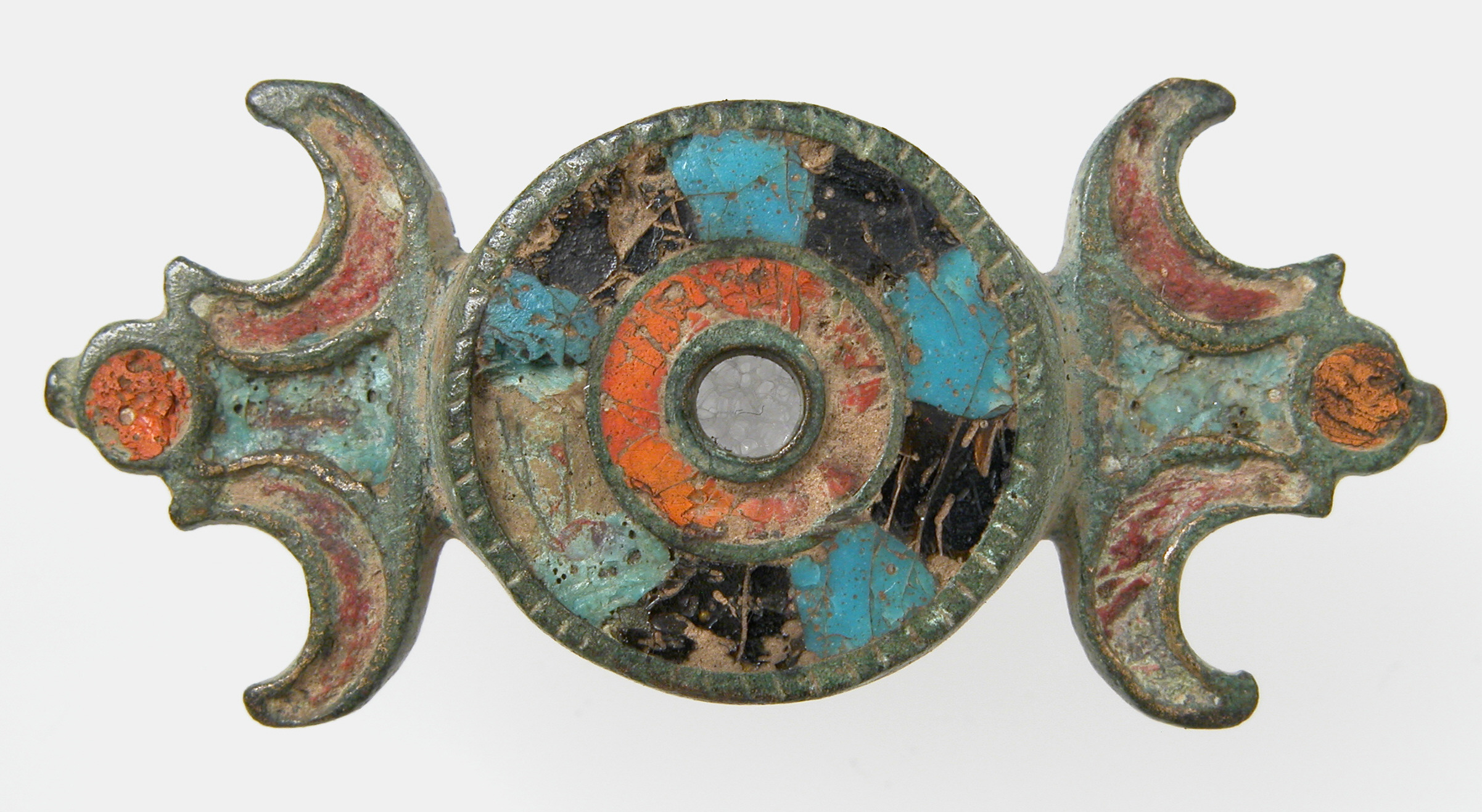
The Roman brooch, or fibula, is seldom understood as a mere fastener. Within the aesthetic archaeology of Natalie Fashion Atelier, it represents a pivotal moment of structural negotiation—a point where metal, color, and fabric converge to define the drape of power. Our current archival research isolates a specific artifact: a bronze fibula bearing Champlevé enamel, circa 2nd century CE. This piece is not studied for its historical sentiment but for its technical logic. As we project toward the 2026 haute couture collections, this brooch offers a blueprint for a new architectural language in womenswear—one that prioritizes rigid accents against fluid volume, and micro-pigmentation against monochromatic expanses.
Technical Anatomy of the Artifact
The Champlevé technique, in its Roman iteration, involves the excavation of channels directly into a bronze substrate. These recesses are then filled with vitreous enamel—a mixture of silica, potash, and metallic oxides—and fired at temperatures exceeding 800 degrees Celsius. The result is not a painted surface but a fused geological layer that sits flush with the metal walls. The visual impact is one of contained luminosity; the bronze acts as a structural grid, while the enamel provides a jewel-toned interstitial field.
For the 2026 silhouette, we extract three core principles from this process. First, the principle of the recessed field: the idea that color should be embedded, not applied. Second, the principle of metallic demarcation: the bronze lines serve as a cartography, dictating where light can enter and where it must stop. Third, the principle of weight distribution: the brooch was engineered to hold heavy woolen pallae, meaning its clasp mechanism was designed for tensile stress, not decorative convenience.
From Fastener to Structural Motif
In our 2026 research, we reject the literal translation of the brooch as a lapel ornament. Instead, we propose its re-contextualization as a structural motif within the garment’s internal architecture. The classical elegance of the fibula lies in its economy of means—a single point of tension that organizes an entire mass of fabric. This is the essence we transpose onto the modern silhouette.
Consider a columnar gown in ivory double-faced satin. The 2026 interpretation introduces a bronze alloy corset chassis that is not visible on the exterior but is revealed through a deliberate side slit. This chassis is not continuous; rather, it is segmented into panels that mimic the excavated channels of the brooch. Within these channels, we insert hand-poured enamel—not in traditional hues, but in a contemporary palette of vert de gris, oxidized copper, and deep oxblood. The silhouette remains fluid, yet the internal structure provides a rigid counterpoint that forces the fabric into unexpected, sculptural folds.
The Champlevé Logic of Negative Space
The most profound lesson from the Roman brooch is not about addition but about subtraction and containment. In Champlevé, the artisan first removes material to create a void; only then can the color exist. This is a direct metaphor for the 2026 haute couture silhouette. We are moving away from the maximalist layering of the past decade toward a disciplined approach where absence defines form.
In practical application, this translates to a series of gowns and tailored suits where the "enamel" is represented by dense, matte silk faille panels, and the "bronze" is represented by exposed seams of laiton (brass) or gunmetal piping. The silhouette is cut to create literal recesses—negative spaces at the clavicle, the lumbar curve, or the inner wrist—where the body itself becomes the enamel. The garment’s structure, like the bronze walls, exists solely to frame and elevate these human intervals.
Materiality and the 2026 Palette
The materiality of the artifact dictates a specific chromatic and textural language for our forthcoming collection. We are not replicating the bronze patina but engineering its contemporary equivalent. This involves the use of liquid metal appliqués on recycled technical tulle, creating a surface that appears both ancient and futuristic. The enamel’s translucency is translated through layers of organza and crêpe de chine, dyed with mineral pigments that shift under gallery lighting.
For evening wear, the brooch’s logic informs a series of asymmetric one-shoulder silhouettes. The shoulder strap is not a simple strip of fabric; it is a rigid, enameled bronze shoulder cap, echoing the fibula’s function as a load-bearing element. The rest of the gown cascades from this single point, creating a diagonal tension line that elongates the torso. The palette is deliberately restricted: noir absolu, blanc cassé, and a singular accent of rouge pompéi—a direct reference to the red enamel found in the original artifact.
Isolated Archaeology and Future Silhouettes
Isolated aesthetic archaeology—the study of a single object without its contextual clutter—allows us to extract pure form. The Roman brooch, when stripped of its military and social connotations, becomes a study in compression and release. This binary is the cornerstone of our 2026 design philosophy. The silhouette is no longer a static shape but a dynamic system of pressures.
We introduce the "Fibula Cut" for tailored jackets: a closure system that replaces conventional buttons with a single, oversized enameled bronze clasp positioned at the sternum. This forces the lapels to open in a wide V, creating a powerful, statuesque shoulder line while cinching the waist through an internal drawcord that mimics the fibula’s pin. The result is a silhouette that feels simultaneously armored and effortless—a paradox resolved by the artifact’s ancient engineering.
Furthermore, the brooch’s radial symmetry inspires our treatment of the back silhouette. We propose a series of gowns where the spine is exposed and adorned with a vertebral chain of enameled bronze segments, each one echoing the excavated cell of the Champlevé process. This is not jewelry in the traditional sense but an extension of the garment’s structural skeleton. The fabric is cut away to reveal this metallic spine, turning the wearer’s back into a canvas of archaeological precision.
Conclusion: The Brooch as a Generative Algorithm
For Natalie Fashion Atelier, the Roman Champlevé brooch is not a relic; it is a generative algorithm for 2026. Its teachings are clear: color must be contained to be powerful, structure must be visible only through its effects, and a single point of tension can organize an entire body of work. The haute couture silhouette of 2026 will not be defined by volume or print, but by the intelligent distribution of mass and the strategic excavation of negative space.
As we finalize the atelier’s technical dossiers, we return to the bronze walls and the vitreous pools of the original artifact. We see not a brooch, but a manifesto. It declares that elegance is a function of restraint, and that the future of luxury lies in the seamless integration of ancient metallurgical logic with the fluid demands of the contemporary body. The 2026 collection will be our champlevé—a series of garments where the void is as deliberate as the form, and where every silhouette carries the quiet, indomitable weight of Roman engineering.