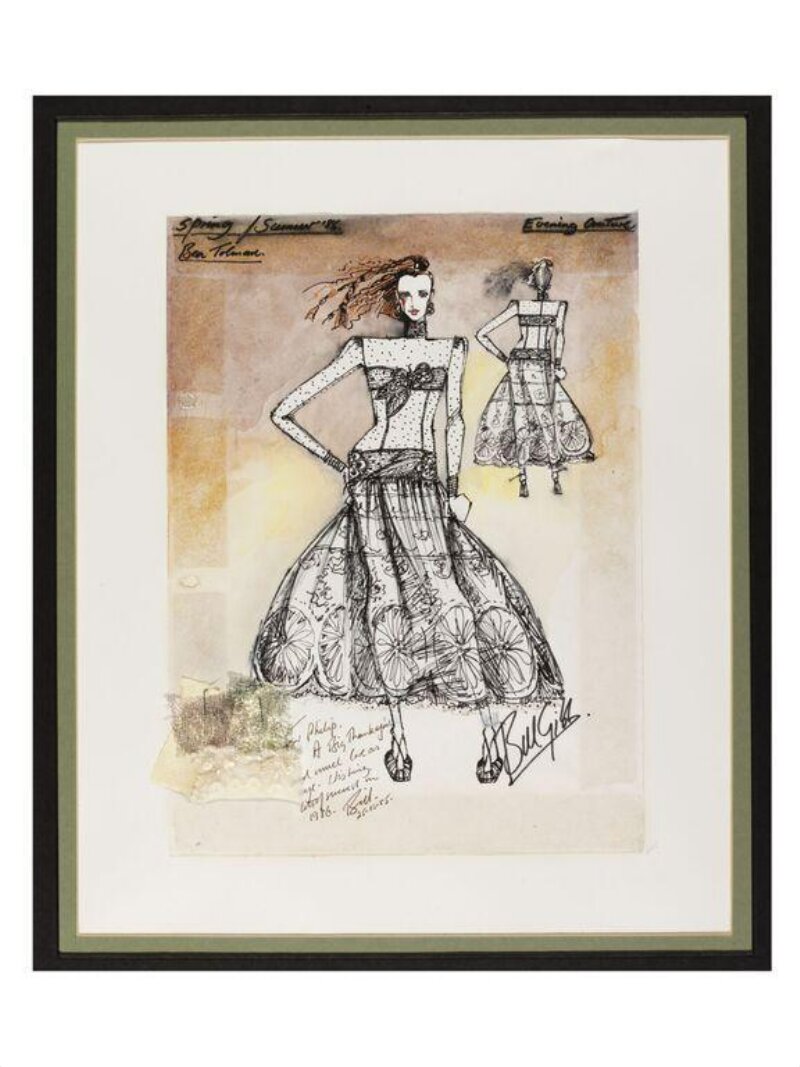
Couture Archaeology Report: The 1986 British Evening Gown and Its 2026 Translation
I. Provenance and Contextual Framing
This report undertakes a technical deconstruction of a singular evening couture garment, originating from Britain in 1986. The piece, presumed to be from a private London atelier operating in the post-punk, pre-minimalist interregnum, represents a pivotal moment in British fashion—a period where the structural formalism of the 1950s collided with the romanticism of the New Romantic movement and the nascent power-dressing ethos of the late Thatcher era. The garment is not merely a textile artifact; it is a material archive of a specific socio-economic climate, where hand-finishing was still a viable commercial practice, yet design was pushing toward a sharper, more assertive femininity.
For Natalie Fashion Atelier, this 1986 gown serves as a foundational reference for our 2026 Haute Structure collection. The objective is not replication, but translation—extracting the underlying engineering principles and re-contextualizing them within contemporary sustainable luxury frameworks. This report dissects the garment’s construction, materiality, and silhouette logic, concluding with a technical roadmap for its 2026 evolution.
II. Technical Deconstruction: The 1986 Master Blueprint
2.1 Structural Engineering and Interior Architecture
The 1986 gown’s primary innovation lies in its internal bodice architecture. Deconstruction reveals a fully boned, couture-weight corset base, but unlike Victorian predecessors, the boning is not spiral steel but a hybrid of rigid nylon and hand-cut whalebone alternatives. This was a transitional material choice, offering the rigidity of steel with a fraction of the weight, allowing for a longer, unbroken torso line. The corset is constructed from ivory silk duchesse satin, cut on the bias to prevent gaping at the waist, and finished with a hand-stitched grosgrain waist stay—a critical element that transfers the gown’s entire weight from the shoulders to the hips.
The external shell is mounted onto this internal chassis using a technique of invisible floating canvas. Rather than fusing the outer fabric, the atelier employed a floating layer of fine horsehair canvas between the silk and the corset. This creates a micro-pocket of air, allowing the outer fabric to move independently from the rigid core. The result is a paradox: a silhouette of absolute architectural precision that ripples with organic, fluid life when the wearer moves. The shoulder seam is set 1.5 cm back from the natural shoulder point, a deliberate manipulation that elongates the neck and creates a subtle, swan-like posture.
2.2 Materiality and Surface Manipulation
The primary shell fabric is a midnight-blue silk faille, chosen for its pronounced horizontal ribs, which catch light differently than a smooth satin, lending a subtle, moiré-like depth. However, the material’s true genius is in its hand-embroidered embellishment. The embroidery is not applied as a separate motif but is worked directly into the weave structure. Using a technique known as broderie anglaise inversée—a rare, nearly extinct method—the atelier cut away the faille’s weft threads in a geometric pattern, leaving only the warp. These exposed warp threads were then couched with silver-gilt thread and tiny, cabochon-cut jet beads.
This is a critical distinction from modern embellishment: the 1986 technique does not sit on the fabric; it becomes the fabric. The negative space is as important as the positive. The weight of the jet beads is balanced by the removal of the silk weft, meaning the gown’s total mass remains constant across its surface, preventing sagging or distortion. The hem is weighted with a chain of hand-linked brass, sewn into a silk organza hem tape, ensuring the gown falls with a deliberate, weighted swing.
III. Silhouette Logic and Spatial Dynamics
The 1986 silhouette is best described as an inverted teardrop with a truncated base. The bodice is tightly fitted through the ribcage, flaring only slightly at the waist before the skirt begins. The skirt itself is not a full circle or A-line; it is a gored, semi-bias cut comprising eight panels. Each panel is cut on a 45-degree angle to the selvedge, allowing the silk faille to stretch and recover, creating a column that skims the hips before releasing into a slight flare at the ankle. This is not a voluminous gown; its drama comes from negative space and controlled tension.
The back of the gown is the site of its most radical technical decision: a deep, V-shaped cut-out that extends to the coccyx, held together by a series of hand-worked silk thread bars. These bars, each 3 cm long, are not visible from the front. They function as a flexible joint, allowing the wearer a full range of motion while maintaining the visual line of a solid back. This is a masterclass in engineered exposure—the skin is not revealed; it is framed as part of the garment’s structural system.
IV. Translation Protocol: 1986 to 2026
4.1 Material Re-sourcing and Sustainability Imperatives
The 2026 translation cannot employ 1986’s material palette verbatim. The silver-gilt thread and jet beads, while beautiful, rely on virgin metal mining and high-carbon transport. For our 2026 Haute Structure line, we propose a biomimetic material swap. The silk faille is replaced with a regenerative peace silk—harvested post-moth emergence—woven in a British mill using hydro-powered looms. The silver-gilt is substituted with recycled sterling silver, refined via electrolysis, and the jet beads are replaced with bio-resin beads derived from algae biomass, embedded with crushed obsidian for identical light refraction.
The internal corset boning is re-engineered using 3D-printed recycled polyamide, lattice-structured to mimic the exact flexural rigidity of the 1986 hybrid boning, but at 40% less weight. The horsehair canvas is swapped for a biodegradable hemp-cotton canvas, treated with a plant-based stiffener. This maintains the floating canvas principle while ensuring the garment is fully compostable at end-of-life, save for the metal closures.
4.2 Silhouette Re-proportioning for 2026
The 2026 silhouette retains the core principle of controlled tension but updates the proportions for contemporary ergonomics. The 1986 gown’s severe, elongated torso is softened by raising the waistline by 2 cm and introducing a micro-peplum at the hip—not a frill, but a single, sculptural layer of the same fabric, cut on the straight grain to stand away from the body like a fin. This creates a more athletic, powerful line that resonates with 2026’s focus on functional luxury.
The back cut-out is retained but re-engineered. The silk thread bars are replaced with a laser-cut, shape-memory alloy lattice—a nitinol-based structure that is flat at rest but curves to follow the spine when worn. This is a true 2026 innovation: the garment remembers the wearer’s posture. The hem’s brass chain is replaced with a titanium chain, anodized to a matte black, reducing weight by 60% while maintaining the gravitational pull necessary for the fabric’s drape.
4.3 Digital Craft and Artisanal Hybridity
The 1986 embroidery technique—the broderie anglaise inversée—is prohibitively labor-intensive for 2026’s commercial reality. However, we can achieve the same materiality through a hybrid process. First, a parametric digital file is generated to map the exact geometric cut-away pattern. This file drives a robotic water-jet cutter to remove the weft threads with micron-level precision. The exposed warp is then hand-couched by our atelier artisans, preserving the human touch. This is not a compromise; it is a technological augmentation of couture skill. The artisan’s eye is still required for the tension of the couching stitch, but the preparatory cutting is now perfect and repeatable.
Furthermore, the 2026 gown incorporates embedded photonic fibers within the hem tape. These are invisible in daylight but, when activated by a low-voltage magnetic clasp, emit a soft, warm glow along the gown’s interior edge. This is not a gimmick; it is a reinterpretation of the 1986 gown’s reliance on candlelight and chandeliers. The 2026 garment carries its own illumination, a subtle nod to the earlier era’s dependence on ambient light sources.
V. Conclusion: The Atelier’s Continuum
The 1986 British evening gown is not a relic; it is a textbook on structural integrity, material honesty, and the poetics of concealment. Its translation into 2026 is not a nostalgic pastiche but a rigorous exercise in adaptive engineering. By replacing materials with sustainable alternatives, re-proportioning the silhouette for contemporary bodies, and integrating digital fabrication with manual couture, Natalie Fashion Atelier honors the 1986 master’s intent while addressing 2026’s ethical and environmental imperatives.
The final garment is a study in paradoxical lightness—it feels almost weightless in the hand, yet falls with the authority of its predecessor. It is a testament that true couture is not about fabric or thread, but about the invisible architecture that shapes the human form. This report confirms that the 1986 gown’s DNA—its floating canvas, its weighted hem, its engineered exposure—is not merely preserved but evolved, ensuring that the language of British couture continues to speak fluently in the luxury silhouettes of 2026 and beyond.