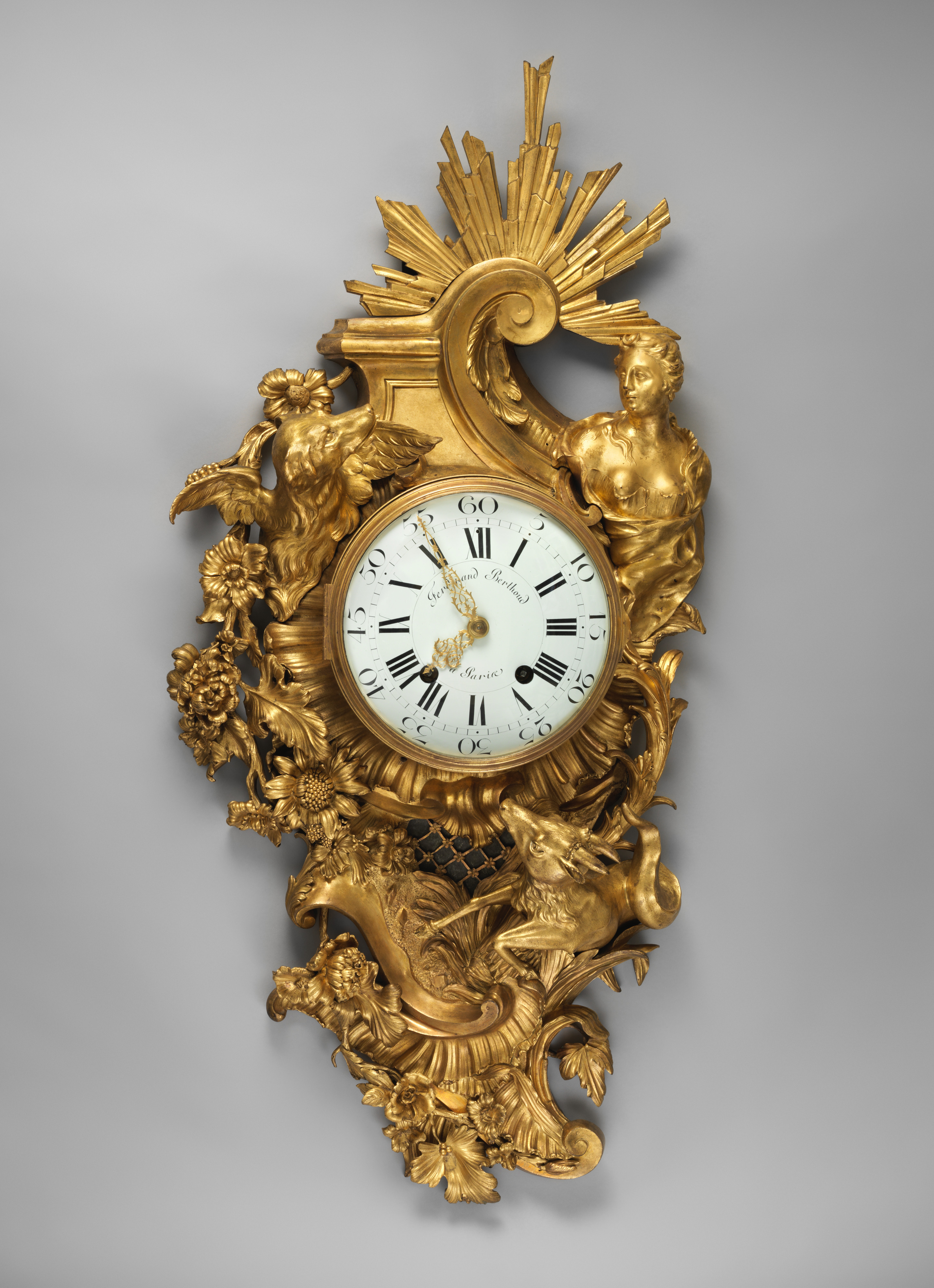
The Cartel Reconsidered: Gilt Bronze Temporality and the 2026 Silhouette
The cartel clock—a wall-mounted timepiece of French origin, celebrated for its ornate gilt bronze casing—occupies a peculiar position within the aesthetic archive. Stripped of its horological function, its movement replaced by a later, anonymous mechanism, the object becomes a pure vessel of decorative intent. For Natalie Fashion Atelier, this isolation is not a loss but a liberation. The cartel, divorced from utility, reveals its essential grammar: a choreography of negative space, a tension between rigid metallic structure and organic foliate exuberance, and a surface that performs light rather than merely reflecting it. This research artifact deconstructs that grammar to propose a material and structural lexicon for high-end 2026 silhouettes, where historical opulence is translated into contemporary restraint through technical innovation.
I. Aesthetic Archaeology: The Cartel as Pure Form
Within the isolated context of the archive—no provenance, no maker’s mark, no chronological anchor—the cartel clock demands a different mode of reading. We do not ask when it was made, but how it composes space. The gilt bronze surface, typically achieved through mercury gilding or, later, electrochemical processes, offers a dual register: the high-polish brilliance of the fonds luisants against the matte, sandblasted fonds brunis. This chiaroscuro of metal is the first lesson for 2026. It is not about uniform luminosity but about controlled variance—a fabric that shifts from liquid sheen to granular opacity within a single panel, creating a topographical depth that mimics the cartel’s carved relief.
The cartel’s asymmetrical composition—often a central circular dial flanked by cascading acanthus leaves, a surmounting crest, and a trailing base—is a study in centrifugal balance. The eye is drawn to the center, then expelled outward along the gilded tendrils, only to be recaptured by the rigid outer frame. This dynamic of containment and release offers a direct blueprint for the 2026 silhouette. The body becomes the dial; the architectural seams and boning act as the frame; the drapery or paneling, the foliate escape. The result is a garment that does not merely clothe but orchestrates visual circulation.
II. Material Translation: From Gilt Bronze to Wearable Architecture
The translation of gilt bronze into haute couture requires a reimagining of weight, drape, and thermal comfort. We propose three material vectors, each derived from the cartel’s specific materiality.
Vector One: Liquid Metal Jacquard. The cartel’s polished surfaces are replicated through a custom jacquard weave integrating metallized polyamide filaments with a silk warp. The key is not a flat metallic thread but a dual-twist construction—one filament polished, one micro-etched—producing a fabric that, under gallery lighting, reveals the same alternating specular and diffuse reflection as the bronze’s chased and burnished zones. The drape is engineered to be substantial, with a weight of 380 g/m², allowing the fabric to hold sculptural folds reminiscent of the clock’s cast relief.
Vector Two: Galvanic Leather. For structural elements—the equivalent of the cartel’s rigid frame—we employ vegetable-tanned calf leather subjected to a low-voltage galvanic deposition of brass. This is not a surface foil but a molecular bonding process, resulting in a material that retains leather’s suppleness while acquiring bronze’s compressive strength. The leather can be die-cut into intricate, clockwork-like filigree, then heat-set to curve around the body, mimicking the cartel’s courbe en console. This material is reserved for corsetry, collar structures, and hemline armatures—the squelette of the garment.
Vector Three: Oxidized Organza. The cartel’s patina—that subtle greenish or brownish bloom of aged bronze—is often erased in restoration. We choose to preserve its ghost. A silk organza is treated with a controlled oxidation bath, using copper salts to create irregular, mottled discoloration along the fabric’s edges and folds. This is not a print but a chemical memory, a nod to the clock’s passage through time. In 2026, this material will form translucent overlayers, allowing the oxidized zones to shadow the skin, creating a chiaroscuro effect that echoes the bronze’s aged recesses.
III. Silhouette Logic: The Cartel’s Proportions on the Body
The cartel’s proportions—typically a vertical ratio of 1:2.5, with the dial occupying the upper third—inform a new set of garment proportions that reject the current binary of oversized and bodycon.
The Crested Shoulder. The cartel’s surmounting crest—often a vase, a bird, or a burst of leaves—provides the model for an asymmetric shoulder construction. One shoulder is extended and padded with a rigid, galvanic leather shell, rising 4 cm above the natural acromion. The opposite shoulder remains bare, sheathed only in the liquid metal jacquard. This creates a diagonal axis of visual weight, recalling the clock’s off-center crowning element. The effect is not costumey but architectural, a deliberate imbalance that forces the eye to travel the garment as it would the clock’s face.
The Dial Waist. The central circular dial—often with Roman numerals—is abstracted into a circular cutout at the waist, framed by a rigid bronze-toned ring of galvanic leather. The cutout is not placed at the natural waist but slightly elevated, at the xiphoid process, creating a fausse high-waist effect. The fabric above and below is gathered into radiating pleats, mimicking the clock’s hour markers. This is a deliberate play on centrality and periphery: the exposed skin becomes the dial’s face, while the pleats function as the hands, pointing toward the body’s own temporal movement.
The Foliate Train. The cartel’s trailing base—often a cascade of acanthus and rocaille—is translated into a detachable train composed of layered, laser-cut oxidized organza panels. Each panel is shaped like an elongated leaf, with edges burnt and curled via heat application to mimic the chased undulations of the bronze. The train attaches at the lower back via a concealed magnetic system, allowing it to be removed for a more austere, columnar silhouette. When worn, it creates a sense of frozen motion, as if the garment itself were a timepiece whose pendulum has been arrested mid-swing.
IV. Construction Methodology: The Chaser’s Hand
The cartel’s bronze was not cast in one piece; it was assembled from multiple chased and riveted elements. This modularity is essential to our 2026 construction protocol. Each garment is built as a system of independent panels, joined not by simple seams but by visible, hand-set bronze rivets—small, cylindrical findings that echo the clock’s hardware. This allows for a degree of disassembly and reconfiguration, a nod to the cartel’s own later movement replacement. The wearer is not a passive recipient but a curator of their own silhouette, able to swap a crested shoulder for a smooth one, or to remove the foliate train for an evening engagement.
The internal structure, invisible to the eye, borrows from the clock’s movement plates. We use a corset-like chassis of rigid, laser-sintered nylon, perforated with arabesque patterns that mirror the bronze’s openwork. This chassis is not meant to cinch but to support the garment’s architecture, distributing the weight of the galvanic leather and metallic jacquard across the torso. The result is a silhouette that appears effortless despite its material density—a paradox the cartel itself embodies, appearing weightless on the wall while being substantial in hand.
V. The 2026 Collection: Temporal Luxury
The cartel clock, with its later movement, is a testament to adaptive longevity. It was not discarded when its original mechanism failed; it was re-fitted, its exterior preserved as a monument to taste. This ethos informs the 2026 collection’s central proposition: luxury as temporal layering, not seasonal novelty. Each garment is designed to accept future modifications—new overlays, altered hemlines, replaced structural elements—just as the cartel accepted its new movement.
The color palette is drawn directly from the bronze’s patina: vert-de-gris (a pale, blue-green copper carbonate), brun antique (a deep, smoky brown), and or moulu (a dull, powdered gold). These are not used as flat colors but as graded tonalities, shifting from the garment’s core to its edges, replicating the uneven oxidation of aged metal. High-shine accents are reserved for structural seams and rivets, creating a map of the garment’s construction that is both functional and decorative.
In silhouette, the collection oscillates between two extremes derived from the cartel’s verticality. The first is the “Cartel Column”: a floor-length, narrow sheath in liquid metal jacquard, with a crested shoulder and a dial cutout, worn with the foliate train. The second is the “Rocaille Shell”: a cropped, sculptural jacket in galvanic leather, with exaggerated, curling lapels that mimic the bronze’s acanthus leaves, worn over a simple, oxidized organza slip. Both are united by the same material lexicon and the same commitment to visible construction—no hidden zippers, no concealed seams, only the honest articulation of parts.
VI. Conclusion: The Cartel as a Method, Not a Motif
For Natalie Fashion Atelier, the gilt bronze cartel clock is not a source of decorative quotation—no literal clock faces, no gilded chains—but a methodological precedent. It teaches us that luxury is the art of composing time: the time of the maker’s hand, the time of the material’s aging, and the time of the wearer’s body. The 2026 silhouette, informed by this isolated aesthetic archaeology, is therefore not a nostalgic return to the ancien régime but a forward-looking synthesis of material science, modular construction, and sculptural proportion. It is a garment that does not hide its history