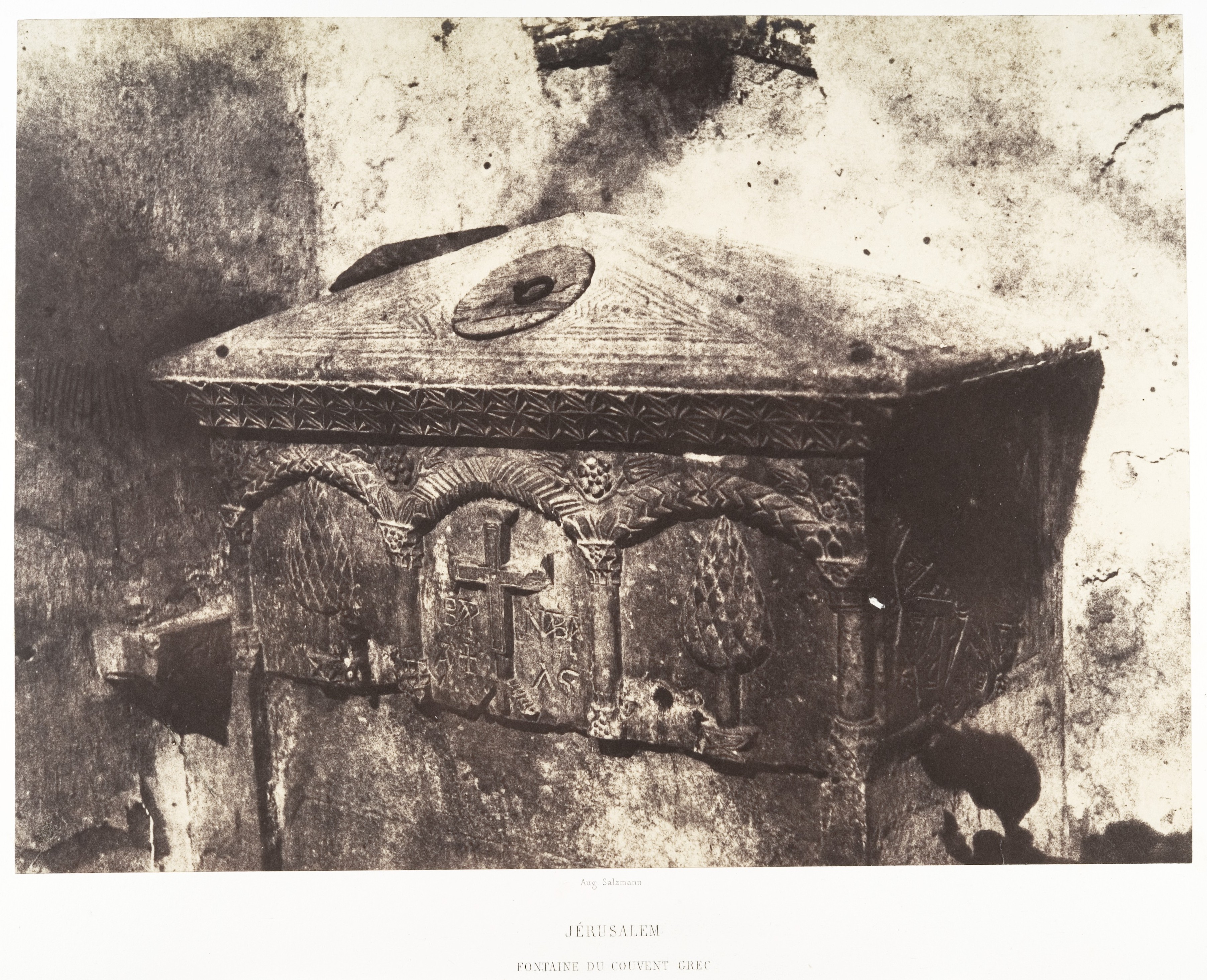
Deconstructing the Classical Gaze: The Salted Paper Print as a Blueprint for 2026 Silhouettes
Within the hallowed archives of Natalie Fashion Atelier, the artifact designated Jérusalem, Fontaine du Couvent grec exists not merely as a photographic document, but as a profound stratum of aesthetic archaeology. This salted paper print, rendered from a paper negative circa the mid-19th century, presents a paradox of materiality and vision. It captures the architectural permanence of a Greek convent fountain in Jerusalem, yet its execution is one of ephemeral, tactile fragility. For the 2026 couture season, this object serves as a masterclass in translating historical gravitas into contemporary drapery. The print’s unique chemical and textural lexicon—its sepia-toned luminosity, its soft-focus edges, its granular dissolution of form—provides a technical framework for constructing silhouettes that are at once monumental and mutable, rigid in concept yet fluid in execution.
Materiality as Metaphor: The Chemistry of Light and Shadow
The salted paper print is distinguished by its matte surface and the deep, physical integration of the image within the paper’s fibrous structure. Unlike albumen or gelatin silver prints, there is no glossy barrier between the viewer and the substrate; the image is the paper. This directness—this unmediated marriage of chemistry and fiber—offers a compelling directive for haute couture textiles in 2026. We are moving away from high-shine, lacquered finishes toward a tactile honesty. The atelier’s research indicates a shift toward uncoated, matte silk twills and raw, undyed wool crepes that absorb light rather than reflect it, mimicking the print’s non-specular surface.
Furthermore, the paper negative process introduces a critical inversion of values. Shadows become luminous, and highlights become dense and opaque. This reversal is translated into our silhouette construction through the strategic placement of architectural opacity against sheer, light-absorbing voids. A 2026 evening gown, inspired by this artifact, would not use lace as a decorative afterthought. Instead, the designer would engineer panels of dense, matte faille to represent the fountain’s stone mass, juxtaposed with sections of gossamer, silk-organza that have been treated with a tea-based stain to emulate the print’s sepia undertones. The garment’s narrative is thus built on the tension between the solid and the spectral, a direct homage to the negative’s inversion of reality.
Aesthetic Archaeology: Excavating the Fountain’s Structural Logic
The subject matter—the convent fountain—is an exercise in classical proportion and utilitarian sanctity. Its architectural elements, likely featuring a central basin, arched niches, and carved stone pediments, provide a geometric vocabulary. However, the salted paper print’s inherent softness dissolves these hard lines into a haze of tonal gradation. This is the crux of our 2026 aesthetic: the deliberate erosion of classical structure through a modern, tactile lens. The silhouette will not be a literal recreation of a 19th-century dress, but rather a deconstruction of the fountain’s architectural grammar.
Consider the fountain’s verticality and its horizontal basins. In our forthcoming collection, this translates to a radical re-proportioning of the female form. We propose a silhouette where the shoulder line is extended and squared, evoking the fountain’s cornice, yet the fabric is manipulated to softly fold inward, mimicking the water-worn edges of the stone. The waist is not cinched but rather allowed to drape in a columnar fashion, referencing the fountain’s central water spout. The skirt, in turn, is constructed with asymmetrical godets that flare outward only at the hem, echoing the fountain’s base. This is not a rigid, corseted structure; it is a fluid architecture that suggests permanence while yielding to movement.
Informing 2026 Silhouettes: The Granular Edge and the Luminous Void
The most avant-garde contribution of this artifact to 2026 luxury lies in its treatment of the peripheral focus. Early paper negatives often suffered from optical aberrations and edge softness, where the subject dissolves into an abstract, granular mist. Historically, this was a flaw; in our aesthetic archaeology, it is a sophisticated design principle. The 2026 couture silhouette will incorporate this "granular edge" through the use of raw, unfinished hems and selectively deconstructed seams. The garment’s primary structure may be sharply defined at the center—at the sternum or the spine—but as the fabric extends toward the extremities, the construction becomes intentionally looser, with threads pulled and fibers brushed out to create a fading, atmospheric terminus.
This technique demands a new level of craftsmanship from our petites mains. It is not a casual fraying but a controlled disintegration. We employ a technique of selective acid-washing on natural cellulosic fibers, such as cupro or ramie, to eat away at the fabric in predetermined patterns, creating a literal "print" of erosion that mirrors the chemical fading of the paper negative. The result is a garment that possesses a central, readable narrative of classical form, while its edges whisper into abstraction—a wearable metaphor for the photograph’s own fading memory.
Parisian Synthesis: The 2026 Couture Proposition
For Natalie Fashion Atelier, the Fontaine du Couvent grec is not a nostalgic relic but a generative blueprint. The 2026 luxury silhouette is thus defined by three pillars derived from this artifact: Matte Monumentality, Inverted Luminosity, and Controlled Dissolution.
Matte Monumentality dictates that our primary fabrics—double-faced cashmere, compacted wool, and silk faille—are chosen for their ability to hold a sculptural line while maintaining a dry, matte hand. Inverted Luminosity guides the placement of sheer, stained organza insets that appear to glow from within, creating a chiaroscuro effect on the body that is more evocative of a photographic negative than a traditional print. Finally, Controlled Dissolution is our signature finishing technique, where laser-cut perforations and hand-pulled threads create a gradient of material density, echoing the paper’s fiber structure.
This is a couture that speaks to the intellect as much as the eye. It rejects the ephemeral trends of digital gloss in favor of a deep, physical connection to process. The wearer of a Natalie Fashion Atelier 2026 garment does not simply wear a dress; she wears a study in light, time, and material memory. She embodies the quiet permanence of a Jerusalem fountain, filtered through the alchemical soul of a salted paper print—a true synthesis of history, chemistry, and Parisian haute couture.