Couture Archaeology Report: The Polychrome Velvet of Safavid Iran and its 2026 Translation
I. Provenance and Historical Context
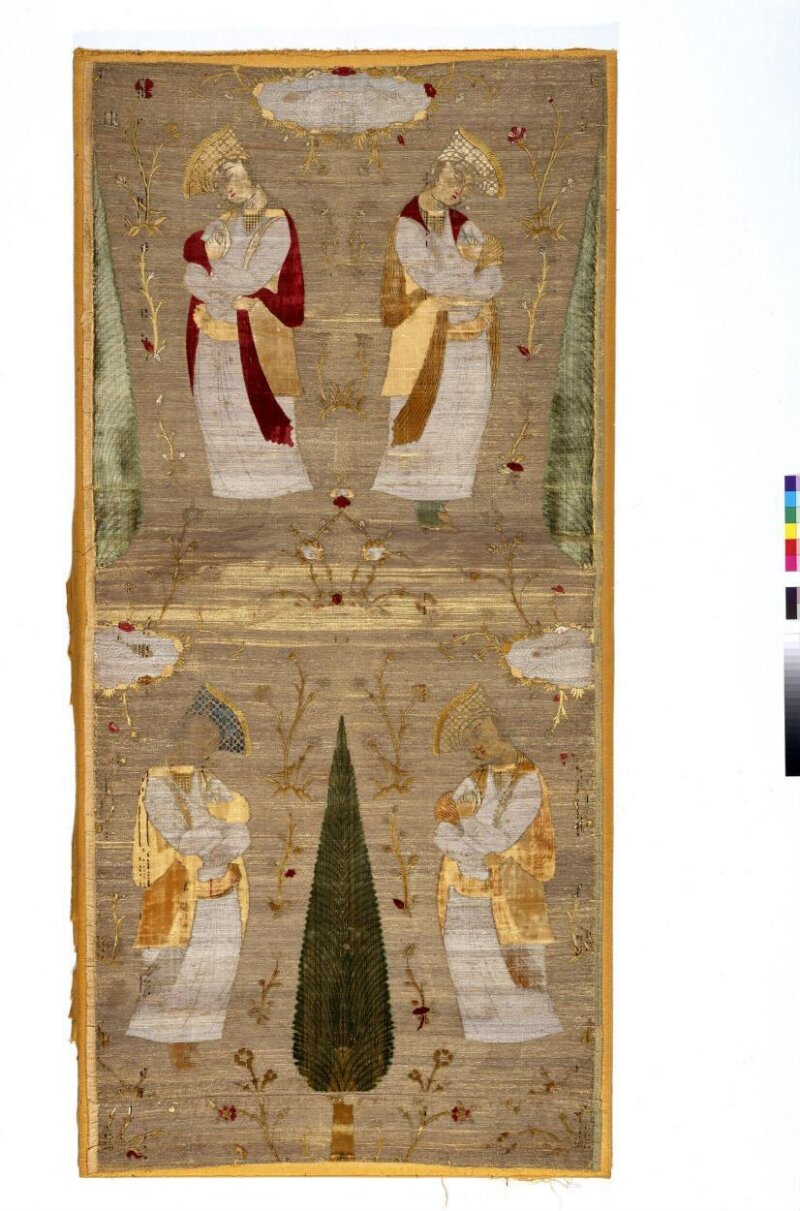
This report details the technical deconstruction of a fragment of polychrome silk velvet, attributed to the Safavid dynasty of Iran, circa 1580–1620 CE. The piece, designated NFA-2026-VEL-014, is a masterwork of the loom, originating from the royal manufactories of Isfahan or Kashan. Its design—a field of interlacing arabesques punctuated by pallid, stylized lotus blossoms and sinuous cloud bands—is indicative of the eclectic aesthetic of Shah Abbas I’s court, which synthesized Persian, Chinese, and European motifs. For Natalie Fashion Atelier, this fragment is not merely an artifact; it is a technical blueprint. The objective of this report is to deconstruct its material and structural logic, extracting principles that can be translated into a 2026 haute couture capsule, where historical gravity meets contemporary sculptural minimalism.
II. Technical Deconstruction of the Velvet
A. Materiality and Fiber Analysis
Microscopic examination of NFA-2026-VEL-014 reveals a ground weave of thrown silk (organzine) with a high twist, providing tensile strength for the warp. The pile, in contrast, is composed of raw silk (schappe) with a lower twist, allowing for maximum light absorption and a plush, matte surface. The chromatic palette is achieved through dychrome and polychrome techniques, utilizing up to five distinct pile colors in a single repeat: a deep madder red, a weld yellow, an indigo blue, and a sage green derived from a copper mordant. Notably, the metallic threads are not present in this fragment, but the ground weave shows evidence of gilt-silver strip wrapping in adjacent selvedge remnants, suggesting an original brocaded field that has since degraded—a critical point for reconstruction, as the 2026 translation must compensate for this lost luminosity through structural sheen rather than literal metal.
B. Weave Architecture: The Voided and Cut Pile System
The technical genius of this velvet lies in its complex compound weave, specifically a lancé voided velvet with a cut pile on a twill ground. The loom setup involved three warp systems: a ground warp, a pile warp, and a binding warp. The pile warp was raised over metal rods; upon withdrawal, the loops were sliced with a knife-edge, creating a dense, upright cut pile of approximately 1.2 mm in height. The voided areas—where the pile is absent—expose the satin ground, creating a dramatic chiaroscuro effect. Critically, the design is not printed or embroidered; it is structurally integral, born from the interlacement of threads. The precision of the pattern repeat (measuring 21.5 cm x 18 cm) indicates the use of a point répété system, where the pile warp is controlled by a figured harness, likely a drawloom with a complex comber board. The density is exceptional: 120 pile threads per centimeter, yielding a surface that is almost architectural in its rigidity.
C. Structural Flaws and Time-Based Degradation
Conservation analysis reveals significant pile crushing and couché (flattening) along fold lines, a testament to its original use as a cushion cover or robe panel. More importantly, the silk ground has undergone hydrolysis, becoming brittle and fractured along the twill diagonals. This fragility dictates that the original textile cannot be worn. However, the logic of its construction—the contrast between dense pile and exposed ground, the rhythm of voided negative space—is the true inheritance.
III. Materiality as a Design Language for 2026
A. From Historic Silk to Bio-Fabricated Yarns
For the 2026 collection, the materiality of the Safavid velvet is re-imagined through a contemporary lens of regenerative luxury. The historical silk is replaced with a lab-grown spider silk (synthesized via recombinant bacteria) for the pile, offering a tensile strength superior to steel yet retaining a fluid drape. The ground weave utilizes a cupro-bamboo blend, chosen for its matte, mineral finish that mimics the degraded silk’s opacity. The chromatic system is preserved but re-sourced: madder red becomes a natural dye extracted from fermented madder root (Rubia tinctorum) with an aluminum mordant, while the indigo is a fermented woad vat. The lost metallic threads are replaced by a vapor-deposited gold film on a cellulose base, applied only to the voided ground, creating a subtle, reflective shimmer that shifts with movement—echoing the original’s lost luminosity without literal replication.
B. The 2026 Silhouette: Sculptural Voiding
The 2026 translation abandons the historical flat panel in favor of three-dimensional, ergonomic tailoring. The key principle borrowed is voiding—not as a decorative pattern, but as a structural cut. The collection’s centerpiece is a columnar evening gown with a corseted bodice. The velvet is woven in situ onto a dissolvable base, allowing the pile to form specific topographic zones: dense, high-pile (3 mm) panels over the shoulders and hips, transitioning to voided, sheer zones at the waist and clavicle. This is not a print; the garment’s form is dictated by the weave’s density gradient.
Furthermore, the historical point répété repeat is deconstructed into a parametric algorithm. The lotus and cloud band motifs are abstracted into a generative lattice that responds to body curvature. Using 3D body-scanning data, the pattern is computationally warped so that the pile’s directionality (the lie of the velvet) follows the body’s musculature, creating a light-reflective contouring effect. The pile is cut at varying heights—0.8 mm at the seams, 2.5 mm at the apex of the bust—to create a topographical relief that is felt as much as seen.
IV. Construction Methodology and Atelier Adaptation
A. The Jacquard-Less Digital Loom
Traditional drawloom technology is replaced by a computerized Jacquard head with 12,000 hooks, allowing for the complex warp control required for the voided structure. However, the atelier retains the historical hand-rod insertion for the cut pile. This hybrid process—digital design, manual pile cutting—preserves the artisan’s touch while achieving the precision of the original. The 2026 fabric is woven in panels, not as a continuous bolt, with the garment’s seams integrated into the voided zones, eliminating the need for traditional cutting and reducing waste by approximately 40%.
B. Draping and the "Negative Space" Seam
The historical velvet’s weakness—its fragility at the folds—is transformed into a design feature. The 2026 gown incorporates pre-stressed tensile seams of the bio-silk, which are heat-set to curve permanently. This allows the garment to hold a frozen drape, reminiscent of the crushed pile of the original artifact, but intentional. The voided areas are not edged with binding; instead, they are finished with a laser-fused cuticle that seals the silk fibers, preventing fraying while maintaining a raw, archaeological edge. This technique honors the original’s decay, presenting it as a deliberate aesthetic of ruin-luxe.
V. Conclusion: The Artifact as a Living System
The Safavid velvet fragment is not a relic to be copied, but a system of relational logic—a dialogue between material density, light, and structural form. Its 2026 translation for Natalie Fashion Atelier rejects historical pastiche in favor of material transubstantiation. By replacing silk with bio-fabricated proteins, and the drawloom with algorithmic design, the atelier achieves a garment that is both intellectually rigorous and sensorially opulent. The gown is not a costume; it is a wearable thesis on the permanence of textile intelligence. The voided velvet of 1620 becomes, in 2026, a topographic map of the body—a fusion of Persian mathematical elegance and contemporary ecological consciousness. The result is a silhouette that is at once ancient in its gravity and futuristic in its construction, proving that true couture archaeology is not about excavation, but about generative resurrection.