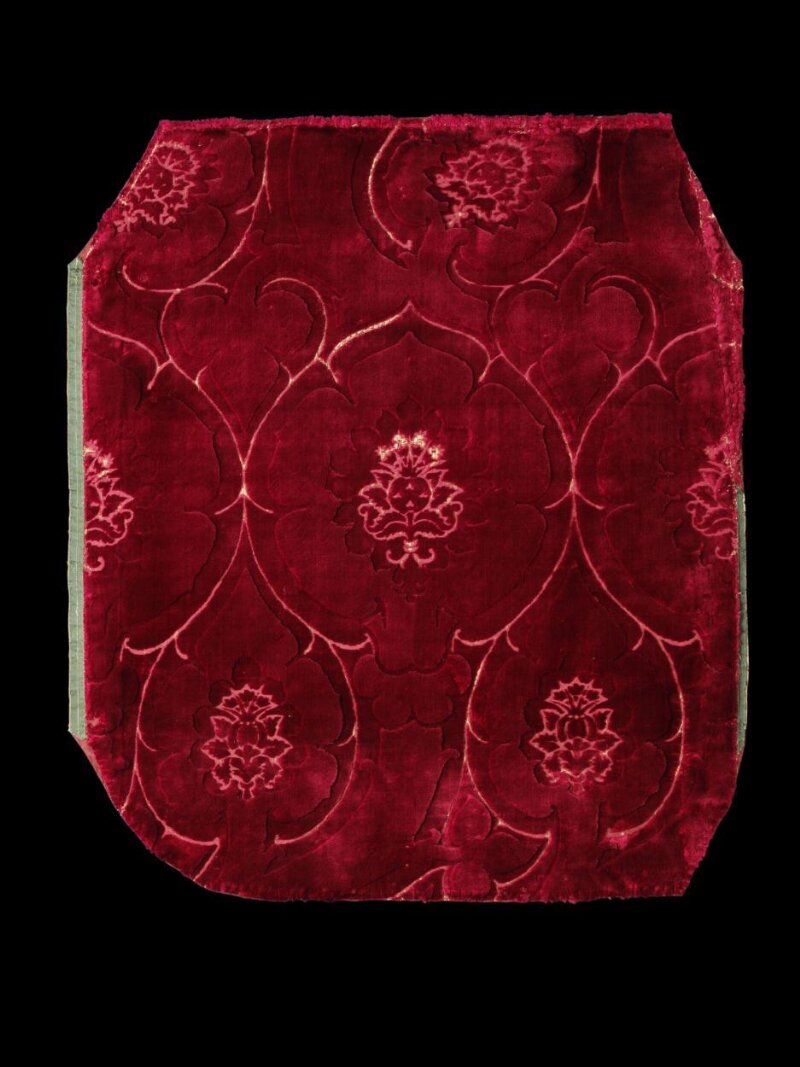
Couture Archaeology Report: Velvet in the Second Renaissance
Subject: Technical Deconstruction of 15th-Century Italian Velvet
Report Code: NFA-ARCH-ITVEL-001 Period: Second Half of the 15th Century (Italian Renaissance) Origin: Republics of Venice, Florence, and Genoa Senior Historian: Natalie Fashion Atelier Couture Archaeology Division
1. Historical Materiality & Technical Fabrication
The supremacy of Italian velvet in the latter 15th century was not merely aesthetic but a triumph of material science and regulated craft. The foundation was a hand-thrown silk warp, prized for its irregular, organic thickness that gave light a complex, living surface upon which to play. The weft was often finest wool or linen, providing body and resilience. The true alchemy, however, lay in the pile formation.
Weavers operated monumental draw-looms, a technology of breathtaking complexity requiring a master weaver and a "draw-boy" assistant to manually raise thousands of individual warp threads via lashes and cords. This painstaking process enabled the creation of intricate, non-repeating patterns. The pile was formed over rods: a round rod produced the iconic uncut pile (known as *ciselé*), while a flat, sharp blade inserted created the plush cut pile. The genius of the period was the combination of both in a single textile—creating a play of texture where a pattern in lush cut velvet emerged from a background of low, luminous uncut loops. This was further amplified by the mastery of voided velvet (*veluto a riccio*), where the pile was selectively woven only in the pattern areas, leaving a ground of sheer silk or metallic cloth.
The materiality was completed by dyes derived from a global network: kermes (scarlet) from the Mediterranean, madder (ruby) from the Levant, and the profound woad-over-madder indigo for blacks so deep they were termed "auster." The result was a fabric of immense weight, drape, and sonic quality—a hushed whisper of profound luxury.
2. Structural Deconstruction: The Anatomy of Opulence
A technical analysis reveals three core structural principles that defined the period's velvet application in garment construction.
Principle 1: The Weighted Drape. The substantial hand of the fabric demanded architecture. Garments were not merely cut but built on the bias across the torso to exploit the material's natural give, while structured seams and linings provided counter-tension. This created a drape that was both fluid and monumental, mapping the body while transforming its silhouette into a geometric ideal.
Principle 2: The Strategic Revelation. The exorbitant cost mandated intelligent deployment. Velvet was used as a heraldic skin, applied as panels, sleeves, and yoke overlays upon foundations of less costly wool or fine linen. The voided and patterned velvets were strategically placed at the center-front, across the shoulders, and on sleeves—points of maximum visual impact and kinetic display.
Principle 3: The Tactile Contrast. Renaissance luxury was synesthetic. Velvet was consistently juxtaposed with antagonistic textures: the cold, hard sparkle of filed sequins (*lamelle*), the smooth, unyielding surface of pearl embroidery, the fluidity of cloth-of-gold linings, and the crispness of linen chemises emerging at sleeve slashes and necklines. This created a multi-sensory landscape on a single silhouette.
3. Translation: The 2026 High-End Luxury Silhouette
For the Natalie Fashion Atelier 2026 collection, the translation is not one of pastiche, but of molecular-level inspiration—extracting the DNA of 15th-century velvet to engineer a new lexicon of luxury.
Silhouette Translation 1: The Monolithic Column. We propose a departure from the layered Renaissance look towards a singular, monolithic column dress. Utilizing a modern, heavyweight silk-organic cotton blend velvet, woven on jacquard looms with voided and ciselé techniques, the garment will be cut in one spiraling bias panel. The pattern—a subtle, non-repeating phytomorphic motif derived from Renaissance herbals—will be voided, revealing a sheer silk-georgette ground only at the edges of the motifs, creating a play of opacity and revelation. The weight will produce a statuesque, gravity-defined drape, modernizing the "Weighted Drape" principle.
Silhouette Translation 2: The Exoskeletal Cage. Interpreting "Strategic Revelation," we will engineer velvet not as a covering, but as an applied exoskeleton. A minimalist, sculptural dress in technical matte silk crepe will be overlaid with a cage of narrow, stiffened velvet bands, strategically placed along anatomical lines of tension—the spine, the clavicle, the scapula. These bands will be of uncut *ciselé* velvet, their direction changing to catch light differentially, creating a topographical map of the body beneath. This abstracts the Renaissance paneling system into a contemporary architectural statement.
Material Innovation: The New Tactility. Honoring the "Tactile Contrast" principle, we will develop proprietary fabrications. A bi-phase velvet is proposed: a base of recycled nylon pile for durability and chromatic intensity, woven with a degradable sacrificial thread. A post-production enzyme wash will dissolve this thread in specific areas, creating organic, non-repeating voids that reveal a substrate of upcycled copper-thread lace. Furthermore, we will pioneer a cool-touch velvet by integrating micro-encapsulated phase-change material into the fiber coating, creating a fabric that feels surprisingly cool against the skin—a sublime, modern sensory contrast.
4. Conclusion: The Archaeologist's Hand
The velvets of 15th-century Italy represent a zenith of pre-industrial textile art, where material limitations were transformed into virtues of depth, light, and symbolic power. For the 2026 luxury landscape, the opportunity lies not in replication, but in transposing these technical and philosophical principles through the lens of contemporary technology and silhouette abstraction. The goal is to capture the *spirit* of the material—its gravity, its luminous depth, its strategic opulence—and re-embody it in forms that speak to a modern, discerning sensibility. The result will be a collection that feels inherently of the moment, yet resonates with the profound material intelligence of the Renaissance atelier.
Recommended Action: Proceed to Phase 2: Prototype Development of bi-phase and cool-touch velvet swatches, and toile construction for the Monolithic Column and Exoskeletal Cage silhouettes.