Archaeology of the Isolated Masterpiece: The Kosode as a Hermeneutic Object
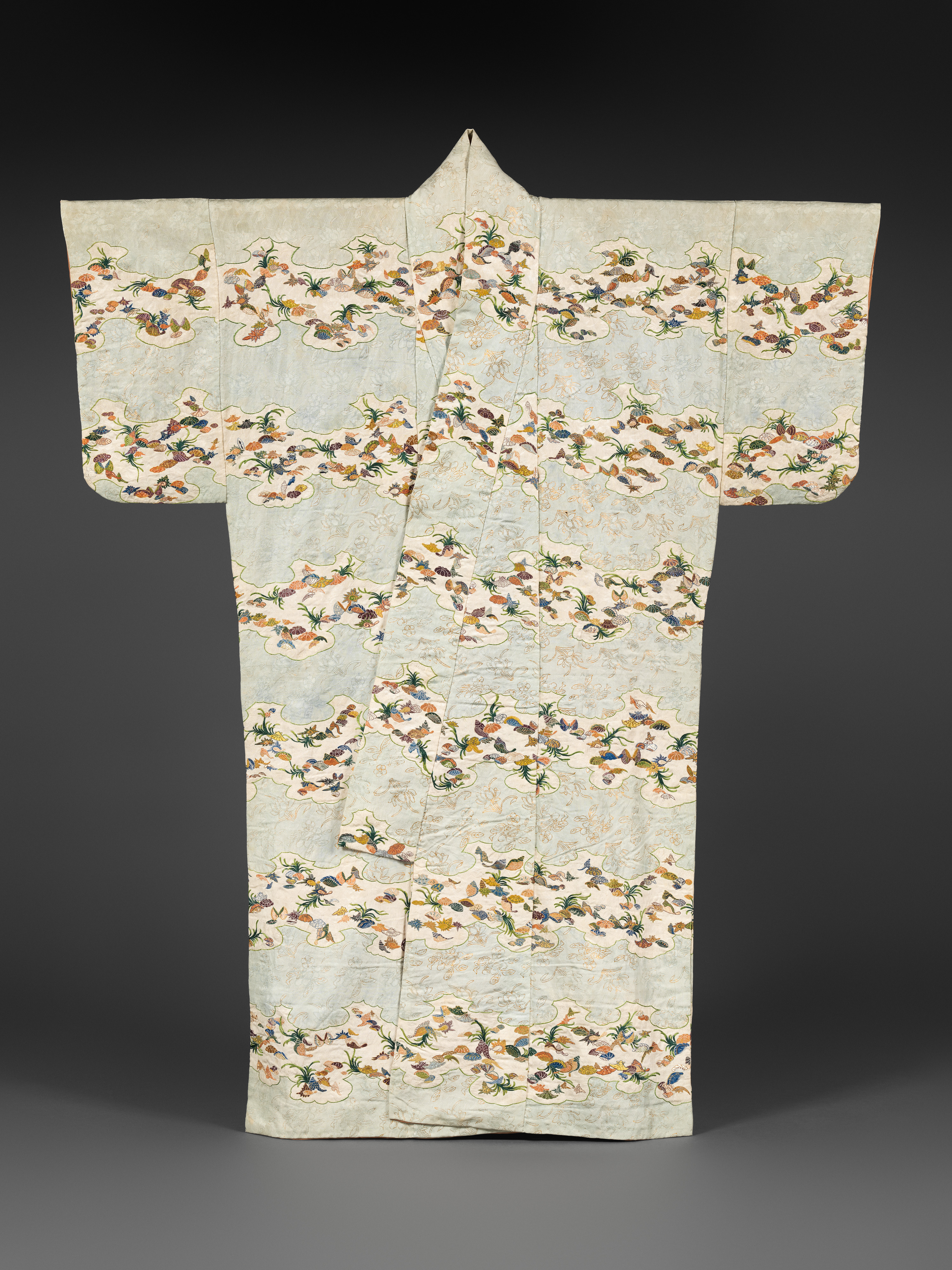
Within the archive of Natalie Fashion Atelier, the Japanese Robe (Kosode) with Shells and Sea Grasses exists not merely as a garment but as an isolated hermeneutic object—a self-contained universe of aesthetic principles. Its isolation is its power; freed from a dense chronology of Western fashion, it offers a pure, undiluted discourse on surface, structure, and symbolism. This 18th-century masterpiece, executed in embroidery and gold leaf on plain-weave silk patterned with warp floats, presents a radical alternative to the sculptural, body-centric ideals of contemporaneous European couture. Its elegance is not one of imposition but of integration, where decoration becomes topography and the garment is a canvas for a contemplative, natural world. Deconstructing this classical elegance reveals a foundational grammar for the 2026 luxury silhouette, one predicated on textural intelligence, dimensional flatness, and narrative materiality.
Deconstructing Classical Elegance: The Tripartite System of Kosode Craft
The kosode's elegance is a technical orchestration of three distinct material strata, each contributing to a holistic sensory experience. First, the ground: a plain-weave silk utilizing warp floats to create a subtle, inherent pattern. This is not a printed motif but a structural birthright of the fabric itself—a whisper of texture that provides a foundational luminosity and a tactile, irregular base. Upon this, the second stratum: gold leaf application (kirikane). This is not embroidery in the Western sense of thread-building form, but the adhesion of minute, fragile planes of metal. The gold exists as light-catching, abstract planes, suggesting the reflective surface of water or the glint of sunlight without literally depicting it. It creates a discontinuous, shimmering plane that interacts dynamically with ambient light. The third stratum is the embroidery—silken threads rendering shells, sea grasses, and waves. Crucially, this embroidery does not seek to replicate three-dimensional reality. It operates in a realm of poetic suggestion, using symbolic shorthand and a masterful manipulation of stitch density to create a soft, graphic impression. The elegance lies in the dialogue between these strata: the structural whisper of the warp, the fragmented gleam of the gold, and the lyrical narrative of the silk thread. The body beneath is acknowledged but not accentuated; the garment is a moving landscape.
Informing the 2026 Silhouette: From Poetic Flatness to Architectural Volume
The 2026 luxury silhouette, as interpreted by Natalie Fashion Atelier, moves beyond the overtly corporeal and the starkly minimalist towards a new paradigm of considered envelope. The kosode’s principles provide the precise technical and philosophical toolkit for this shift. The future silhouette embraces a moderated, architectural volume—not the grandiose crinoline, but the soft, structured space found in the kosode’s T-shaped construction. This allows for a focus on the artistry of the surface as an independent plane, much like the kosode was viewed when displayed on a stand. The relationship between garment and wearer becomes more nuanced; it is a dwelling space, a portable environment.
Textural Intelligence & Warp Float Logic
The concept of warp float patterning translates directly into 2026’s obsession with intrinsic, rather than applied, texture. We foresee luxury fabrics engineered with intelligent irregularities—jacquards and triple-weaves that embed geometric or organic shadow-patterns within the very loom state of the cloth. This creates a foundational depth, a "first skin" of texture upon which further artistry is layered. A 2026 evening coat may thus have a ground woven with a faint, all-over cloud motif via warp floats, providing a mutable, luminous base that changes with movement, eliminating the need for overt ornamentation and achieving sophistication through structural ingenuity.
Fragmented Light: The New Gold Standard
The kosode’s use of kirikane informs a break from continuous sequin or bead embroidery. The 2026 silhouette will feature fragmented, planar appliqués of metallic leather, micro-thin foils laminated onto silk georgette, or irregular patches of mirror-polished resin. These elements will be applied in a deliberately asymmetric, non-figurative manner, catching light in unpredictable bursts. This creates a garment that is alive to its environment, its brilliance episodic and modern, moving away from total coverage towards strategic, painterly highlights. A column gown may feature a cascade of shattered-gold leaf appliqué along one seam, echoing the kosode’s abstraction of aquatic reflection.
Embroidery as Topographical Cartography
The narrative, softly graphic embroidery of the kosode evolves into a language of topographical cartography for 2026. Embroidery will be used to create textural maps—dense, raised knotting to represent land, flowing streams of chenille for water, delicate latticework for flora—inspired by nature but not imitative of it. This aligns with a growing desire for garments with embedded, personal narrative and artisan-led storytelling. The silhouette becomes a canvas for this exploration, with embroidery flowing across seams and panels, ignoring traditional bodily demarcations, much like the sea grasses meander across the kosode’s field. This technique will be executed in a monochromatic or tonal palette, emphasizing texture over color, ensuring the work reads as an integral part of the fabric’s architecture rather than a decorative afterthought.
Conclusion: The Hermeneutic Shift in Luxury
The Robe (Kosode) with Shells and Sea Grasses ultimately instructs us that luxury in 2026 is not defined by historical revivalism, but by the hermeneutic absorption of isolated principles. Its legacy is a silhouette that privileges intelligent texture over mere shape, fragmented light over uniform glitter, and embodied narrative over literal depiction. For Natalie Fashion Atelier, this artifact validates a design philosophy where the garment is a curated spatial experience—a direct translation of the kosode’s role as a contemplative, wearable environment. The 2026 client does not merely wear a dress; she inhabits a meticulously constructed world of light, texture, and meaning, born from the deep, technical poetry of an isolated masterpiece. This is the new elegance: architectural, intelligent, and profoundly resonant.