Couture Archaeology Report: The 1955 Balenciaga Lineage
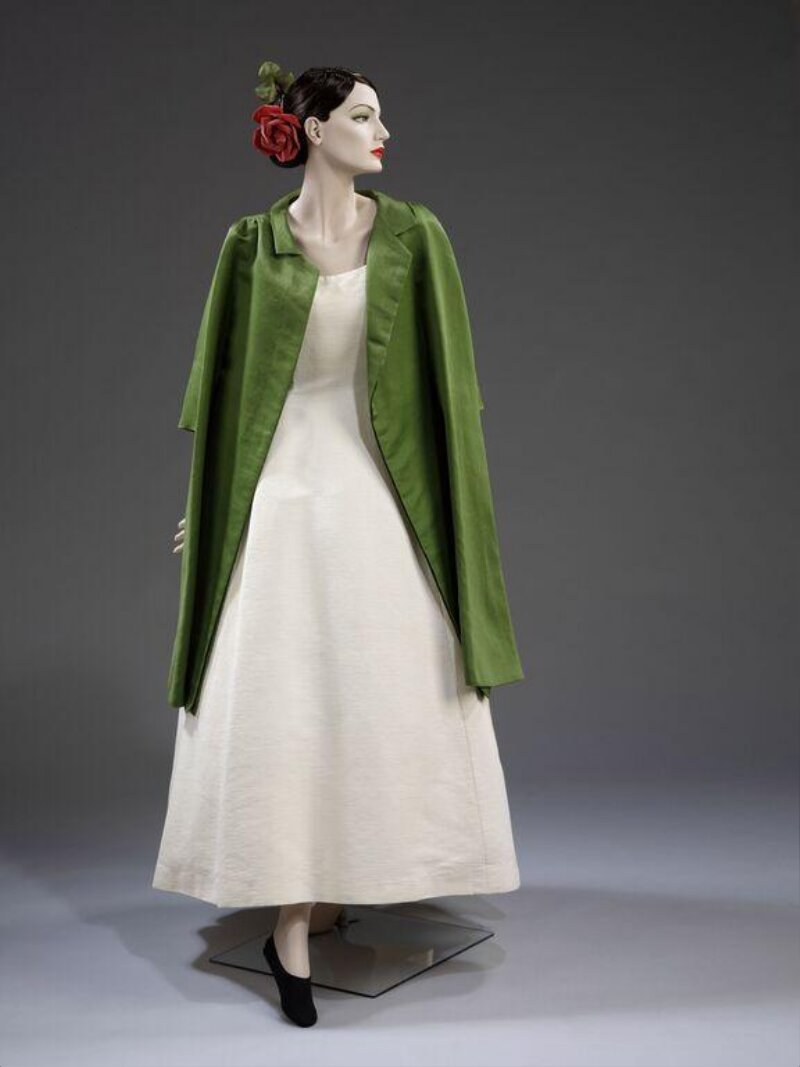
Subject: Technical Deconstruction of a Cristóbal Balenciaga Evening Ensemble, circa 1955, Paris.
Origin: House of Balenciaga, Avenue George V, Paris. Autumn/Winter 1955-56 collection.
Analyst: Senior Textile Historian, Natalie Fashion Atelier.
Date: October 26, 2023
Objective: To excavate and codify the foundational techniques and material philosophies of Cristóbal Balenciaga’s mid-1950s work, providing a technical blueprint for their translation into the 2026 high-end luxury silhouette.
I. Technical Deconstruction: The Architecture of Ease
The 1955 period represents a pivotal moment in Balenciaga’s pursuit of sculptural abstraction. Moving beyond the fitted waist and overtly feminine hourglass, he engineered volume that appeared to emanate from the body itself, rather than being imposed upon it. Our analysis focuses on three core technical pillars.
The Sleeve Cap Revolution: Balenciaga’s most significant technical contribution is the reconfigured sleeve cap. Historically, sleeve caps were cut to accommodate the shoulder’s natural curve, often requiring padding or gathers. Balenciaga inverted this logic. He raised the shoulder seam by several centimeters and widened the sleeve cap dramatically, transferring its volume from the top of the arm to the upper arm itself. This created the legendary “bracelet sleeve” and its variations—a sleeve that appeared to stand away from the shoulder before falling in a clean, unbroken line to the wrist. The technical result was an unprecedented sense of ease and monumentality. The body’s architecture was subtly abstracted, the shoulder line softened into a more parabolic, architectural form.
Minimal Seaming and Geometric Cutting: Balenciaga achieved complex volume through geometric purity, not complexity. A hallmark 1955 evening coat might be constructed from as few as seven pieces: a back, two fronts, two sleeves, and two facings. He utilized the inherent weight and drape of his selected fabrics, cutting panels that were themselves shaped—wider at the hem, curved at the neckline—so that the garment assumed its form with minimal internal structuring. Darts were often eliminated or displaced to hidden locations, preserving the integrity of the fabric’s surface. This technique demands absolute precision in cutting and a profound understanding of textile behavior; a miscalculation of a single degree in the bias cut would collapse the entire silhouette.
Internal Infrastructure: Despite the external appearance of simplicity, Balenciaga’s work featured a meticulous, lightweight internal architecture. Hems were often weighted with fine chains or lead tape, calibrated to the specific drape of the fabric, ensuring a perfect, static fall. Seams were finished with a consummate attention to detail—bound, piped, or covered with silk organza to prevent bulk and maintain a flawless interior. This invisible engineering is the cornerstone of haute couture, where the internal finish is as considered as the external presentation.
II. Material Materiality: Fabric as Co-Creator
Balenciaga did not merely select fabrics; he collaborated with textile manufacturers to engineer materials that could realize his vision. The 1955 silhouette is inextricable from its physical substance.
The Primacy of Weight and Drape: He favored fabrics with a intrinsic sculptural capacity: heavy silk gazar, a crisp, paper-like silk organza; woolen fabrics with enough body to hold a shape but enough pliability to flow; and duchesse satin of a substantial weight. These materials did not cling; they described space. The famous “balloon” shapes of the era were possible only because the fabric possessed enough internal resistance to hold air and form, while still moving with gravity.
Surface and Substance: Surfaces were often matte, absorbing light to emphasize form over ornament. When embellishment occurred, it was strategic and substantial—appliquéd velvet, dense embroidery that followed structural lines, or jet beading that added functional weight to a hem. The materiality was honest; the structure of the garment was celebrated, not concealed.
III. Translation to 2026 High-End Luxury Silhouettes
For Natalie Fashion Atelier’s 2026 vision, the Balenciaga archive provides not a template for replication, but a lexicon of principles for modern abstraction and wearability.
Abstracted Volume through Technical Fabrics: We propose interpreting the raised sleeve cap and geometric volume using 21st-century material innovations. Imagine a sleeve engineered from a technical matte neophene fused to a biodegradable silk substrate, creating a self-supporting, aerodynamic curve. The weighted hem principle can be translated using smart alloys or magnetic trims, allowing the wearer to modulate drape and silhouette dynamically. The goal is to achieve Balenciaga’s sense of considered volume, but through materials that offer new functionalities: temperature regulation, sustainable provenance, or adaptive form.
The New Couture Body: The 1955 silhouette liberated the waist. The 2026 iteration must liberate the silhouette from static form. Using parametric modeling derived from Balenciaga’s geometric cutting, we can create pieces with articulated seams and strategic gussets that accommodate a wider range of motion and body diversity, while retaining a sculptural, monolithic appearance when at rest. This aligns with the modern luxury demand for both profound elegance and intuitive comfort.
Minimalism of Means, Maximalism of Effect: Balenciaga’s economy of seaming is a direct precursor to contemporary zero-waste patterning. For 2026, we can push this further by developing single-piece, bias-cut gowns using algorithmically generated patterns that minimize textile waste while creating complex, cocooning volumes. The internal infrastructure will evolve to include seamless integration of wearable technology, with conductive threads and micro-sensors embedded within couture finishes like silk-bound seams.
Conclusion: The Living Archive
Cristóbal Balenciaga’s 1955 work is not a relic, but a rigorous thesis on the relationship between body, fabric, and space. His techniques—the architectural sleeve, the geometric cut, the strategic weighting—were solutions to the problem of creating dignified, modern volume. For 2026, the mandate is to apply this same problem-solving ethos with a new set of tools and values. By deconstructing his materiality, we learn to collaborate with innovative textiles. By understanding his internal engineering, we learn to build for imperceptible comfort and adaptive form. The translation is not stylistic homage, but a philosophical continuity: the pursuit of elegance through structural intelligence, where the most profound luxury lies in the precision of the unseen and the authority of the silhouette.