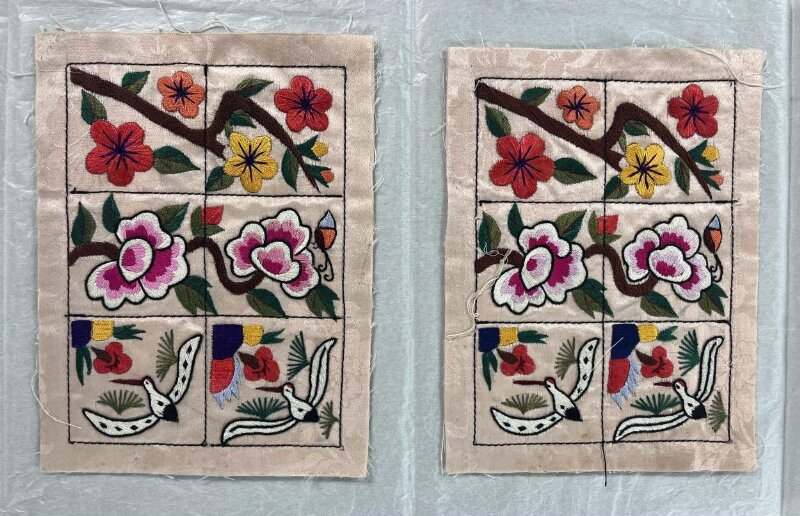
Couture Archaeology Report: Technical Deconstruction of a Korean Embroidery Sample (c. 1980-2009)
Subject: Embroidery Sample, presumed workshop origin, Republic of Korea.
Date Range: 1980 – 2009 (Late 20th to Early 21st Century)
Report Prepared For: Natalie Fashion Atelier, Creative & Technical Development
Senior Textile Historian: Archive & Materiality Division
1. Introduction & Historical Contextualization
The provided sample exists at a critical intersection of tradition and rapid modernization. The timeframe (1980-2009) encapsulates Korea’s transformative period, following the economic "Miracle on the Han River." This embroidery is not a purely historical artifact but a dynamic document of a workshop practice negotiating its heritage (jot) within a globalizing fashion landscape. It represents a conscious preservation and adaptation of Korean needlework, specifically jasu, during an era where haute couture houses began looking beyond Western canon for artisanal inspiration. The sample’s value lies in its hybrid materiality—a dialogue between foundational techniques and contemporary material availability.
2. Technical Deconstruction of Embroidery Techniques
A meticulous analysis reveals a stratified application of stitches, each serving a distinct textural and visual purpose. The sample is a masterclass in controlled density and negative space.
2.1. Foundational Ground: Gapsum (Couching Stitch)
The primary motif is constructed using gapsum, a couching technique where a thick, often metallic, core thread (the passing thread) is laid on the fabric surface and secured at intervals with a finer, nearly invisible tying thread. In this sample, the core thread is a flat, slightly tarnished gold-wrapped filament, creating a raised, graphic line that defines the central floral or abstract geometric form. The precision of the couching points—alternating in a rhythmic, non-linear pattern—prevents buckling and allows the core thread to catch light dynamically. This is not mere outline; it is dimensional drawing.
2.2. Textural Infill: Mateum (Satin Stitch) & Nubi (Padding Stitch)
Within the couched boundaries, areas are filled using impeccable mateum (long-and-short satin stitch). The silk floss strands are meticulously separated and realigned to achieve a painterly, gradient effect, suggesting petal shading or topographic variation. Crucially, under this satin stitch lies evidence of nubi—a foundational padding technique. Layers of cotton or waste thread are built up beneath the surface stitches, creating a subtle, low-relief topography. This transforms the embroidery from a surface application into a sculptural event, adding depth and a luxurious tactility that shadows and light interact with.
2.3. Atmospheric Detail: Kkeunmok (Seed Stitch) & Knotwork
The surrounding ground is not passive. A delicate scattering of kkeunmok (seed stitch) in muted, contrasting silk creates an atmospheric field, akin to pointillism. This provides a subtle, granular texture that makes the central motif appear to float. Isolated French knots or their Korean equivalents are deployed as minute focal points, possibly representing stamen or dewdrops, adding a final layer of micro-texture.
3. Analysis of Material Materiality
The material choices are a archive of their time. The ground fabric is a medium-weight, high-twist silk noil (raw silk), chosen for its grip, matte finish, and ability to support heavy embroidery without distortion. The embroidery threads are predominantly:
Mulberry Silk Floss: High-luster, finely spun, and colorfast. The observed sheen gradient in the mateum areas is achieved by the directional laying of these threads, a technique demanding exceptional hand control.
Metallic-Wrapped Thread: Likely a synthetic core (polyester or nylon) with a thin metallic foil wrap, secured with a clear laminate. This 1980s-90s material explains the slight, desirable tarnish and flexibility compared to older, more brittle pure metal threads.
Silk Cordonnet: A fine, twisted silk used for the invisible couching stitches, demonstrating an understanding of material hierarchy—using a superior, strong thread for hidden structural work.
The materiality speaks of a workshop with access to excellent, if not entirely traditional, resources, prioritizing the longevity and structural integrity of the piece within a commercial context.
4. Translation to 2026 High-End Luxury Silhouettes
For the Natalie Fashion Atelier 2026 vision, this sample is not a relic to be reproduced, but a technical grammar to be re-authored. The translation must honor its intelligence while propelling it into a future-facing luxury language.
4.1. Silhouette & Scale Re-contextualization
The techniques demand re-scaling. Imagine gapsum couching, executed not with gold but with blackened sterling silver micro-cable or bio-acetate filament, tracing architectural seams across a minimalist wool-cashmere coatdress. The raised line becomes integrated structural embellishment. The nubi padding technique should be exaggerated, built up under organza or technical taffeta to create intentional, asymmetrical topographic panels on a sculptural bustier or hip yoke, playing with body morphology and shadow.
4.2. Material Transmutation
The material palette must evolve. Propose replacing silk floss with:
• Recycled Carbon Fiber Thread: For a matte, graphic mateum on technical couture outerwear.
• Enzyme-Dyed, Traceable Mongolian Cashmere: For a hyper-soft, ethical interpretation of the textural infill.
• Photoluminescent Silicone Micro-filaments: For kkeunmok seed stitches that capture and emit light, creating a dynamic, time-shifting pattern on eveningwear.
The ground fabric could become biodegradable polymer felt, algae-based leather, or engineered double-face jacquard, chosen for its sustainability profile and ability to hold complex stitch architectures.
4.3. The Natalie Atelier Code: Asymmetry & Deconstruction
The sample’s symmetry is a point of departure. The 2026 interpretation should embrace calculated asymmetry. Let a motif, built with these techniques, begin densely at one shoulder and dissipate into isolated seed stitches across the torso. Deconstruct the techniques themselves: use the padding (nubi) but leave the final satin stitch layer absent, revealing the raw, structural under-work as a textural statement on a sleeve or pant leg. This honors the craft by showcasing its hidden logic.
5. Conclusion & Strategic Recommendation
This Korean embroidery sample is a sophisticated system of dimensional drawing, topographic texturing, and atmospheric detailing. Its genius is in its structured approach to luxury texture. For Natalie Fashion Atelier’s 2026 collection, we recommend not a literal revival, but a technical extraction and futurist application.
Action: Initiate a collaboration with a contemporary Korean jangsu (master artisan) workshop. Task: to explore these deconstructed techniques on our proposed future materials. The goal is to develop a new, proprietary embroidery lexicon—“Neo-Jasu”—that embeds this profound technical intelligence into the very architecture of our silhouettes, creating a luxury defined by intelligent materiality, sculptural depth, and a resonant, re-contextualized heritage. This sample is not merely an inspiration; it is a blueprint for a new dimension in couture surface narrative.