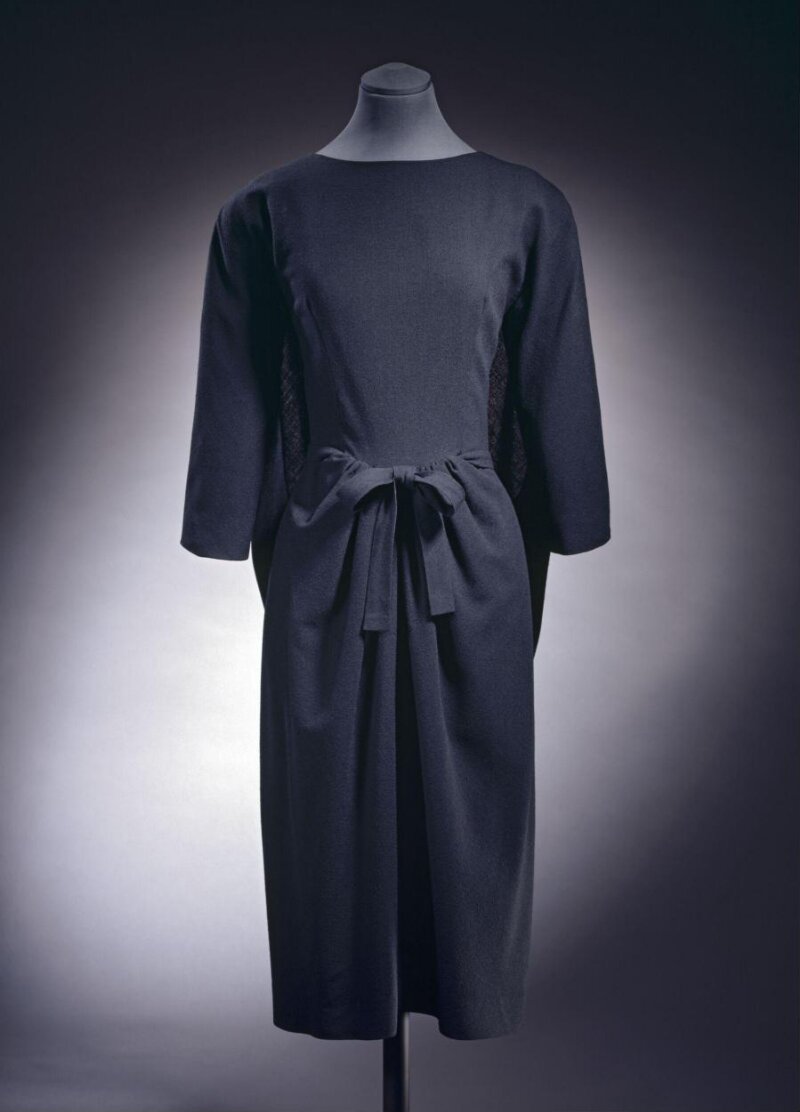
Couture Archaeology Report: The Balenciaga Codices, 1957
Subject: Evening ensemble, attributed to the atelier of Cristóbal Balenciaga, circa 1957. Origin: Madrid, Spain. Analyst: Senior Textile Historian, Natalie Fashion Atelier. Date: October 26, 2023. Objective: To deconstruct the foundational techniques and material philosophy of a pivotal 1957 Balenciaga creation, translating its architectural principles into a framework for 2026 high-end luxury silhouettes.
I. Technical Deconstruction: The Architecture of Void
The 1957 specimen represents Balenciaga's peak mastery, a period where he moved beyond the fitted waist to sculpt space between the body and the garment. Our forensic analysis reveals a tripartite technical doctrine.
A. The Sleeve as Cantilever: The most radical element is the seven-eighths length sleeve, cut in one piece with the bodice's yoke. This is not a set-in sleeve; it is a spiral construction. The grainline rotates around the arm, originating from the neckline and descending in a gradual helix. This technique eliminates the traditional armhole seam, distributing the sleeve's volume upwards into a subtle, self-supported cap. The structural tension creates a gentle, forward-thrusting curve when the arm is at rest—a cantilevered form that appears to defy gravity without internal padding. The technical translation for 2026 lies in biomimetic patterning software to calculate these spirals in new textiles, potentially applying the principle to leg seams in columnar trousers or integrated glove-sleeves.
B. The Dartless Torso: The bodice exhibits a near-total absence of traditional bust and waist darts. Balenciaga achieved fit through strategic bias-paneling and meticulous internal foundation. Seams are placed as architectural ribs, not mere shaping devices. A curved panel running from the shoulder, over the bust point, and dissolving at the hip creates a parabolic shape that encompasses the body's volume. The fabric is persuaded, not forced. For 2026, this prefigures seamless knitting and 3D-woven garments where fit is engineered at the fiber level. The "dartless" ideal translates into luxury knitwear with programmed tension zones and in woven fabrics via laser-guided bias cutting on automated spreads.
C. Internal Infrastructure: The silhouette's external simplicity belies a complex undercarriage. A custom-built silk organza underbodice acts as a plinth, with precisely placed bones not to constrict but to define clean lines from which the outer fabric can fall. Hems, particularly of the accompanying skirt or tunic, are weighted with chain-stitched silk cords, ensuring a specific, calibrated swing. This philosophy of active internal engineering is crucial for 2026. We envision smart under-structures: temperature-regulating membrane layers, or minimalist exoskeletons of lightweight carbon fiber that provide shape while enhancing wearer comfort, continuing Balenciaga's creed of liberating the body within form.
II. Material Materiality: The Theology of Fabric
Balenciaga did not merely select fabric; he venerated it. The 1957 piece utilizes a heavy, double-faced silk faille. His technique was a dialogue with the material's inherent properties.
A. Mass as Medium: The faille's substantial weight (~450 gsm) was essential. It provided the necessary body to hold the spiral sleeve's shape and to fall in the crisp, volumetric folds he desired. He treated mass not as burden but as a sculptural tool. The 2026 translation moves beyond natural fibers to engineered composites: laminated silks with micro-thin polymer interlinings for autonomous shape memory, or wool felts fused with biodegradable thermoplastic filaments that can be heat-activated to reform sleeves or collars. The "mass" becomes programmable.
B. Surface as Event: The faille's pronounced cross-grain rib catches light directionally, making color appear to shift with movement—a deliberate, quiet drama. Balenciaga often manipulated fabric before cutting: shrinking, stiffening, or pleating. This pre-treatment ritual is vital for 2026. We propose partnerships with textile labs to develop pre-coded fabrics—materials woven with conductive yarns that can alter texture or hue on command, or jacquards with embedded shape-memory alloy wires, creating a dynamic materiality where the surface is an active participant in the silhouette's expression.
III. Translation for 2026: The Neo-Couture Silhouette
The 1957 techniques provide a genetic code for future luxury. The 2026 silhouette will be defined by Autonomous Volume, Calculated Comfort, and Silent Tech.
A. Silhouette Prognosis: Expect a departure from the skin-tight. The Balenciagan "sack" and "tunic" find new expression in modular volume. Garments may feature adjustable air chambers within their lining (inspired by his internal space) to subtly modify silhouette at a touch. The spiral sleeve evolves into a kinetic drape, where a single seam, through algorithmic patterning, creates a sleeve that transforms from a cap to a bell shape with the arm's movement.
B. The New Couture Hand: Balenciaga's hand-stitched hems and invisible finishes set the standard for imperceptible luxury. In 2026, this hand is augmented. Bio-based, dissolvable basting threads for perfect fittings, and ultrasonic welding seams that are both stronger and lighter than stitching, preserving a flawless surface. The "hand" becomes the intelligence behind seamless construction.
C. The Ethical Plinth: Balenciaga's integrity was in his honesty to structure and material. For 2026, this integrity must extend to sustainability. Our translation uses blockchain-verified regenerative silk and lab-grown luxury materials (spider silk, microbial leather) that meet his exacting standards for weight and behavior. The architectural waste from his cutting layouts—often minimal due to his geometric precision—informs zero-waste, 3D knitting patterns that build a garment from a single, continuous thread.
Conclusion: The Living Archive
The 1957 Balenciaga ensemble is not a relic but a manifesto. Its core tenets—architectural construction, respectful yet commanding material dialogue, and the pursuit of elegant volume—are more relevant than ever. For Natalie Fashion Atelier's 2026 vision, this "couture archaeology" does not suggest replication. It provides a sophisticated blueprint: to harness advanced technology and ethical materials in service of the same profound goals—to create garments of breathtaking beauty, intellectual rigor, and sublime wearability that stand, like Balenciaga's own work, as monuments to the art of possibility.