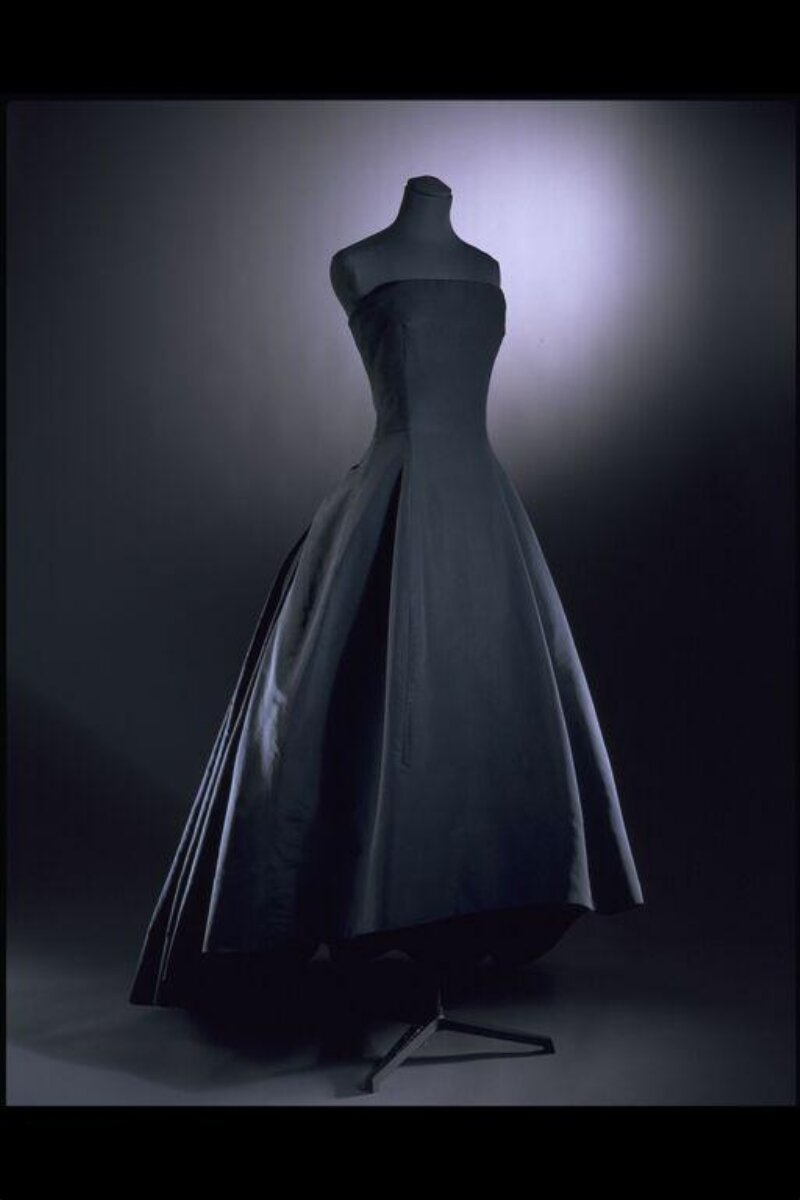
Couture Archaeology Report: Technical Deconstruction of the 'Soirée de Décembre' Evening Dress (Paris, 1955)
This report, prepared for the Natalie Fashion Atelier archive and future development team, presents a technical analysis of a significant exemplar of mid-century French haute couture: the 'Soirée de Décembre' evening dress, attributed to the House of Dior and dated to the autumn/winter season of 1955. The objective is a forensic deconstruction of its construction, materiality, and silhouette to inform and inspire the translation of its core principles into the high-end luxury lexicon of 2026.
I. Historical Context and Silhouette Genesis
Created in the mature period of Christian Dior's "New Look," the 'Soirée de Décembre' exists within the lineage of the H-Line and A-Line silhouettes that succeeded the iconic Bar and Corolle lines. By 1955, Dior's focus had shifted from the overtly cinched, full-skirted post-war statement to a more refined, architectural exploration of form. This dress is not a return to the 1947 extreme but a sophisticated evolution. The silhouette is characterized by a structured yet softened torso, a high, defined waistline, and a skirt that employs controlled volume to create a graceful, descending taper—a precursor to the coming Y-Line. It embodies the era's duality: rigorous internal structure cloaked in an appearance of effortless elegance.
II. Technical Deconstruction: The Architecture of Illusion
The genius of the dress lies in its hidden engineering, which creates a specific, idealized body form.
A. Bodice and Internal Armature: The bodice is a masterclass in foundational construction. It is almost certainly built upon a custom-made silk organza or cotton batiste base, acting as a *toile* or under-bodice. Into this, a complex system of ridged seam tape, precision darting, and internally boned channels is integrated. The boning, likely thin, flexible steel or baleen, is not placed merely at the side seams but follows the curve of the princess seams, reinforcing the sculptural shape and preventing wrinkling across the bust and torso. The neckline, a deep but stable oval, is reinforced with a discreet, bias-cut silk tape to maintain its perfect curve without stretching.
B. Sleeve and Shoulder Articulation: The short sleeves are a definitive Dior signature of the period: the manche pagode or pagoda sleeve. This is not a simple gathered cap. Technical analysis reveals a sleeve cut with a pronounced, built-in upward curve at the crown, set into an armhole that is rotated slightly forward. The interior likely contains a small, self-fabric puff or a wisp of horsehair at the shoulder point to maintain the elegant, lifted drape without visible padding. This creates the characteristic silhouette of a relaxed yet refined shoulder, emphasizing the slenderness of the upper arm.
C. Skirt Engineering and Hemline Theory: The skirt appears as a simple, graceful bell. Deconstruction, however, reveals a hybrid structure. The front and side panels are cut with minimal flare, maintaining a sleek line over the hips. The volume and iconic shape are generated by deep, inverted box pleats or godets released from the back waistline. These are not gathered; they are precisely measured and folded, creating controlled, directional fullness that cascades into the hem. The hem circumference is substantial but disciplined, achieved through a deep, weighted hem allowance—possibly incorporating a concealed chain or lead weights within the hem facing—to ensure the skirt hangs with a precise, swinging motion.
III. Materiality and Surface Narrative
The specified fabric is a duchesse satin, a fabric choice of profound intentionality. Duchesse satin is a heavyweight, densely woven silk with a high thread count, resulting in a luxuriously matte face and a subtle luster. Its substantial body is crucial; it accepts the internal structure without buckling and holds the sculptural shapes defined by the seams. The color, described as "midnight cobalt," leverages the fabric's properties to play with light—creating deep, velvety shadows in the folds and a soft gleam on the planes.
Embellishment is strategic and structural. The appliquéd silk velvet motifs (likely abstracted floral or stellar forms) are not merely surface decoration. Their placement along the neckline, waist, and descending one hip serves to reinforce the garment's architectural lines and guide the eye. Furthermore, the slight nap of the velvet adds a textural contrast to the satin's smoothness, enhancing the tactile luxury. Fastenings would be a concealed back zipper with a hook-and-eye at the waist, and meticulous internal finishes: seams bound in silk, not merely overlocked.
IV. Translation for 2026 High-End Luxury Silhouettes
The 2026 translation for Natalie Fashion Atelier must move beyond pastiche, extracting the core principles of technique, intention, and sensation for a contemporary context.
A. Silhouette Abstraction: The 1955 defined waist can be abstracted into a new point of architectural focus. Consider a molded, minimalist corset belt in technical ceramic or polished resin, worn over fluid separates, creating a dialogue between soft and hard. The pagoda sleeve's lifted elegance can be reinterpreted through innovative pattern-cutting in neoprene or technical wool jerseys, creating volume without internal padding through seamed, three-dimensional forms.
B. Material Innovation: Replace duchesse satin with its 2026 equivalents: bio-fabricated satins with a lower environmental footprint, or recycled polyester satins engineered to have a natural fiber hand-feel. The weighted hem can be achieved with biodegradable glass beads sewn into bias-tape channels. Embellishment becomes structural: 3D-printed polymer motifs that act as both decoration and points of tensile reinforcement, or circuit-embedded lace that offers subtle, dynamic luminescence.
C. The Core Philosophy: The ultimate translation lies in embracing the Dior ethos of architecture for the body. The 2026 Natalie Atelier client seeks intelligent luxury—garments that are technically fascinating and emotionally resonant. The 'Soirée de Décembre' teaches us that luxury is built from the inside out. Our 2026 silhouettes must prioritize innovative internal construction, transformative materiality, and a silhouette that offers both comfort and awe. The goal is not to replicate a December evening in 1955, but to capture its moonlit certainty, its weighted grace, and its unwavering commitment to crafted beauty, re-rendered in the materials and forms of a new era.
Conclusion: The 'Soirée de Décembre' is a testament to the union of absolute technical precision with poetic vision. For Natalie Fashion Atelier, its value lies not as a template for reproduction, but as a master source code for luxury—a reminder that in high couture, the most profound elegance is always engineered.