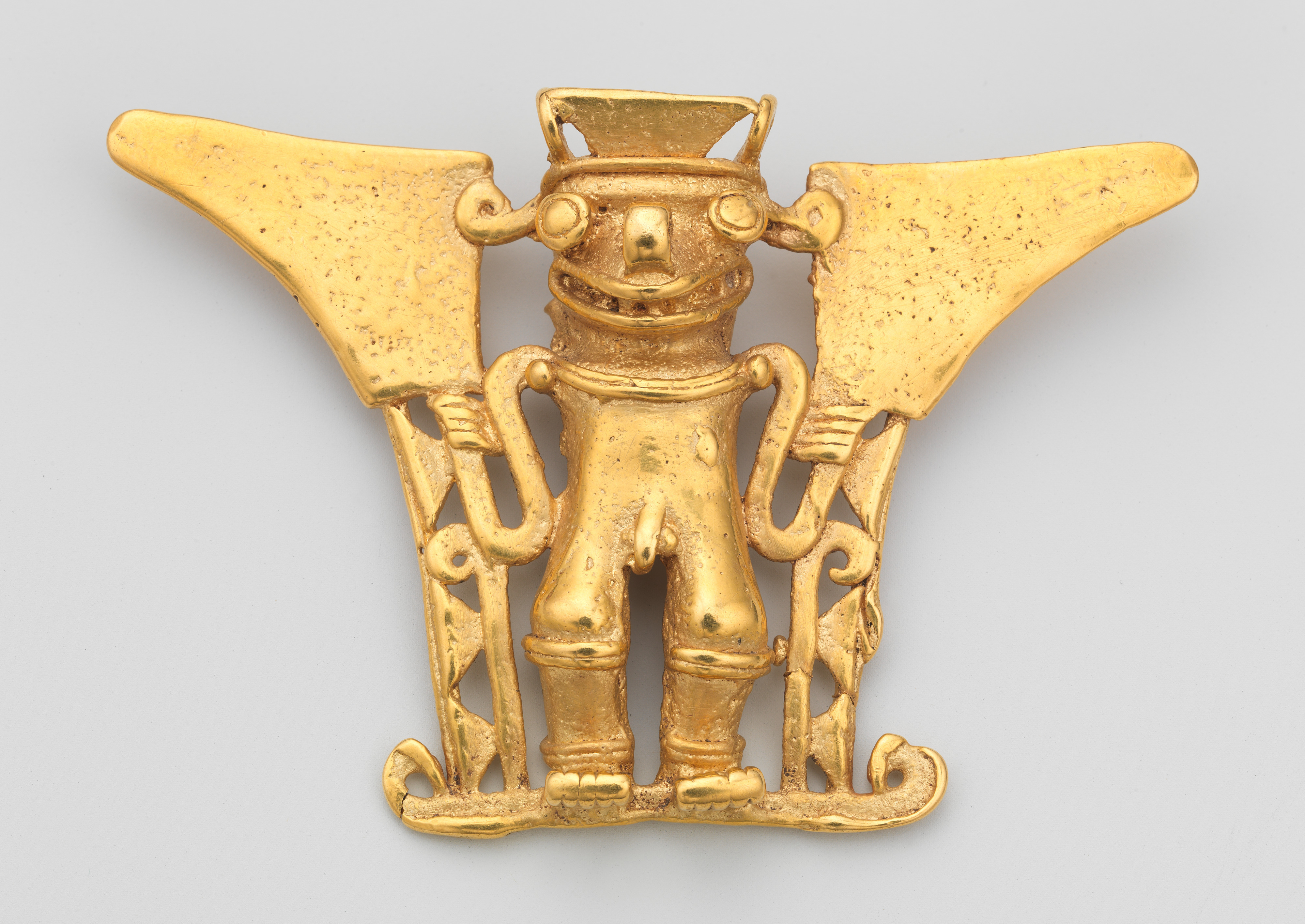
Archaeology of Form: The Diquís Bat-Head Figure Pendant as a Seminal Silhouette
The Diquís Bat-Head Figure Pendant, a masterwork of pre-Columbian goldsmithing, transcends its status as a ritual object to emerge as a foundational treatise on structured elegance. For Natalie Fashion Atelier, its significance lies not merely in its auric materiality but in its profound articulation of architectural volume, symbolic contour, and the dialogue between negative and positive space. Crafted between 700-1500 CE in present-day Costa Rica, the pendant synthesizes the biomorphic—the bat's corporeal form—with the geometric, resulting in a wearable sculpture of formidable presence. Its elegance is classical not in a Greco-Roman sense, but in its immutable resolution of form and function: a ceremonial shield that is simultaneously an extension of the body's own architecture. This artifact provides a critical archive node, resonating with the described duality of "a mirror with split-leaf palm design" and a "stone sarcophagus panel." It embodies this very paradox: one facet is a polished, reflective plane of symbolic adornment (the gold itself), while the other is a narrative, textured relief speaking of metamorphosis and the nocturnal soul. Deconstructing this piece unlocks a lexicon for 2026, where luxury seeks depth, legacy, and intelligent silhouette construction beyond ephemeral trend.
Technical Deconstruction: Principles of Pre-Columbian Classical Elegance
The pendant's classical elegance is engineered through three core principles, each offering a direct technical translation to the couture form. First, Controlled Asymmetry within a Bilateral Framework. The bat's head, while broadly symmetrical, is animated by subtle asymmetrical details in the ear forms and surface engraving. This creates a dynamic, living tension, avoiding sterile perfection. In silhouette construction, this translates to gowns and jackets where the structural armature is precisely balanced, yet detailed with off-kilter drape, singular epaulette treatments, or a single, dramatic godet flare. The body remains the central axis, but movement is born from calculated imbalance.
Second, Volumetric Reduction to Essential Planes. The artisan reduced the complex anatomy of a bat to an assemblage of smoothed, intersecting planes—the trapezoidal head, the conical ears, the cylindrical body. This is not minimalism, but essentialism: the form is distilled to its most potent geometric representation. For 2026, this informs a move away from excessive fullness or deconstruction. Instead, we propose silhouettes built from clear, clean geometric volumes: a cocoon coat articulated as a single, rounded plane broken by a sharp seam; a column gown whose torso is a flattened, oval sheath transitioning into a circular skirt. The focus is on the purity of the shape as it interacts with light and space.
Third, The Perforated Silhouette and the Weight of Emptiness. The pendant’s large, circular eye and the space between its ears and body are not absences, but active design elements. They frame the wearer's skin or underlying garment, making the body part of the composition. This principle directly informs 2026's approach to cut-outs and transparency. Rather than arbitrary flesh exposure, we engineer architectural fenestration: precise, geometric apertures in a bodice that reveal a contrasting underlay of silk or a second skin of illusion tulle, creating layered depth and a modern sense of armor. The negative space carries equal weight to the fabric.
Material Translation: From Ritual Gold to 2026 Fabric Architecture
The materiality of the pendant—hammered gold—is intrinsic to its message. The surface holds a duality: a luminous, reflective face and a tactile, hand-worked substrate. This directly mirrors the archive node's "mirror" and "carved sarcophagus." Our 2026 material palette will emulate this dichotomy. We will develop fabrics with a bi-facial character: a duchesse satin with one side polished to a mirror finish and the reverse matte and textured with a浮雕-like jacquard depicting abstracted bat-wing or palm motifs. Metallics are not used frivolously but as structural elements: gold-foiled leather is cut into rigid, pendant-inspired appliqués that articulate seams, while gilded chainmail, lightweight and fluid, mimics the play of light on hammered gold, creating a garment that is both protective and luminous.
Furthermore, the pendant’s function as a chest-centered focal point informs our approach to embellishment and density. Ornamentation will be centralized and monumental, not all-over. A stark, minimalist wool crepe column gown may feature a singular, sculptural gold-metal and resin breastplate inspired directly by the pendant's form, acting as both jewelry and garment structure. This creates a powerful, ritualistic focal point, echoing the pendant's ceremonial role.
Silhouette Prognosis for 2026: The Nocturnal Architectonics Collection
Informed by this deconstruction, Natalie Fashion Atelier's 2026 direction—Nocturnal Architectonics—will be defined by silhouettes that are protective, poetic, and geometrically resolved. The bat, as a creature of perception and transition, guides a collection exploring elegance in shadow, sharpness, and metamorphosis.
Key Silhouette Manifestations:
The Bi-Plane Coat: A masterpiece of tailoring, rendered in a bi-facial wool. Its silhouette is a single, sweeping plane from shoulder to hem, broken only by a dramatic, off-center seam that curves like the pendant's contour. One side reflects light; the other absorbs it, embodying the mirror/sarcophagus duality. It is worn as a ceremonial shield.
The Fenestrated Sheath: A gown of utmost precision, built from a technical silk-georgette fused to a rigid underlining. The bodice features a series of calculated, circular and trapezoidal cut-outs (echoing the pendant's eyes and form) that reveal a second layer of gilded mesh. The silhouette is a pure, essentialized column, animated by these architectural voids.
The Asymmetric Volante: A skirt or dress where fullness is not radial but directional. Inspired by the pendant's asymmetrical balance, a single, massive godet erupts from a minimalist, fitted hip, creating a parabolic sweep of fabric. The structure is classical; the motion is dynamic and unexpected.
Conclusion: Heritage as Forward Propulsion
The Diquís Bat-Head Figure Pendant is not a relic to be reproduced, but a generative algorithm for elegance. Its principles of essentialized volume, strategic asymmetry, and meaningful materiality provide a robust, intellectual framework for 2026 luxury. In an era seeking substance, clients will gravitate toward silhouettes that speak a language of ancient wisdom and modern rigor. By transposing the pendant’s sacred geometry and aurous gravity into fabric, cut, and silhouette, Natalie Fashion Atelier will not merely reference history but will continue its narrative, crafting a contemporary couture that is, like the artifact itself, both a protective armor and a luminous testament to refined civilization.