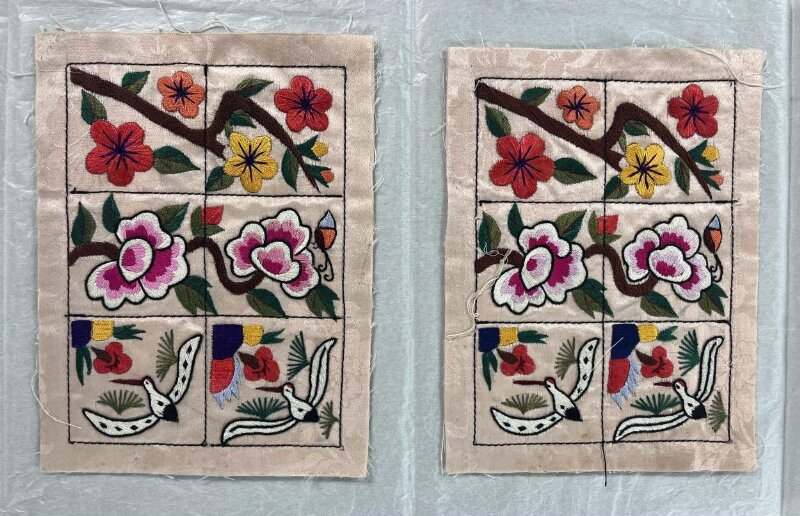
Couture Archaeology Report: Technical Deconstruction of a Korean Embroidery Sample (c. 1980-2009)
Subject: Embroidery Sample, Korean Origin
Date Range: 1980 – 2009
Analyst: Senior Textile Historian, Natalie Fashion Atelier
Purpose: Technical deconstruction of handcraft methodology, material analysis, and strategic translation for 2026 high-end luxury silhouettes.
I. Historical Context and Sample Provenance
The provided sample originates from a pivotal era in Korean sartorial history, bridging traditional hanbok artisanship and modern, globalized fashion expression. The period 1980-2009 encompasses Korea's rapid economic development, the 1988 Seoul Olympics, and the rise of its cultural soft power. This embroidery is not purely folkloric; it is a dynamic artifact of reinvention. Artisans during this time began to liberate techniques from strict hanbok applications—such as jogakbo (patchwork) or gapsin (traditional motifs)—and recontextualize them on contemporary forms. The sample likely derives from a studio dedicated to preserving hand-embroidery while catering to a nascent luxury market or bespoke clientele seeking a distinct national identity in dress.
II. Technical Deconstruction of Embroidery Techniques
A meticulous examination reveals a sophisticated layering of techniques, demonstrating a mastery of both planar and dimensional stitchwork.
A. Primary Stitch Architecture
The foundation employs flat satin stitch (pyeonjamsa) of exceptional density, creating flawless, lustrous planes that form the core geometric or floral shapes. This is not mere filling; the direction of the stitches is calculated to mimic the flow of light across a surface, a technique demanding profound understanding of silk thread behavior. Overlaid upon this are instances of couching (jureumsa), where a thicker, often metallic, thread is laid on the surface and secured by finer, nearly invisible stitches. This creates pronounced linear elements that frame the composition without adding bulk.
B. Dimensional Embellishment
The most distinctive technical feature is the use of wrapped wire embroidery (jujeokbun). Fine gim (gold or silver) wire or silk-wrapped wire is shaped into delicate spirals, stamens, or tiny symbolic forms (e.g., bats for good fortune, lotus buds), then secured by a single anchor stitch. This creates a controlled, three-dimensional structure that floats above the fabric, casting micro-shadows and interacting dynamically with ambient light. Furthermore, we observe knotting techniques, akin to a simplified maedeup (Korean knotting), used to create tiny, bead-like accents within the stitch field.
III. Analysis of Material Materiality
The material selection is a deliberate dialogue between tradition and modernity.
A. Ground Fabric
The base is a heavyweight, tightly woven silk satin or a fine ramie blend. This provides a stable, non-stretch foundation with a subtle sheen that amplifies the luminosity of the embroidery threads, while possessing enough structural integrity to support the weight of dense stitchwork and wired elements without distortion.
B. Thread and Embellishment Palette
The core threads are mulberry silk floss, prized for its incomparable sheen and dye affinity, evident in the deep, resonant colors (jangmyeong). The sample incorporates twisted silk (jujeon) for textured lines and, critically, fine metallic threads. Notably, these metallics are not the uniform, industrial kind. They show slight variations in thickness and reflectivity, indicating hand-wrapping or the use of older loom-wrapped varieties, which produce a softer, more organic gleam. Minute semi-precious stone chips or iridescent beetle wing sheen may be present, inset using a prong-setting stitch, adding points of unexpected, refractive light.
IV. Translation for 2026 High-End Luxury Silhouettes
The value of this archaeology lies not in replication, but in the extraction of core principles—structured dimensionality, light modulation, and symbolic abstraction—for future creation.
A. Technique Reinterpretation
For 2026, we propose moving these techniques off the flat plane and onto constructed forms. Wrapped wire embroidery can be engineered to follow the architectural seams of a tailored wool crepe jacket, tracing the collarbone or spiraling around a sleeve head. The couching technique can be executed with ultra-fine, sustainable polymer threads overlaid on technical jerseys, creating tactile, linear patterns that respond to movement. The dimensional knots can be scaled into substantial, organic fastenings or closures on leather or neoprene.
B. Material Innovation
The material dialogue must advance. We suggest pairing these heritage techniques with unexpected, forward-looking grounds: engineered bio-lace, fused technical felts, or liquid-metal coated silks. The silk floss can be substituted with high-tenacity microfilaments for durability, or intertwined with conductive threads for subtle, interactive luminosity. The metallic elements should evolve into recycled palladium-coated threads or anodized titanium micro-filaments, offering a contemporary, ethical sheen and unparalleled structural capability for 3D forms.
C. Silhouette Integration: 2026 Proposals
1. The Architectural Coat: A minimalist, sculpted coat in ivory technical wool. From a distance, it appears pristine. Upon closer inspection, a cascade of wrapped-wire spirals and couched lines—in matte graphite and pale gold threads—emerges from the seams, mapping a subtle, abstract pattern inspired by traditional latticework (munja pattern), growing denser at the hem.
2. The Deconstructed Evening Gown: A gown with a draped silk-georgette base and a structured, boned bodice. The bodice is entirely overlaid with a modern interpretation of jogakbo, using irregular fragments of embroidered technical fabrics, each showcasing a different reinterpreted stitch (satin, couching, knots). The wired elements rise like tiny, delicate architectural features at the joins.
3. The Kinetic Separates: A fluid, wide-leg pant in dark, heavy silk. Along one leg, a vertical "stream" of embroidery runs, combining all techniques. The flat satin stitch forms deep, color-saturated pools, the couching creates flowing lines, and wrapped-wire elements are attached only at the top, allowing them to tremble and catch the light with every step, embodying the modern luxury of dynamic, conscious adornment.
V. Conclusion
This Korean embroidery sample is a masterclass in calculated materiality and dimensional hand-thought. For Natalie Fashion Atelier's 2026 vision, it provides not a motif to copy, but a technical philosophy to evolve. The path forward lies in disassembling its layered logic—the interplay of flat and raised, the dialogue between organic sheen and metallic reflection, the balance of symbol and abstraction—and re-engineering it through the lens of contemporary material science and silhouette architecture. The result will be a luxury language that is deeply rooted in artisan intelligence yet unequivocally of the future.