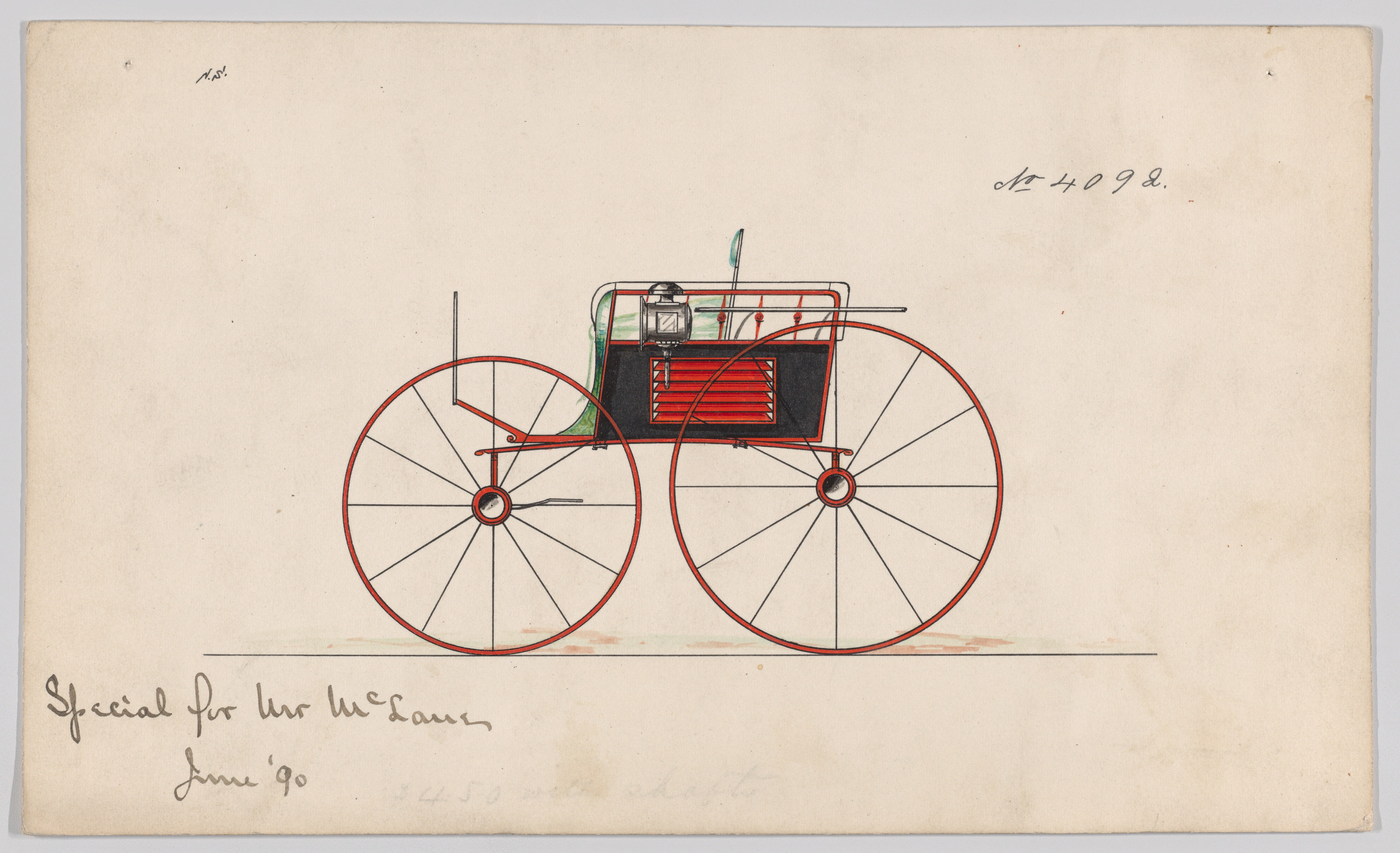
Design for Dos-à-Dos Phaëton, No. 4092: An Aesthetic Archaeology
Within the isolated context of aesthetic archaeology, the artifact designated Design for Dos-à-Dos Phaëton, No. 4092 emerges not merely as a technical drawing of a carriage, but as a profound treatise on structured elegance. Executed in graphite, pen and black ink, watercolor and gouache with gum arabic, this object from the Global Heritage archive transcends its original purpose. It presents a codified language of curvature, proportion, and dynamic tension—a language that speaks directly to the foundational principles of Haute Couture. The Phaëton, a light, open carriage designed for speed and visibility, embodies a specific late-19th-century aspiration: performance cloaked in impeccable grace. This analysis deconstructs its classical elegance to illuminate its direct conceptual and structural application in shaping the 2026 luxury silhouette, where heritage is not reproduced but re-engineered.
Deconstruction of Classical Elegance: The Phaëton as a Structural Archetype
The artifact’s materiality is the first key to its enduring relevance. The graphite and ink establish an armature of absolute precision, delineating the chassis, spokes, and sweeping arcs of the carriage body with architectural clarity. This is the toile of the object—the underlying structure. Upon this, the watercolor and gouache, bound with gum arabic for luminosity, apply the métier: the nuanced play of light on lacquered surfaces, the suggestion of rich upholstery, and the atmospheric depth of the scene. This dichotomy between rigid understructure and fluid, luminous surface is the core dialectic of couture.
Specifically, the elegance is located in three interlocking principles. First, the Dos-à-Dos configuration—where passengers sit back-to-back—creates a silhouette that is simultaneously intimate and expansive, a study in balanced opposition. Second, the pronounced curvature of the wings and dashboard is not merely decorative; it is a functional aerodynamic gesture that has been aestheticized, a precursor to biomimicry in design. Third, the exquisite tension between the fragility of the spoked wheels and the solidity of the axle and chassis mirrors the couture principle of creating garments that appear to float on the body while being supported by complex, hidden internal architectures. The carriage is a mobile sculpture, its elegance derived from resolved engineering.
Informing the 2026 Silhouette: From Carriagework to Corsetry
For the 2026 collection, Natalie Fashion Atelier translates these archetypal principles into a new lexicon of volume, support, and surface. The historical artifact does not inspire literal replication but rather provides a blueprint for a modern structural philosophy.
1. The Dos-à-Dos Architecture: Silhouettes of Opposition
The back-to-back seating arrangement directly informs a revolutionary approach to silhouette construction for 2026. We propose the "Dos-à-Dos Dress", a garment conceived from two opposing points of tension. Imagine a gown where the front drapes in a soft, Phaëton-wing curve from a single shoulder, flowing into a minimalist column. The back, in stark yet harmonious opposition, features a rigorous, corseted architecture inspired by the carriage's chassis, with intricate strap work mimicking the precision of the inked wheel spokes. This creates a biographical garment, presenting a serene, fluid front and a complex, structural narrative in the rear—a silhouette that engages space and observer dynamically from every angle.
2. Curvilinear Armature and Aerodynamic Draping
The pronounced, sweeping curves of the Phaëton's body, designed to cleave the air, are abstracted into internal and external armatures for 2026. We move beyond traditional boning. Using advanced polymers and layered graphite-infused textiles (a direct material homage to the medium of the artifact), we will construct lightweight, flexible understructures that define silhouette through curvature rather than constraint. Over these armatures, fabrics will be applied using a technique we term "aerodynamic draping". Inspired by the watercolor's suggestion of rushing air, layers of silk gazar and technical faille will be cut on hyperbolic curves and anchored at singular points, creating permanent, gravity-defying waves that appear to be in motion, much like the captured velocity of the drawn carriage.
3. The Lumière of Gum Arabic: Surface as Depth
The most poetic translation lies in the material finish. The gum arabic in the artifact’s paint suspends pigment to create a deep, luminous glaze. For 2026, this inspires a focus on surface alchemy that creates perceptual depth. We will develop couture finishes where layers of ink-black lacquer are hand-applied to jacquard, then partially dissolved and buffed to reveal underlying metallic threads, mimicking the play of light on a lacquered carriage panel. Embroidery will not sit upon the fabric but will be embedded within it, using techniques of trapunto and reverse-appliqué to create the illusion that the watercolor’s hue is emerging from within the cloth itself. The silhouette thus gains a trompe-l'œil dimensionality; what appears from a distance as a simple, elegant curve reveals, upon closer inspection, a landscape of micro-details.
Conclusion: The Archive as an Active Atelier
The Design for Dos-à-Dos Phaëton, No. 4092 demonstrates that classical elegance is, at its zenith, a perfect marriage of calculated structure and emotive form. Through the discipline of isolated aesthetic archaeology, we have extracted not a motif, but a generative logic for modern luxury. The 2026 silhouette, as informed by this artifact, will be defined by this dialogue of opposites: rigid and fluid, front and back, structure and surface, historical intelligence and future execution. It champions a couture where the garment is a architectured environment for the body, a personal carriage of exquisite pace and presence. In this, the Phaëton’s legacy is secured—no longer as a means of transport through the Bois de Boulogne, but as a vehicle for transporting the fundamental principles of elegance into the future of Natalie Fashion Atelier.