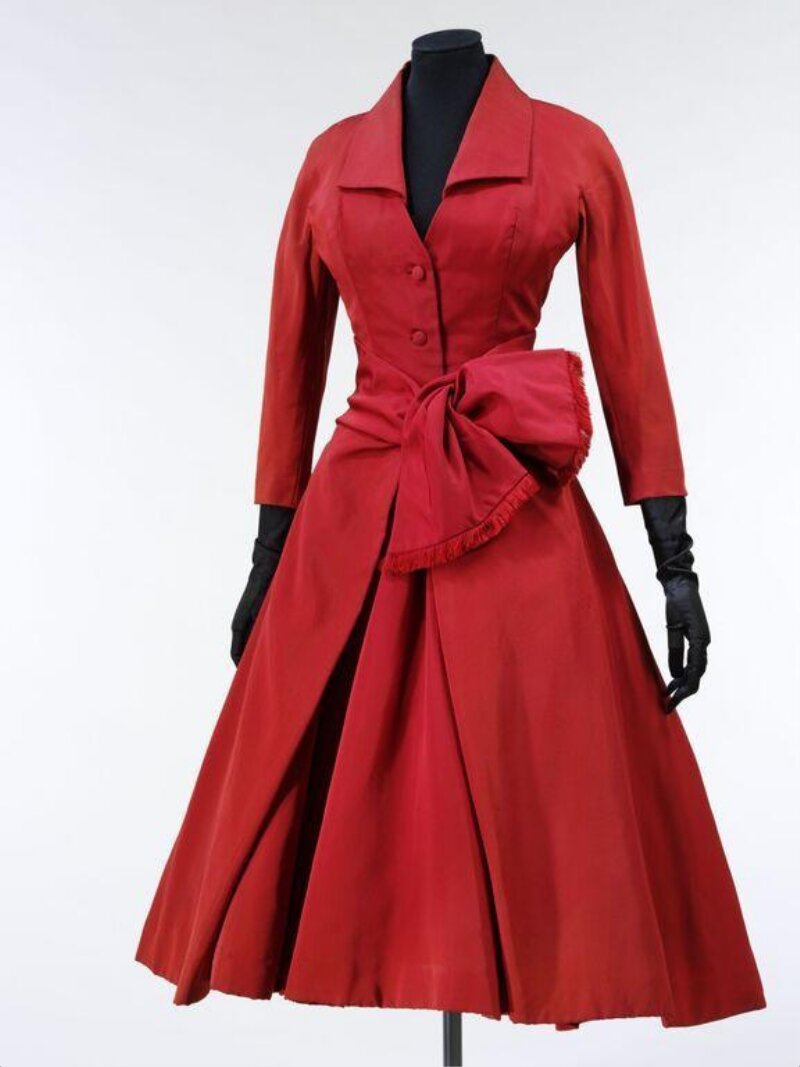
Écarlate: A Technical Deconstruction of Dior's 1955 Haute Couture and Its 2026 Translation
This report presents a technical and material analysis of the garment codenamed Écarlate, a premier modèle from the House of Dior’s Autumn-Winter 1955 Haute Couture collection. The objective is a precise archaeological deconstruction of its construction, materiality, and silhouette to inform and inspire the Natalie Fashion Atelier’s 2026 high-end luxury direction. The 1955 period represents a zenith of post-war Parisian couture, where technical mastery and material opulence converged to create an architecture of femininity. Écarlate exemplifies this, serving not as a relic, but as a living treatise on proportion, structure, and tactile luxury.
I. Technical Deconstruction: The Architecture of the "A-Ligne"
The 1955 Dior silhouette, later termed the "A-Line," marked a deliberate softening from the severe wasp-waist of the "New Look." Écarlate is a masterclass in this transitional geometry. Its architecture is built upon a foundation of hand-tailored internal scaffolding.
Bodice Analysis: The bodice employs a six-panel princess seam construction, meticulously draped to contour the bust and ribcage without compression. The true innovation lies in its internal structure. A combination of haircanvas interfacing, quilted with silk thread in a honeycomb pattern, provides a lightweight yet resilient substrate. Boning is not the rigid spiral steel of earlier decades, but narrow, flexible whalebone (baleen) strips, placed only at the side seams and center front, serving to guide the drape rather than enforce it. The armhole is cut high and deep, allowing for sleeve movement while maintaining a clean shoulder line—a signature Dior precision.
Skirt Silhouette: The "A" shape is achieved not through excessive fullness, but through calculated geometric cutting. The skirt is comprised of eight gores, each panel widening progressively from hip to hem at a precise angle. The hem circumference is exactly 2.75 times the waist measurement, a ratio that ensures a dramatic but controlled flare. No crinoline is used; instead, the shape is maintained by a layered underskirt of silk organza, each layer cut to a specific radius and hand-hemmed with a 3mm rolled edge for weight and fluidity.
II. Material Materiality: The Substance of Scarlet
The garment’s codename, Écarlate (Scarlet), is central to its identity. This is not a simple dye lot, but a complex material narrative.
The Wool: The primary fabric is a French worsted wool barathea, woven in Lyons. The barathea weave—a compact broken rib—produces a fine, pebbled surface with a subtle crosswise grain, giving the cloth a dense, springy hand and a muted, luminous finish that absorbs and reflects light deeply. The scarlet dye is achieved through a multi-stage process using synthetic alizarin derivatives, providing a depth and colorfastness that natural madder could not guarantee, resulting in a hue that is neither orange nor purple, but a pure, resonant crimson.
Contrast & Detail: The collar, cuffs, and a distinctive waistband cummerbund are fashioned from duchesse satin in the same scarlet. The contrast in texture—between the matte, fibrous wool and the glossy, reflective satin—creates a dialogue of surfaces within a monochromatic scheme. Fastenings are concealed; the back zipper is a heavyweight brass éclair, its teeth set on silk tape for silent operation. All internal seams are finished with pinked and overcast edges, then lined with a burgundy Bemberg cupro, chosen for its moisture-wicking and anti-static properties—a hidden luxury.
III. Translation for 2026 High-End Luxury Silhouettes
The translation of Écarlate for 2026 lies not in replication, but in the abstraction of its core principles: architectural clarity, intelligent material synergy, and immersive tactility.
Silhouette Evolution: The 1955 "A-Line" must be deconstructed and re-proportioned for a contemporary posture and pace. We propose an asymmetric A-silhouette for 2026. The foundational princess seam paneling can be extended into dramatic, spiraling seams that wrap the torso, culminating in a skirt with a variable flare—tighter over one hip, exploding into volume at the opposite side. The internal scaffolding evolves from haircloth to laser-sintered polymer mesh, custom-molded to provide support and shape memory with negligible weight. The high armhole remains relevant but can be exaggerated into a deep, geometric armbrace, extending over the shoulder blade.
Material Innovation: The material dialogue of matte and gloss is ripe for technological enhancement. The wool barathea can be re-engineered as a bio-fabricated protein wool, grown from collagen structures to replicate the hand but with enhanced sustainability. The scarlet dye can be achieved through structural color technology, where nano-patterning on the fibers creates an iridescent, chromatic shift unseen in 1955, moving from deep scarlet to violet at certain angles. The satin contrast can be replaced with a liquid metal laminate or a mylar-embedded silk, offering a futuristic gloss. Internal luxury shifts to performance: micro-encapsulated climate-regulating linings and seams finished with ultrasonic welding for a flawless, weightless interior.
The 2026 Écarlate Ethos: The final translation is an ethos. It is the marriage of couture’s analytical, made-to-measure philosophy with the material intelligence of the 21st century. The 1955 garment was a shield of elegance; the 2026 iteration is a second skin of enhanced experience—sculptural, responsive, and sensorially rich. It respects the past not through pastiche, but through a shared commitment to technical ambition and profound material understanding.
In conclusion, Écarlate provides a foundational blueprint in the archaeology of elegance. Its value lies in the explicit connection it forges between unseen internal structure and external aesthetic effect. For Natalie Fashion Atelier in 2026, its legacy is a mandate: to build luxury from the inside out, to treat material as narrative, and to sculpt silhouettes with the confident, analytical hand of the atelier, armed with the tools of the future.