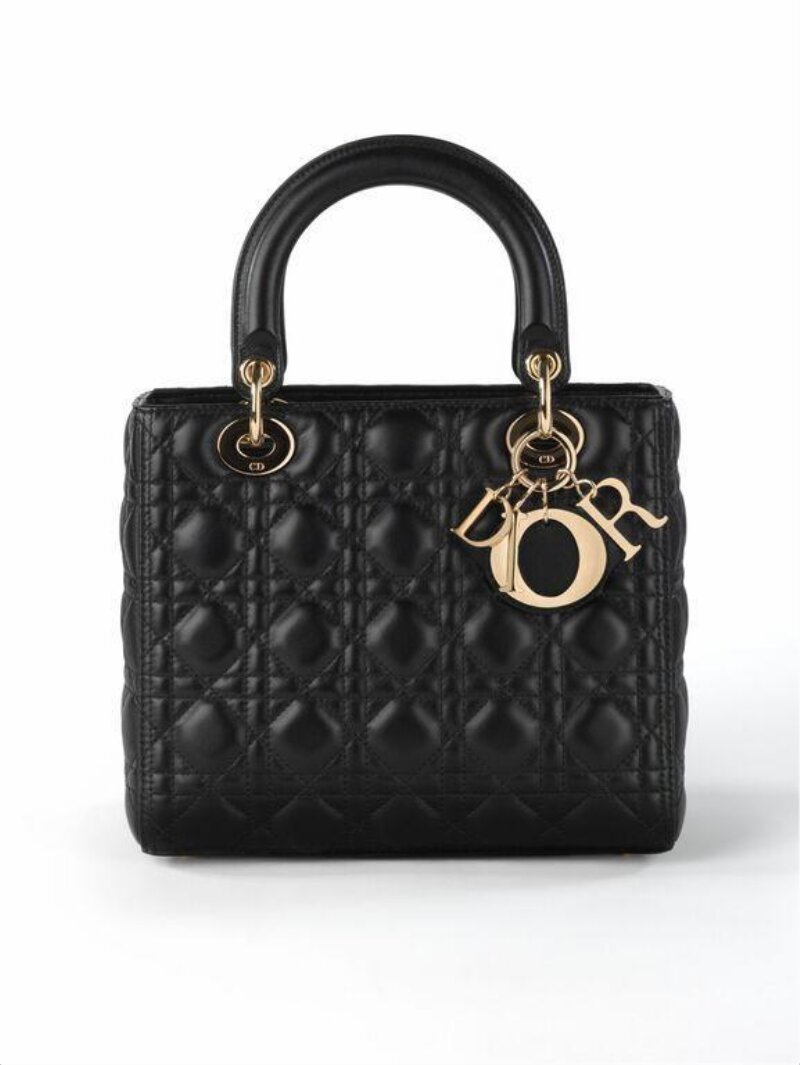
Couture Archaeology Report: Object D-2020-001 "Lady Dior"
Subject: 'Lady Dior' Medium Handbag (Cannage Quilting, Lambskin, Silver Hardware)
Origin: France, 2020 (Dior)
Analyst: Senior Textile Historian, Natalie Fashion Atelier
Date: [Current Date]
Report Focus: Technical deconstruction of signature Dior techniques, analysis of material materiality, and prognostic translation into high-end luxury silhouettes for the 2026 season.
1. Technical Deconstruction: The Architecture of an Icon
The Lady Dior is not a mere accessory; it is a feat of micro-architecture. Its structural integrity derives from a rigid, three-dimensional form, achieved through a complex marriage of foundational materials and couture-level hand-finishing. The core is a shaped thermoplastic panel, over which the primary leather is stretched and secured. This creates the bag's signature upright, volumetric silhouette, resistant to slouching—a direct antithesis to the soft, unstructured bags prevalent in its era.
The quintessential Cannage quilting is a technical marvel that transcends decoration. Each intersecting diamond is not simply stitched but is a padded, topographic feature. The process involves a secondary layer of backing fabric, between which a precise amount of wadding is inserted prior to the meticulous diamond-grid stitching. This technique, inspired by Napoleon III cane chairs, serves a dual purpose: it creates a luminous play of light and shadow, enhancing the material's richness, and it provides a reinforced, textured surface that camouflages minor wear. The stitching itself is performed with calibrated precision, ensuring each diamond is perfectly symmetrical and the tension uniform, a testament to the atelier's rigorous standards.
Further evidence of couture-level execution is found in the handle attachment. The iconic "D.I.O.R." charm hardware is not merely applied but is integrated into the handle's structural support system. The handles are tubular, filled for rigidity, and hand-stitched directly onto the bag's body with reinforced, often double-stitched, saddle techniques. This distributes weight and stress, ensuring longevity—a principle borrowed from equestrian saddlery and luggage-making, foundational pillars of heritage leather goods.
2. Material Materiality: Tactile Semiotics of Luxury
The 2020 iteration of the Lady Dior exemplifies a deliberate material narrative. The primary material, supple grain de poudre lambskin, was selected for its specific sensory and visual properties. Its fine, pebbled texture provides a soft luminosity and a resilient surface that interacts elegantly with the Cannage quilting, deepening the three-dimensional effect. The leather's hand-feel is pliant yet substantial, communicating immediate luxury through touch.
The materiality of the hardware is equally semiotic. The palladium-finished silver hardware offers a cool, modern sheen, contrasting yet harmonizing with the warm leather. Its weight is calculated—substantial enough to denote quality and provide a satisfying tactile feedback when handled, but not burdensome. The charms are cast, then polished and finished by hand to remove any seam lines, achieving a seamless, jewel-like appearance. This interplay between organic, textured leather and precise, cold metal establishes a dialogue between nature and artifice, a core tension in modern luxury.
Internally, the material story continues with a signature microfiber-lined interior and branded metal plaque. The lining is not a passive component; its color and soft, sueded finish are designed to protect contents and provide a sensorial surprise upon opening—a private luxury known only to the wearer.
3. Prognostic Translation: 2026 High-End Luxury Silhouettes
For the 2026 season, the archaeological principles of the Lady Dior—structure, artisanal texture, and hardware-as-jewelry—must be translated through the lens of evolving form and technological materiality. The silhouette will shift from the rigidly architectural to the articulated architectural.
We propose the development of a "Modular Cannage" system. Instead of a single rigid form, imagine a structured bag composed of interlocking, quilted panels connected by flexible, tensile ligaments of biotech leather or coated technical fabric. This allows the silhouette to adapt—from geometric and upright to softly slouched—while maintaining a defined shape. The Cannage quilting itself can be rendered in variable scales and padding densities across these panels, creating a new topography of texture.
Materiality will evolve towards regenerative tech-luxury. The foundational leather will be supplanted by next-generation materials: lab-grown leathers with engineered grain patterns, or high-density, plant-based mycotextiles finished with nanocoatings for water and stain resistance without compromising breathability or hand-feel. The material will be sustainable at its origin but indistinguishable in luxury from its 2020 predecessor.
Hardware transforms into kinetic intelligence. The functional charms will be reimagined as modular, interactive elements. A detachable charm could serve as a discrete battery pack for integrated, soft-lighting within the bag's interior or for device charging. The iconic "D.I.O.R." letters might incorporate subtle, haptic-feedback mechanisms or NFC chips for authentication and digital wardrobe integration. Their form will remain recognizably derived from the original, but their material could shift to ceramics, matte anodized titanium, or even transparent polymers with embedded, fibrous elements.
Finally, the silhouette will expand beyond the handbag. The principle of rigid, quilted formwork will be applied to high-neck collars, structured peplums, and articulated sleeve caps on eveningwear and tailored separates. Miniaturized Cannage, executed in laser-cut and thermally-bonded technical fabrics, will create a new language of texture on bodices and sheaths, offering a lightweight, flexible alternative to traditional beading.
Conclusion
The 2020 Lady Dior is a repository of foundational luxury codes: unwavering structure, artisanal surface manipulation, and the elevation of hardware to heirloom status. For 2026, the Natalie Fashion Atelier must not replicate, but transmute these codes. By deconstructing its technical DNA and recombining it with advanced materials and intelligent design, we can create a new generation of luxury objects. These pieces will honor the tactile, human-centric craftsmanship of the past while embracing a future where form is adaptive, materiality is conscious, and detail is dynamically interactive. The legacy of the Lady Dior thus becomes not a static icon, but a living blueprint for the evolving anatomy of luxury.