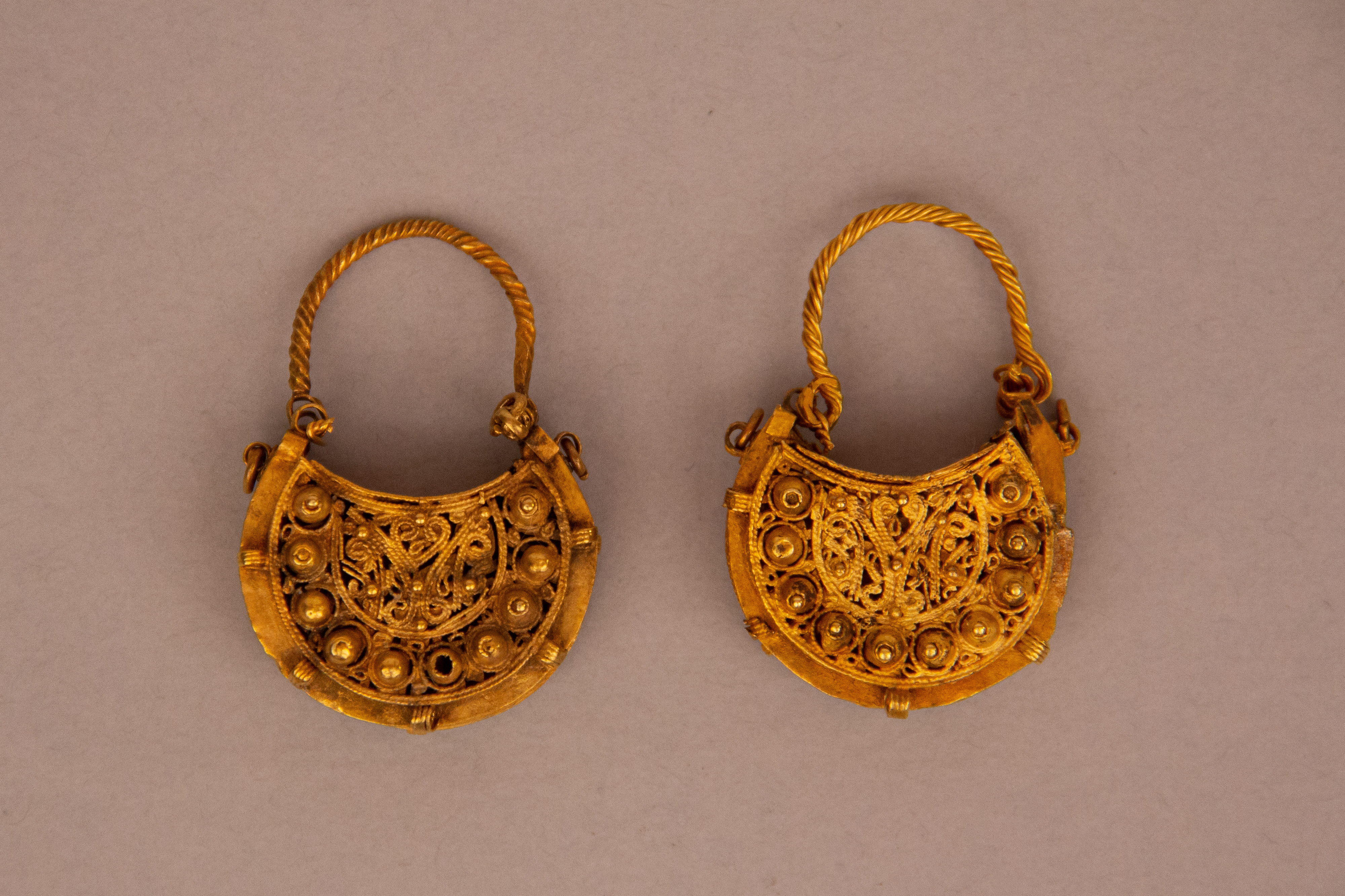
Artifact Exegesis: The Structural Poetics of a Singular Earring
Within the curated silence of the atelier archive, isolated from its pair and its original cultural context, this artifact—Earring, One of a Pair—transcends mere adornment to become a treatise on foundational luxury. Its materiality—gold rendered as wire, strip, filigree, and granulation—represents not just a catalog of techniques, but a hierarchical architectural language. The wire provides the unseen armature, the tensile strength. The strip forms the primary planes, the defined surfaces. Filigree introduces narrative complexity and permeable light. Granulation offers conclusive punctuation, a textural full stop. This deconstruction reveals a core tenet of classical elegance: a sublime equilibrium between structural integrity and decorative delicacy, where the method of construction is intrinsically linked to the aesthetic result. The artifact’s power in isolation lies in its forced self-sufficiency; it must hold the gaze and communicate its entire philosophy alone, a principle directly transferable to the impactful singularity of a 2026 haute couture silhouette.
Archaeology of Light: Filigree as a Design Protocol
The filigree work on this artifact is not merely applied decoration; it is a calculated manipulation of void and solid, of opacity and luminosity. This technique, historically reliant on meticulous hand-coiling and soldering of fine wires, creates a permeable membrane of gold. For the 2026 silhouette, this translates into a design protocol centered on strategic permeability and layered transparency. We are moving beyond sheer overlays to engineered architectural lace and laser-sintered metallic meshes that mimic filigree’s play of light. Imagine a column gown where the torso is defined not by opaque fabric, but by a bodice of 3D-printed titanium filigree, offering glimpses of skin and an underlying silk slip—a dialogue between the protective and the revealed. Furthermore, the filigree principle informs fabric development: embroidered tulle with voids deliberately left unfilled, or jacquard weaves where the pattern is formed by absences, creating a silhouette that is as much about the spaces as the substances.
The Grammar of Texture: Granulation and Modern Surface Narratives
Granulation, the art of fusing minute gold spheres to a surface, provides the artifact’s most intimate textural dialogue. It is a tactile punctuation, a braille of luxury that demands close inspection. In the context of 2026, granulation informs a macro-scale approach to surface and silhouette. The concept of a singular, flat textile is obsolete. Instead, we see silhouettes built from cumulative textural events. This manifests in several key directions. First, in hyper-scaled embellishment: three-dimensional ceramic or resin "granules" applied to wool crepe or technical neoprene, creating a topographic map across the body. Second, in engineered fabric crenellations: laser-cut leather or fused organza manipulated to form permanent, raised textural clusters that catch light as granules do. Finally, it inspires a mono-material layering technique, where a single material—perhaps matte jersey—is folded, gathered, and self-appliquéd to create a densely granulated surface effect, resulting in a silhouette of profound depth and quiet, sophisticated volume.
Informing the 2026 Silhouette: From Ornament to Architecture
The artifact’s legacy is its demonstration of how ornament, when rooted in structural logic, becomes architecture. For Natalie Fashion Atelier’s 2026 vision, this means silhouettes where decoration is not applied but integral, where the line of the body is defined by the logic of its embellishment. The classical elegance deconstructed here is one of holistic composition, a principle that will define the next generation of high-end design.
Silhouette I: The Filigreed Exoskeleton
Informed directly by the wire armature and filigree membrane of the artifact, this silhouette features externalized structure as ornament. A minimalist sheath dress serves as a canvas for a lightweight, sculptural exoskeleton crafted from gold-anodized aluminum wire or resin-infused carbon fiber, tracing the lines of the collarbone, spine, and hip. This external "filigree" does not conceal but rather diagrams the body’s architecture, creating a silhouette of precise, luminous lines. It is protective yet open, strong yet delicate—a direct translation of the earring’s core dichotomy into a full-scale corporeal experience.
Silhouette II: The Granulated Volume
Here, the principle of granulation dictates form. This silhouette explores controlled, textural volume, moving away from sweeping drapery towards intentional, localized expansion. A tailored wool jacket may feature one shoulder and sleeve overwhelmed by a cascading accumulation of hand-rolled silk "granules," creating an asymmetrical, organic profile. A column gown might emerge from a densely granulated hip yoke, where the texture itself generates the silhouette's shape. The body is both revealed and obscured by this tactical topography, offering a modern, abstracted take on classical opulence that is felt as much as it is seen.
Silhouette III: The Strip-Wrapped Linear
Derived from the artifact’s use of gold strips to create clean planes, this silhouette is an exercise in linear purity and gilded segmentation. It involves wrapping the body with narrow bands of material—gilded leather, metallic bias-cut satin, or rigid paper taffeta—that articulate the form in a series of parallel or spiraling lines. These "strips" create the silhouette through their spacing and tension, leaving strategic gaps of skin or an underlying base. The result is a graphic, kinetic silhouette that plays with perception, fragmenting and reconstructing the body’s image with geometric precision, echoing the disciplined elegance of the artifact’s foundational construction.
This isolated earring, through the forensic analysis of its materiality, provides a complete design lexicon. Its golden techniques—wire, strip, filigree, granulation—are not historical relics but active verbs for 2026: to armature, to plane, to filtrate light, to punctuate texture. For Natalie Fashion Atelier, this artifact confirms that the future of the haute couture silhouette lies not in the rejection of history, but in its deep technical deconstruction, allowing the timeless principles of balance, structure, and luminous detail to inform a new, rigorously elegant architecture for the body.