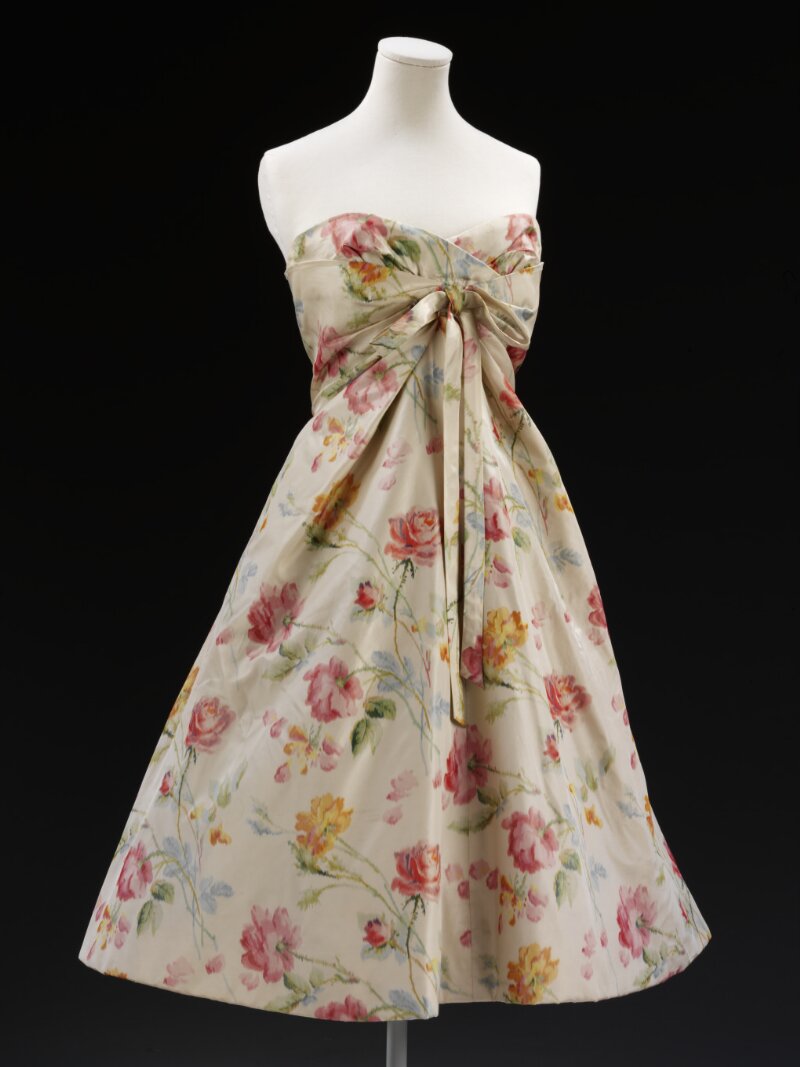
Couture Archaeology Report: Technical Deconstruction of a 1956 Parisian Monte Carlo Evening Dress
Subject: Monte Carlo Evening Dress (Attributed)
Origin: Paris, 1956
Atelier Attribution: Strong stylistic alignment with the House of Dior, post-"New Look" era
Report Prepared For: Natalie Fashion Atelier Creative Direction & Atelier Teams
Objective: Technical deconstruction of construction, materiality, and silhouette to inform the 2026 luxury lexicon.
I. Historical Context & Silhouette Analysis
This specimen, a quintessential "Monte Carlo" or resort evening dress from 1956, exists at a pivotal moment in mid-century couture. The austerity of the war years had fully given way to an opulent, globally-minded luxury. The silhouette is a masterclass in controlled exuberance: a close-fitting, boned bodice erupts into a spectacular, wide-scale skirt, creating the iconic "lily" or "cornet" shape. This is not the full-circle skirt of 1947, but a sophisticated evolution—often built from six to eight graduated gored panels, it achieves maximum volume at the hem with a calculated, directional flare. The waist is cinched, not merely seamed, acting as the architectural keystone of the entire garment. The strapless, heart-shaped bodice emphasizes the collarbones and shoulders, a silhouette designed for the Riviera’s casino floors and ballrooms, balancing exposure with formidable structure.
II. Technical Deconstruction: The Dior Atelier Method
The genius of this dress lies beneath its surface, in a hidden architecture that manipulates both fabric and form.
A. The Bodice: A Cage of Precision
The bodice is a self-contained corset, constructed separately from the skirt. Analysis indicates a foundation of coutil, a robust herringbone-weave cotton, onto which spiral and flat steel boning (approximately 10-12 pieces) is channeled. The boning strategy is critical: bones radiate from the waistline toward the bust and back, following the curve of the ribcage to avoid digging. A central front bone maintains a rigid, vertical line. The top edge is finished with a sprung steel wire, meticulously padded and covered, which allows the strapless bodice to grip the torso without buckling. All inner seams are finished with silk bias binding, and the entire structure is lined with peau de soie before the external fashion fabric is applied.
B. The Skirt: Engineering Volume & Motion
The skirt’s volume is achieved through a multi-layered approach. The primary support comes from a foundation of crisp organdy or taffeta underskirts (likely 2-3), each cut with progressively wider hems. These are mounted onto a separate waistband, which is then meticulously hand-whipped to the bodice’s lower edge, distributing the skirt’s significant weight. The fashion fabric itself, a heavy silk duchesse satin, is cut on the bias in key panels (particularly over the hips) to encourage a cling-and-flare effect, while the side and back panels are cut on the straight grain to hold the bell shape. The hemline is weighted with a chain-stitched silk cord within the hem allowance, ensuring the skirt swings with a deliberate, luxurious motion.
III. Material Materiality: The Substance of Luxury
The material choices are deliberate acts of sensory communication.
Silk Duchesse Satin: Selected for its high density, substantial weight (approximately 140-160 grams per square meter), and luminous, almost liquid surface. It holds the sharp, sculpted presses of the gores and provides a canvas for light to play across its surface. Its acoustic property—the specific swish it produces—is a calculated element of luxury performance.
Internal Ecosystems: The use of coutil, sprung steel, and weighted hem cording speaks to a hierarchy of materials where internal integrity justifies external beauty. The juxtaposition of rigid and fluid, rough and smooth, on the inside of the garment creates a dialectic of comfort versus control that defines the mid-century couture experience.
Translation for 2026: From Archaeology to Algorithm
For Natalie Fashion Atelier’s 2026 vision, this deconstruction is not a blueprint for replication, but a source code for innovation. The translation must honor the technical intelligence while evolving the form language and material science.
I. Silhouette Translation: Deconstructed Architecture
The 2026 silhouette should abstract the core principles—the cinched central axis and the expansion of volume—but through contemporary lenses. Proposals include: Asymmetric Tension: A bodice that appears as a single, spiraling band of structure, dissolving into a skirt with volume concentrated at one hip or the back. The Floating Waist: Using transparent technical meshes or laser-cut leather to create the illusion of a cinched waist that is not physically constrictive, playing with notions of weight and support. The "lily" shape can be reimagined in minimalist, geometric godets or through heat-set pleats that hold permanent, architectural flares.
II. Technical & Material Innovation
The atelier techniques must be translated through advanced methods.
Structural Hybrids: Replace traditional boning with flexible 3D-printed polymer cages or shape-memory alloy wires that respond to body temperature, offering adaptive fit. Bonded technical fabrics can provide internal structure without layered underpinnings, creating a lighter, more fluid garment that maintains its shape.
New Materiality: Sustainably sourced, heavy-weight silk alternatives (e.g., lab-grown silk or high-twist organic cottons with a satin finish) offer a new ethical narrative. The sensory "swish" can be engineered through textured jacquards or integrated with subtle sound-responsive technology for an interactive element. The internal ecosystem becomes a visible, celebrated feature: contrast-color seam binding, branded technical tapes, and exposed, anodized architectural elements turn the inside into a modern objet d’art.
III. The 2026 Couture Ethos: Intelligence Over Opulence
The 1956 dress communicated luxury through material abundance and hidden labor. The 2026 translation will communicate luxury through technical intelligence, sustainable material innovation, and personalized adaptability. The weight of the chain-stitched hem becomes the precision of a piezoelectric fiber that generates a soft luminescence with movement. The multiple underskirts become a single layer of engineered fabric with variable stiffness. The goal is to achieve the same breathtaking impact—the drama of silhouette, the perfection of fit, the dialogue of motion—but through a lexicon of 21st-century problem-solving and conscious creation.
This 1956 Monte Carlo dress is a testament to the atelier’s role as an architect of desire. For 2026, Natalie Fashion Atelier must evolve from architect to engineer, crafting desires that are as intellectually compelling as they are visually sublime.