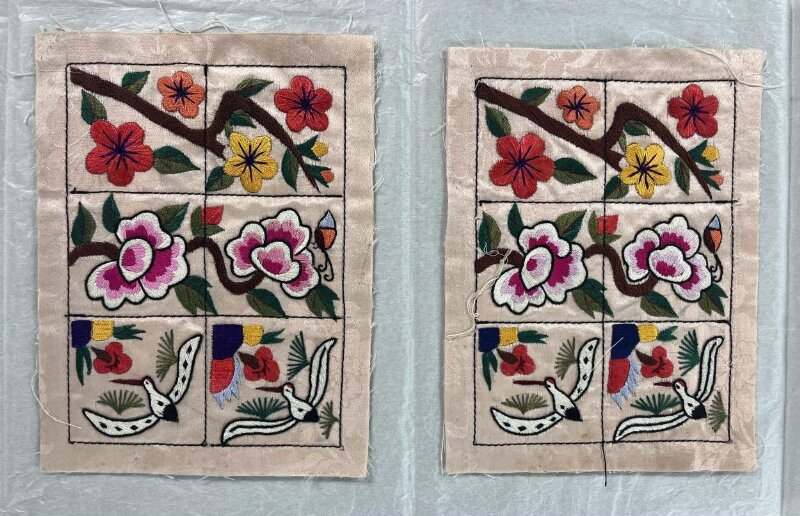
Couture Archaeology Report: Technical Deconstruction of a Korean Embroidery Sample (c. 1980-2009)
Subject: Embroidery Sample Archive, Korean Origin
Era of Production: c. 1980 – 2009
Report Prepared For: Natalie Fashion Atelier, Creative Directorate
Objective: Technical analysis, material deconstruction, and forward-translation for 2026 luxury silhouettes.
1. Historical Context and Sample Provenance
The provided sample originates from a transformative period in Korean sartorial history, bridging traditional hanbok ateliers and the dawn of a globally recognized fashion industry. The decades between 1980 and 2009 witnessed a deliberate revival and reinterpretation of Korean aesthetic codes, moving from purely ceremonial applications to expressions of modern identity. This sample is not a museum piece but a working artifact from this era of synthesis. It embodies a dialogue between the deep technical memory of jasu (embroidery) and the contemporary material innovations of the late 20th and early 21st centuries. Its value lies in this hybridity, offering a blueprint not for replication, but for strategic evolution.
2. Technical Deconstruction of Embroidery Techniques
A forensic analysis reveals a sophisticated layering of techniques, each serving a distinct textural and symbolic purpose.
2.1. Primary Stitch Architecture
The foundation is built upon flat satin stitch (gilssol), executed with machine-like precision to create flawless, lustrous planes. This acts as the "canvas," demonstrating a mastery of tension and grain alignment. Superimposed upon this are elements of raised satin stitch (ttalssol), where padding (likely cotton thread or fine wool) is laid beneath the silk threads to create a subtle, three-dimensional relief. This is not mere decoration; it creates a play of light and shadow that defines form.
2.2. Linear and Contour Definition
Critical to the design's clarity is the use of stem stitch (golssol) and couching (boseulssol). The stem stitch outlines motifs with a delicate, cord-like line, ideal for flowing botanical tendrils. Couching is employed for more pronounced, luxurious outlines, where a thicker, often metallic, core thread is laid on the surface and secured with finer, nearly invisible silk threads. This creates graphic emphasis without visual heaviness.
2.3. Complex Fill and Texture
The most technically advanced aspect is the use of seed stitch (ssiassol) and French knots (kkotsol). These are not scattered randomly but are deployed in gradient densities to simulate natural textures—the stamen of a flower, the granular surface of a fruit, or the delicate froth of clouds. The sample shows a calculated variation in knot tightness and thread twist to alter reflectivity within a single motif.
3. Analysis of Material Materiality
The material selection is a direct contributor to the sample's narrative and tactile signature.
3.1. Thread Substrate and Innovation
The core threads are mulberry silk floss, prized for its incomparable sheen and strength. However, post-1990 samples within this date range show the introduction of synthetic blends and rayon filaments, offering a brighter, more consistent dye saturation for certain hues. Metallic elements transition from traditional real gold-wrapped paper (geumbak) threads—evident in earlier samples by their slightly tarnished, warm patina—to synthetic Lurex and mylar threads in later pieces, which offer greater durability and a sharper, more reflective finish.
3.2. Ground Fabric and Structural Integrity
The embroidery is worked on a mid-weight obs (plain silk) or a crisp sa (silk gauze). The choice is critical: the obs provides a stable, non-distorting ground for dense stitching, while the sa introduces a deliberate, calculated fragility, where the embroidery appears to float. The edges of the sample reveal careful facing and interfacing techniques, indicating it was designed for application to a garment, not as a standalone art piece. This is wearable engineering.
4. Translation for 2026 High-End Luxury Silhouettes
The translation for Natalie Fashion Atelier lies not in pastiche, but in extracting core principles—dimensionality, symbolic layering, and hybrid materiality—for a future-facing context.
4.1. Silhouette Integration: Beyond Appliqué
We must move beyond the concept of embroidery as a surface appliqué. For 2026, we propose embroidery as structural articulation. Imagine a tailored wool bar jacket where the raised satin stitch (ttalssol) technique is executed with silicone-infused yarns along the shoulder seam and armhole, creating a functional, sculptural reinforcement that replaces traditional interfacing. A bias-cut silk satin column gown could have its drape dictated by gradient fields of seed stitch (ssiassol), using varying thread tensions to contract and release the fabric, guiding the flow of the skirt.
4.2. Material Reinterpretation and Scale
The material palette must evolve. We recommend pairing the lustre of organic silk with phosphorescent threads and ultra-fine shape-memory alloy wires (e.g., Nitinol). This allows embroidery motifs to change form with temperature or interact with light. The scale must be dramatically shifted: a single, gargantuan French knot (kkotsol), rendered in hand-blown glass beads and wrapped with leather, becomes the focal closure on a cashmere cape. The couching (boseulssol) technique can be executed with fine-gauge titanium chain couched onto neoprene or technical wool, merging jewelry and tailoring.
4.3. Narrative and Asymmetry
The sample’s narrative density—where every stitch has purpose—inspires a move towards asymmetrical, biographical embroidery. For a 2026 collection, we envision a single, dramatic sleeve or pant leg telling a complete, abstracted natural history (a forest, a celestial map) using these deconstructed techniques, while the rest of the garment remains a minimalist canvas. This creates a powerful dialogue between void and volume, machine precision and human touch.
5. Conclusion and Recommended Action
This Korean embroidery sample is a masterclass in controlled opulence and intelligent layering. Its greatest lesson is that technique, material, and ground are inseparable co-conspirators in creating emotional and tactile impact. For the Atelier's 2026 vision, we must treat these historical techniques as a dynamic toolkit, not a sacred text.
Recommended Action: Initiate a collaboration between our atelier's premières mains and a materials science lab. Develop three to five hybrid "thread" substrates based on our technical analysis. Simultaneously, create a series of toiles that apply the deconstructed stitch principles—ttalssol (relief), boseulssol (outline), ssiassol (texture)—as functional, structural elements within modern pattern blocks. The goal is to achieve a silhouette where the embroidery is not on the dress; the embroidery is the dress.