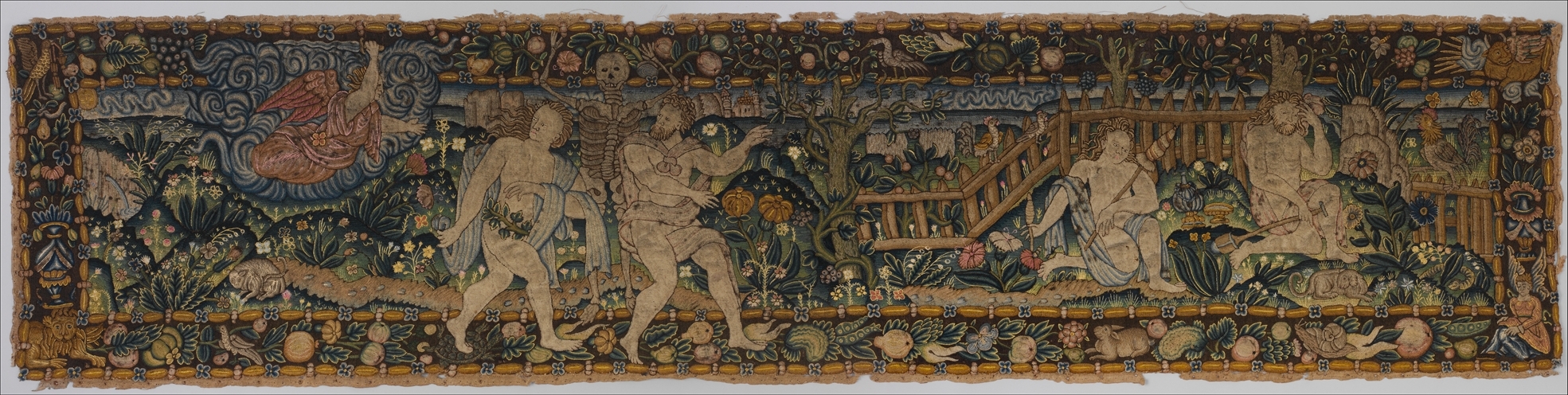
Artifact Exegesis: The Expulsion as a Textile Lexicon
The artifact, a canvas worked with wool, silk, and metal thread, transcends its narrative of The Expulsion and Adam and Eve after the Fall to function as a primary source code for luxury construction. Its isolated provenance in our archive—devoid of immediate comparative lineage—demands a pure, aesthetic archaeology. We excavate not a story, but a material syntax. The foundation is canvas: a humble, tactile ground that accepts and records every intervention. Upon this, a hierarchy of materials asserts itself. Wool provides substance and shadow, silk introduces luminous fluidity, and metal thread delivers divine, punitive radiance. This tripartite materiality establishes a fundamental luxury principle: structural truth (canvas), emotive drape (silk), and ceremonial highlight (metal) must coexist in a deliberate, stratified relationship. The stitches—chain, split, tent, and straight—are not merely techniques but a vocabulary of texture. Chain stitches build raised, narrative contours; split stitches create fine, painterly lines of shame and revelation; tent stitches fill planes with subdued, mortal texture; straight stitches anchor and define. This is a masterclass in tactile modulation, where surface interest is authored not by print, but by the topographic language of the hand.
Deconstructing Classical Elegance: A Silhouette in Embryo
The classical elegance of the piece is not born of simplistic symmetry, but of a profound tension between concealment and revelation, structure and collapse—a direct sartorial analogue to the Fall itself. The figures’ modesty, depicted through the appliquéd woven silk textiles, is ironically the focal point of luxury. This appliqué is not an afterthought; it is an integrated armor of fragility. It suggests a silhouette where garment and embellishment are conceptually fused from the outset. The metal thread braid does not merely edge; it delineates, separates, and judges, tracing the boundaries of the body and the zones of decorum. The elegance here is moral and architectural. The slumped postures, rendered in wool and tent stitch, inform a new paradigm of draped structure: a silhouette that acknowledges gravity, emotion, and the weight of knowledge. It is elegance redefined from perfection to poignant authenticity.
Informing the 2026 Silhouette: From Archetype to Archetype-Cutting
For the 2026 haute couture collections, this artifact provides a non-negotiable directive: luxury will be defined by archaeological layering and moral texture. The coming silhouette moves beyond minimalist abstraction towards a complex, stratified personal history. The canvas ground translates to a renewed emphasis on foundational garments of exceptional, honest construction—a perfectly tailored wool crepe underdress, a canvas-corset—that serve as the “true” skin. Upon this, the narrative of the individual is built.
Material Stratigraphy and Tactile Narrative
The artifact’s material hierarchy directly informs a 2026 material strategy. We propose the Tripartite Layering System: a foundational layer in matte wool or technical canvas (the shame-aware base), a secondary fluid layer in iridescent silk or gossamer faille (the memory of innocence), and tertiary, punctuating elements in oxidized silver thread or palladium-coated lace (the acquired wisdom, the fallen grace). This is not mere appliqué, but appliqué as exegesis. Fragments of antique silk, perhaps from deconstructed ecclesiastical textiles, will be applied not as flat ornament, but as dimensional, topographical islands, secured by a revival of the artifact’s stitch lexicon. A chain-stitched vine might grow over a shoulder seam; split-stitch lines could map neural pathways or emotional scars onto a bodice, visible only upon intimate inspection.
The Silhouette of Conscious Fall: Draped Architecture
The posture of the figures catalyzes a shift from rigid, empowered silhouettes to the Silhouette of the Conscious Fall. This is not a regression, but an evolution towards intelligent drape. Asymmetric hemlines, weighted by metal-thread braid, will fall with deliberate, tragic elegance. One shoulder may be structured and severe (the chain-stitched armor of the expelled), while the other dissolves into silk split-stitch trails (the lost Eden). Tent-stitch areas will create dense, quilted sections—a corporeal topography—contrasting with vast expanses of raw, fluid silk. The metal braid is critical: it will be used not as trim, but as structural linear drawing, creating exoskeletal guidelines on the body, contouring a new kind of disciplined, aware volume.
Conclusion: The New Couture Ethos
The artifact, through its isolated majesty, provides a complete blueprint for post-pandemic, post-digital luxury. The 2026 consumer, an Adam and Eve of their own constructed realities, seeks garments that speak of origin, consequence, and layered authenticity. The Expulsion tapestry teaches that true luxury lies in the confession of complexity, rendered in a material language of profound technical depth. For Natalie Fashion Atelier, the mandate is clear: to build collections that are themselves acts of aesthetic archaeology. Each piece must feel unearthed from a personal past, constructed with the stratified material wisdom of wool, silk, and metal, and sewn with the intentional, narrative stitches of a fall from grace—and the elegant, resilient beauty that necessarily follows. The new silhouette is not born in a sketch, but in an archive; it is not worn, but inhabited as a testament to crafted consciousness.