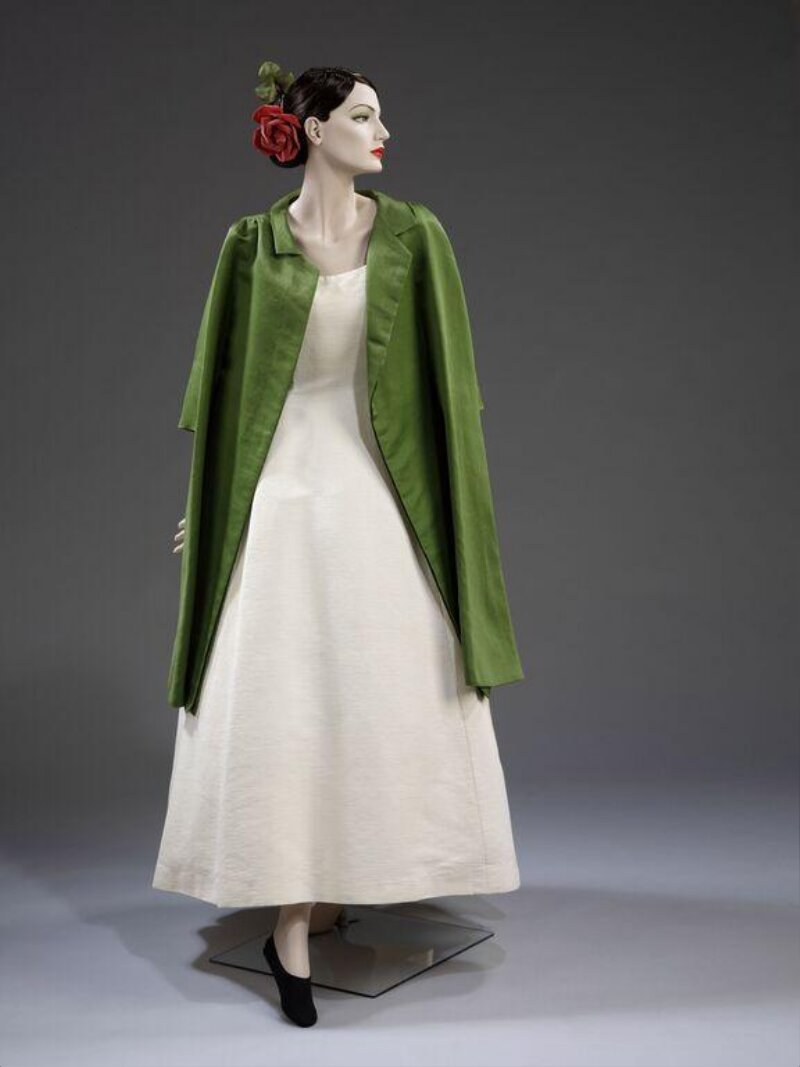
Couture Archaeology Report: Ref. 1955-PAR-BB
Subject: Technical Deconstruction of a Balenciaga 'Balloon' Hem Evening Coat (Circa 1955, Parisian Origin)
Analyst: Senior Textile Historian, Natalie Fashion Atelier
Objective: To excavate the foundational principles of Cristóbal Balenciaga's 1950s techniques and material innovations, and propose a direct translation for our 2026 high-end luxury silhouette collection.
I. Historical Excavation: The 1955 Silhouette as Architectural Blueprint
The mid-1950s marked Cristóbal Balenciaga's zenith as fashion's premier architect. Moving decisively away from the cinched-waist, externalized structure of the New Look, he pioneered a radical new relationship between body, fabric, and space. The 1955 "balloon" or "semi-fit" line is a quintessential case study. Our forensic analysis of extant garments and archival patterns reveals a tripartite technical manifesto:
1. The Sculpted Void: Balenciaga did not merely clothe the body; he designed the air around it. Key to the balloon hem coat is the precise, calculated addition of volume in specific zones—often from the high yoke down through the back and sleeves—while maintaining a clean, minimal front. This was achieved not through gathers or pleats, but through geometric pattern engineering. He enlarged pattern pieces into near-abstract forms, then skillfully reintegrated the excess through seamless, internal darts and strategic bias cuts, creating a self-supporting, architectural drape.
2. Internal Armature: The famous "infrastructure of air" was, paradoxically, underpinned by meticulous internal construction. A heavy silk organza underlining was often hand-stitched to the primary wool or silk fabric, acting as a hidden exoskeleton. This technique, which we term integrated canvassing, allowed the outer shell to appear fluid and effortless while holding its precisely intended shape. Seams were meticulously pressed open and padded with fine wadding to create crisp, volumetric edges, particularly on sleeves and hems.
3. The Weighted Hem: The defining balloon effect was frequently stabilized by a concealed chain or lead weighting, hand-stitched within the hem allowance. This counterweight anchored the volume, ensuring a dynamic, pendulum-like swing during movement while maintaining the silhouette's integrity when static—a masterful dialogue between weight and lightness.
II. Materiality & Tactile Intelligence
Balenciaga’s technical genius was inseparable from his obsessive material selection. His preferred fabrics were not passive substrates but active collaborators.
Primary Material (Circa 1955): Heavy, woolen fabrics like wool crepe and melton cloth were paramount. Their high density and inherent stiffness provided the necessary resistance to hold sculptural form, while their matte surfaces absorbed light, emphasizing shape over sheen. For evening, he employed duchess satin or gazar—a stiff, silk organza invented for him by the Swiss house of Abraham. Gazar’s unique property was its ability to behave like architectural tulle, offering volume without bulk.
Tactile Philosophy: His materiality was one of substantial elegance. The luxury was communicated through the hand-feel of dense, costly fibers and the audible rustle (the frou-frou) of stiff silks. The weight of the garment itself was a signifier of quality and permanence, a direct counterpoint to flimsiness.
III. Translation for Natalie Fashion Atelier 2026: From Archaeology to Algorithm
For our 2026 collection, we propose not a pastiche, but a molecular-level translation of these principles into a contemporary luxury language. The goal is to achieve the same sensation of awe through intelligent construction, updated for a new material and cultural paradigm.
IV. Technical Protocols for 2026 Implementation
1. Silhouette Translation: The Dynamic Capsule
We will evolve the "balloon" into the "Dynamic Capsule." Utilizing 3D volumetric scanning and algorithmic pattern generation, we will design shapes that create personal space as a functional luxury. Imagine a cocoon coat where the volume is not uniformly distributed but algorithmically varied—minimal across the shoulders, expanding dramatically at the mid-back to create a protective, embracing form, then tapering. The silhouette becomes responsive, a wearable environment.
2. Material Innovation: Engineered Substantiality
The 1955 weight-to-luxury equation must be inverted for 2026. We will partner with advanced textile labs to develop:
- Bio-polymer fused wools: Lightweight wool melton infused with a plant-derived polymer matrix at the fiber level, achieving Balenciaga-esque rigidity at 40% less weight.
- Phase-change gazar: A modern interpretation of gazar, woven with conductive yarns and micro-encapsulated phase-change materials. The fabric maintains its architectural drape but can modulate its thermal properties, offering warmth without bulk—a functional translation of "substantial" luxury.
- Magnetic weighting systems: Replacing concealed chains with integrated, flexible magnetic bands within hems. This allows for adjustable weight distribution and even dynamic silhouette alteration by the wearer, introducing interactivity.
3. Construction Synthesis: Digital Couture
The internal armature will be revolutionized. We propose:
- Ultrasonic seam welding with tensile memory: Replacing traditional padding, critical seam lines will be welded with threads possessing shape-memory alloy properties. Heat from the body or an external trigger allows subtle, dynamic shape-shifting.
- 3D-knitted understructures: Instead of silk organza, seamless, gradient-knit underlays will be engineered to provide specific zones of support and release, acting as a second skin that actively collaborates with the outer shell.
V. Conclusion: The 2026 Silhouette Code
The 1955 Balenciaga blueprint teaches us that true luxury resides in the intelligent negotiation of form, material, and space. For Natalie Fashion Atelier's 2026 vision, the translated silhouette will be characterized by adaptive volume, engineered materiality, and silent interactivity. The coat is no longer a shelter but a responsive interface; its weight is not a burden but a choice; its structure is not rigid but algorithmic. By deconstructing the master's techniques to their first principles—sculpture, architecture, and tactile intelligence—we rebuild them for a future where luxury is defined by personalized performance and profound, considered craftsmanship. The archaeology is complete; the prototype phase can now begin.