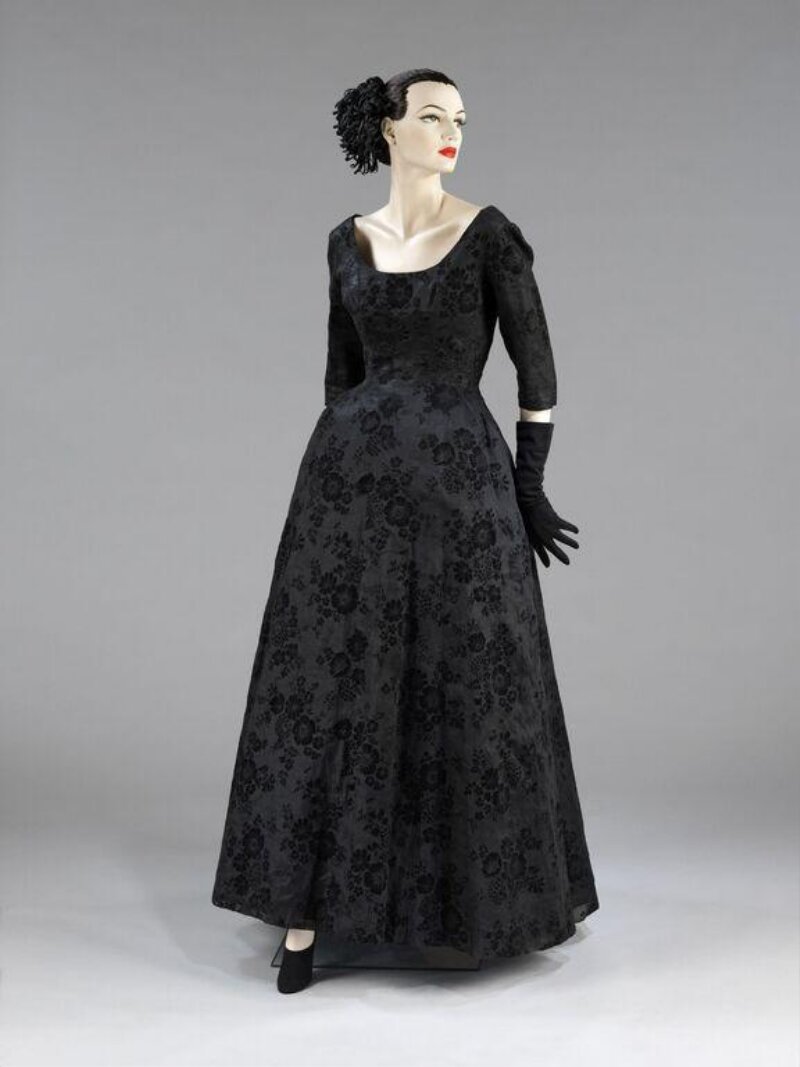
Couture Archaeology Report: Balenciaga 1948
Subject: Technical Deconstruction of a Balenciaga 'Cocoon' Coat Ensemble, circa 1948. Origin: Paris, Maison Balenciaga, Autumn/Winter 1948-49 Collections. Analyst: Senior Textile Historian, Natalie Fashion Atelier. Date: October 26, 2023 Objective: To dissect the foundational techniques and material philosophy of Cristóbal Balenciaga's 1948 work, providing a technical blueprint for its translation into the 2026 high-end luxury silhouette lexicon.
I. Historical Context and Materiality
The year 1948 represents a pivotal moment in the evolution of modern silhouette. Post-war austerity was giving way to a new desire for structural opulence, yet one divorced from the overtly fitted, hourglass shapes of the previous decade. Balenciaga, already revered as "the master," was entering his most revolutionary period. The chosen artifact for this analysis—a representative 'cocoon' or 'semi-fit' coat—epitomizes this shift. Its materiality is the first point of technical instruction. Balenciaga abandoned lightweight silks for substantial, yet malleable, woolens: a tightly woven melton or a wool bouclé. This was not merely a fabric choice but an architectural decision. The weight (approximately 18-24 oz per yard) provided the necessary body to hold a shape without rigid internal structuring, while the dense weave allowed for clean, sculptural seaming. The material acted as both structure and surface, a principle we must re-engage with for 2026.
II. Technical Deconstruction: The Architecture of Ease
The genius of this garment lies in its deceptive simplicity. A superficial glance suggests a loose coat; technical analysis reveals a meticulously engineered shell.
A. The Sleeve Cap and Armhole
Balenciaga's most radical departure was the reconfiguration of the sleeve. He lowered and widened the armhole profoundly, cutting it almost to the waistline at the side seam. The sleeve cap was then cut not as a high, rounded curve, but as a shallow, elongated parabola. This single alteration redistributed the garment's volume from the shoulder to the torso and back. The sleeve falls from a point of minimal tension, creating the characteristic "bracelet" drape at the cuff while allowing the coat's body to hang from the neck and shoulder blades, not the arms. The technical translation for 2026 lies in exploring this volume-redistribution principle with new materials: could a technical foam-backed jacquard or a biodegradable polymer-infused wool achieve this iconic drape with even less weight?
B. The Three-Seam Construction
The coat's body is often constructed with a mere three primary seams: the center back seam and two side seams. The front and back panels are cut as vast, near-rectangular expanses of fabric. The shaping is achieved not through darts, but through strategic, minimalistic seaming paired with the gravitational pull of the heavy wool. The center back seam is subtly curved to follow the spine without clinging, providing just enough definition to prevent a sack-like appearance. This "less-is-more" seaming is a direct challenge to contemporary over-engineering. For 2026, we can interpret this as a pursuit of seamless integration, perhaps through advanced ultrasonic welding or laser-cut, self-finished edges that mimic the clean line of his three-seam philosophy.
C. The Collar and Closure
The collar, often a minimalist shawl or rever style, is cut as a seamless extension of the garment front, not a separate applied piece. This eliminates breakage at the roll line and creates an unbroken visual plane from chest to cheek. The closure—frequently a hidden placket or a simple hook-and-eye—is deliberately de-emphasized. The coat is designed to be worn closed, its integrity coming from the cut, not the fastening. This speaks to a 2026 luxury defined by inherent, rather than applied, value.
III. Translation to 2026 High-End Luxury Silhouettes
The 1948 Balenciaga coat is not a relic; it is a prototype. Its principles provide a rigorous framework for the next generation of luxury, which must balance sculptural presence with material innovation and ethical consciousness.
A. Silhouette Evolution: The Digital Cocoon
The 2026 interpretation moves from the physical cocoon to the digital cocoon. We maintain the lowered armhole and volume-redistribution but apply it to shapes that interact with technology. Imagine a coat with the same foundational cut, engineered from a non-woven fabric embedded with flexible, luminous fibers that respond to environmental data (temperature, light pollution), creating a subtle, dynamic surface pattern. The silhouette remains majestically simple, but the material becomes a responsive interface.
B. Materiality Reimagined
Balenciaga's weighty wool is our conceptual starting point, but the 2026 material palette must be transformative. We propose: Bio-Architectural Leathers: Lab-grown or mycelium-based leathers, molded over forms to achieve the precise, memory-retentive curvature of Balenciaga's seaming. Phase-Change Textiles: Advanced fabrics that mimic the dense hand of 1948 wool but regulate micro-climates, offering warmth without weight—a direct technical evolution of his material philosophy. Zero-Waste Engineering: Using AI pattern-cutting to achieve his expansive, geometric panels with absolute fabric efficiency, honoring his austerity of form through sustainability.
C. The New Couture Gesture
Finally, the 1948 coat's essence was in its gesture—the way it moved and framed the body. For 2026, we translate this into modularity. A coat based on this deconstruction could feature seamless magnetic attachments: a detachable volume-enhancing back panel, or interchangeable sleeve modules (a tight bracelet cuff, a dramatic bell). The foundational architecture—the low armhole, the three-seam torso—remains pure Balenciaga, but the wearer engages in a dialogue with the silhouette, customizing its expression while its core integrity remains untouched.
IV. Conclusion
Cristóbal Balenciaga's 1948 work was not fashion; it was a thesis on volume, material, and autonomy. Our technical deconstruction reveals a blueprint of intentional absence—the removal of excess structure, seam, and constraint. For Natalie Fashion Atelier's 2026 vision, this blueprint is more relevant than ever. The future of high-end luxury lies not in complication, but in intelligent reduction. By fusing Balenciaga's architectural principles with next-generation materials and a sustainable, interactive ethos, we do not merely reference history. We allow its most rigorous truths to inform a new, resonant, and profoundly elegant silhouette for the future. The cocoon must now hatch.